
For gutter cleaning, match the tool to the debris and the way you can reach the gutter: a shaped hand scoop for loose material, or a pole or vacuum attachment when its reach and connections fit the job. The current Gutter Tools listing groups scoops, brushes, and kits; product availability changes, so compare the current specifications rather than choosing by a product name alone. Checked October 6, 2026.
Trace the route before choosing an attachment
A gutter is a channel along the roof edge that leads toward a drop outlet, then into a downspout. Debris in the channel calls for a tool that can reach the gutter floor and corners. A blockage at the outlet or inside the downspout is a different access point, so a gutter scoop may not reach it.
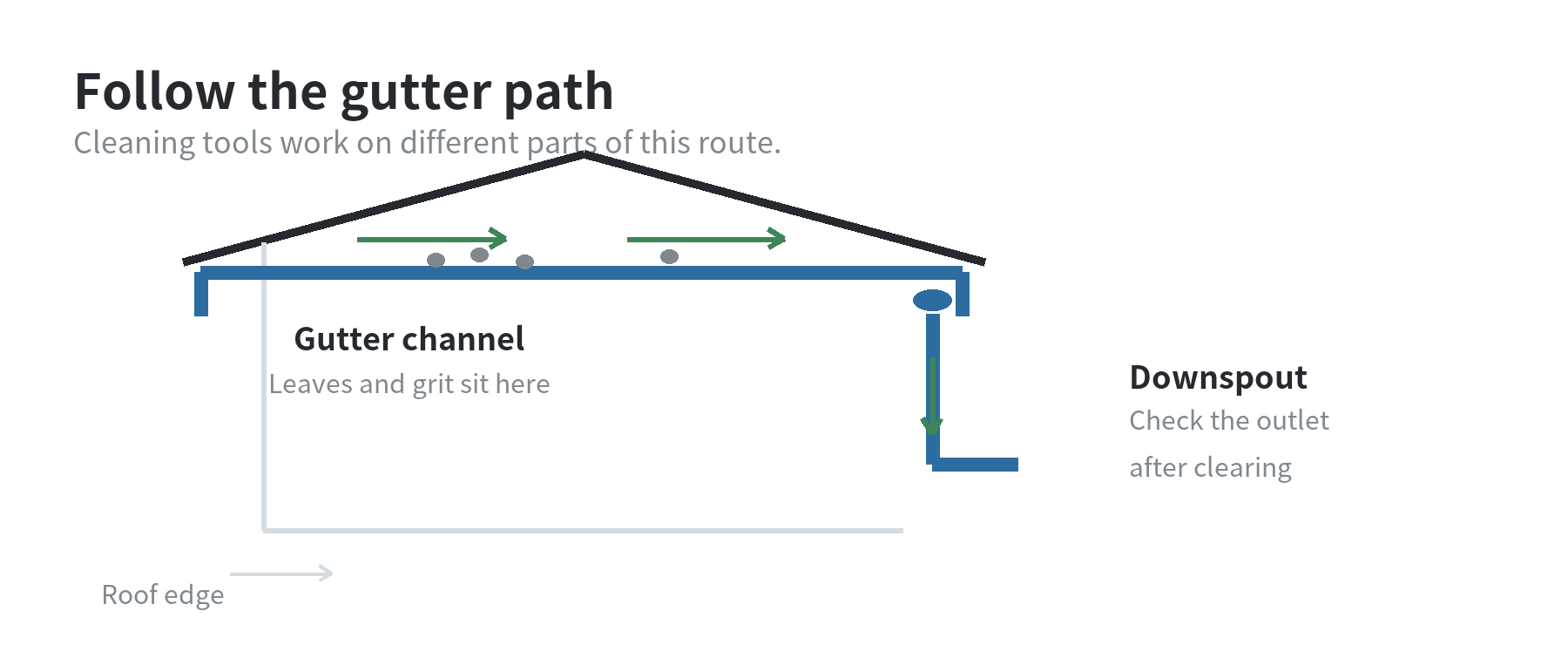
Walk the perimeter from the ground first. Note the gutter profile, approximate height, corners, seams, guards, outlet locations, and places where branches or roof valleys drop material. Do not lean over the edge to measure. A photo from the ground and the house plan can help you estimate length and identify bends without standing under the eaves.
The gutter system diagram in the residential gutter installation instructions labels the gutter, drop outlet, downspout, elbows, and extension as distinct parts. That distinction matters: pick an attachment for the part you need to clear, then check whether it can turn through the actual corners and outlet opening.
Compare the tool forms by the job they reach
The official category listing and manufacturer instructions show several useful tool forms rather than one universal tool. This table describes what to check on the item label or instructions; it does not assume every item fits every gutter.
| Tool form | Useful when | Check before use |
|---|---|---|
| Hand scoop | Loose leaves and sediment are accessible from a stable work position. | Scoop width and flexibility against the channel, hangers, and gutter guard. |
| Long-handled brush or pole attachment | The tool can reach the target while you stay in a planned safe position. | Working length, head angle, control, and whether the end can be seen. |
| Wet/dry vacuum accessory kit | A compatible vacuum and hose can be positioned without pulling you off balance. | Hose diameter, included adapters, extension pieces, and whether the instructions allow wet or dry debris. |
| Downspout or outlet tool | The opening or bend is the suspected obstruction point. | Opening dimensions, bend direction, and the maker’s limits for pushing or flushing. |
A scoop is the simplest match for material that can be lifted out by hand. The maker’s scoop instructions describe a flexible tip that can be squeezed for a narrow gutter and pressed against a flat bottom. The same instructions warn users to take care when working from a ladder or roof and to avoid power lines. Read the scoop instructions before relying on that shape; support brackets, sharp edges, and a screen or cover can change the fit.
Do not treat “long reach” as a safety rating. Keep the working head in view and stop if you cannot control it from the ground or it catches on a gutter guard. A tool that drags along the gutter edge can move debris sideways or put force on the gutter itself.
Check vacuum fittings before comparing kits
Vacuum attachments are connection-dependent. The maker’s current gutter accessory page says its kit uses a 2-1/2-inch accessory diameter and lists a gutter elbow, extension wands, blower nozzle, and adapter. The matching product page in the retailer’s listing also specifies a 2-1/2-inch wet/dry vacuum hose. Those details were checked October 6, 2026. Treat the diameter as a fit requirement for that kit, not a universal gutter-tool standard.
Before selecting any vacuum accessory, compare the hose’s marked diameter with the kit’s stated size, then confirm the included adapters and locking method. Do not treat an improvised reducer as confirmed compatibility. Check the vacuum manual for approved attachments and for limits on wet material. The manufacturer’s vacuum manual says not to expose the unit to rain or let liquid enter the motor compartment, and not to direct blower air at bystanders.
For example, if your vacuum hose is marked with a different diameter than the kit label, do not assume a loose sleeve or improvised wrap will make the joint secure. If a gutter guard blocks the curved end, a more powerful vacuum does not solve the access problem; first confirm that the guard is designed to open or be removed. If neither the hose connection nor the head path can be confirmed, set the kit aside and use a tool whose instructions match the physical setup.
Also separate reach from collection. A wand may move the head to the roof edge, while the vacuum or blower controls what happens to the material. Read both the accessory directions and the vacuum manual as a pair. If the manufacturer gives no direction for the debris or surface in front of you, do not infer that a tool is suitable simply because its shape looks right.
Keep adapters with the accessory kit and note the hose connection size in your maintenance records. That gives you a concrete fit detail to compare the next time you check a replacement attachment or a different vacuum.
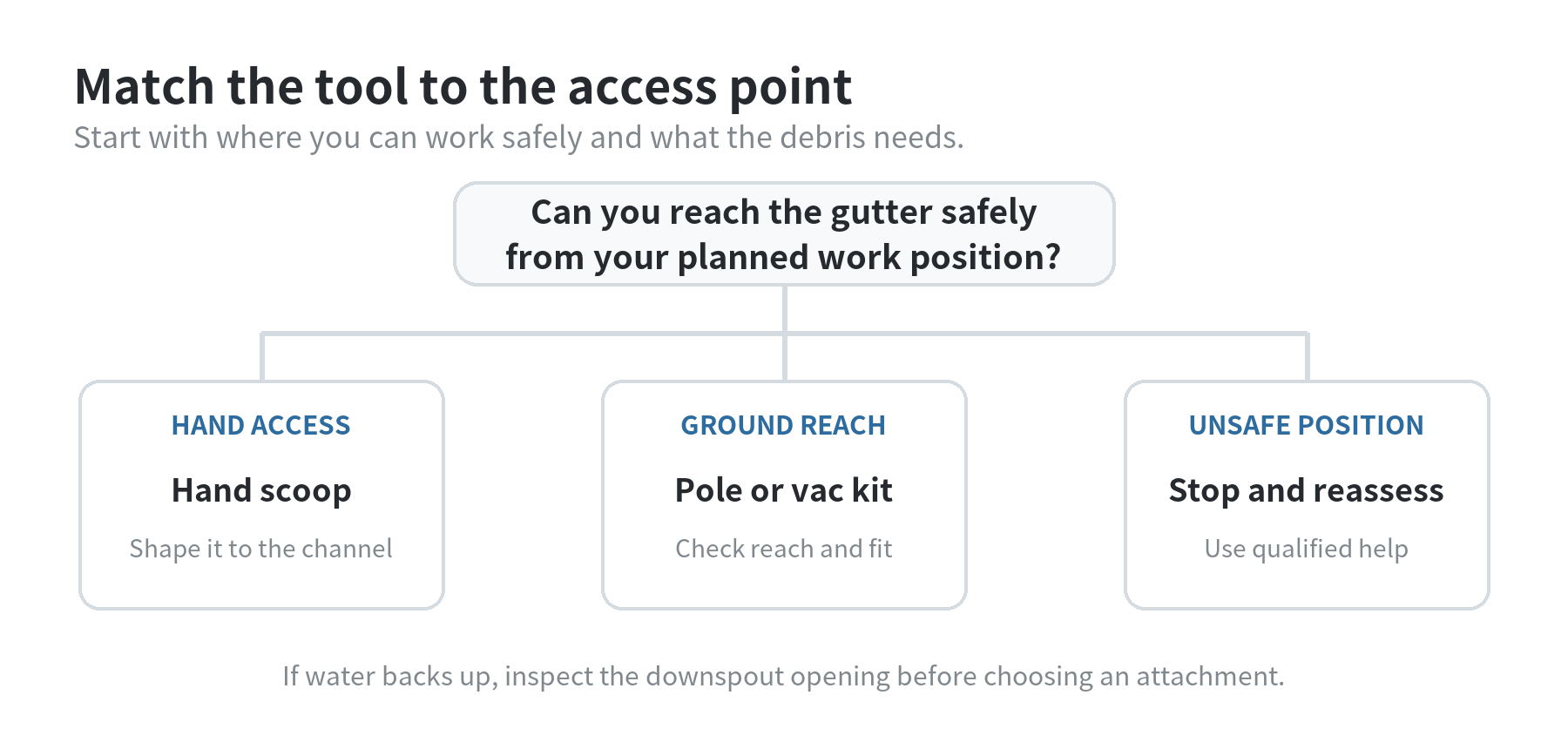
A curved elbow can help direct the attachment into the channel, while extension pieces add reach. They do not prove that the far end is clearing the gutter. Work in short sections that remain visible from the ground, then inspect the outlet and the discharge point. If debris or water backs up, stop and inspect the downspout opening instead of forcing an attachment through an unknown bend.
Use a ladder only when the work position is sound
Ground-reach equipment does not suit every home, and a ladder is not automatically the next step. Check footing, ladder condition, overhead wires, roof edge, and whether the work requires both hands. NIOSH’s residential-construction ladder guide says to keep three points of contact while climbing, lift tools with a belt or hoist, avoid overreaching, and climb down to reposition. Its advice is written for construction work, but the balance principles are useful when planning home maintenance.
OSHA’s construction ladder standard says a portable ladder used to access an upper landing must extend at least 3 feet above the landing, or be secured with a grasping device when that extension is not possible. NIOSH also describes an extension-ladder setup around a 75-degree angle. These are work-safety references, not a substitute for the ladder manufacturer’s instructions or a safe site assessment. If the ground is soft, the ladder cannot be placed correctly, wires are nearby, or you must lean sideways to reach, stop and arrange qualified help.
Check fit, cleanup, and availability as separate questions
A product page can tell you dimensions and included pieces; it cannot tell you whether your gutter is reachable from your yard or whether a bent section is loose. Write down the actual hose size, gutter shape, access height, outlet location, and any guard or hanger that interrupts the channel. Compare those notes with the current listing and product instructions. If a specification is missing, ask the manufacturer or the retailer for the exact item details instead of inferring it from the photograph.
Availability and local stock can change. The category page may display several tool forms at one time, while an individual item page may be unavailable or replaced. The assortment was checked October 6, 2026; use the current listing only to confirm which types are shown, not as a safety recommendation or a promise of stock. There is no need to start with a powered tool if a hand tool matches the debris and can be used from a safe position.
After clearing, check whether water can leave the gutter through the outlet and downspout, and whether the discharge exits where it should. If a joint is separated, the gutter is sagging, or water still backs up after visible debris is removed, record the location and have the drainage issue assessed before applying more force. For seasonal planning, see the site’s home maintenance checklist; for ladder-specific planning, use the site’s ladder overview as a separate reference.
FAQ
Can a gutter scoop work with a gutter guard installed?
Only if the guard can be removed or the scoop can pass through an opening without bending or catching it. Check the guard maker’s instructions and do not pry against the gutter edge.
Can a wet/dry vacuum attachment fit any shop vacuum?
No. The connection diameter and adapter arrangement must match the vacuum hose. The manufacturer’s accessory page lists a 2-1/2-inch connection for its kit; verify your own vacuum model and manual before using an attachment.
What should I do if water still backs up after the gutter is cleared?
Stop pushing debris farther into the system. Check the visible outlet and downspout opening, then arrange an assessment if the blockage appears beyond the reachable section.
When should I hire someone instead of using a gutter tool?
Arrange qualified help when the ground, roofline, nearby wiring, ladder position, or gutter condition prevents a controlled work position. NIOSH’s ladder guidance recommends choosing another access method when the task cannot be done safely from a ladder.
Last updated: 2026-10