Choose a gas grill if you want quick heat adjustments and a straightforward start;
choose charcoal if tending coals and managing airflow are part of the appeal.
Both can handle everyday grilling, so the useful comparison is the routine you want before, during, and after a meal.
Weber’s grilling guidance, checked October 5, 2026, explains the central control difference: gas heat changes with burner knobs,
while charcoal heat responds to airflow through the vents.
That difference shapes setup, flavor, and cleanup more than a broad claim that one fuel cooks better.
Choose the routine you want to repeat
Think about a regular dinner rather than a special cookout.
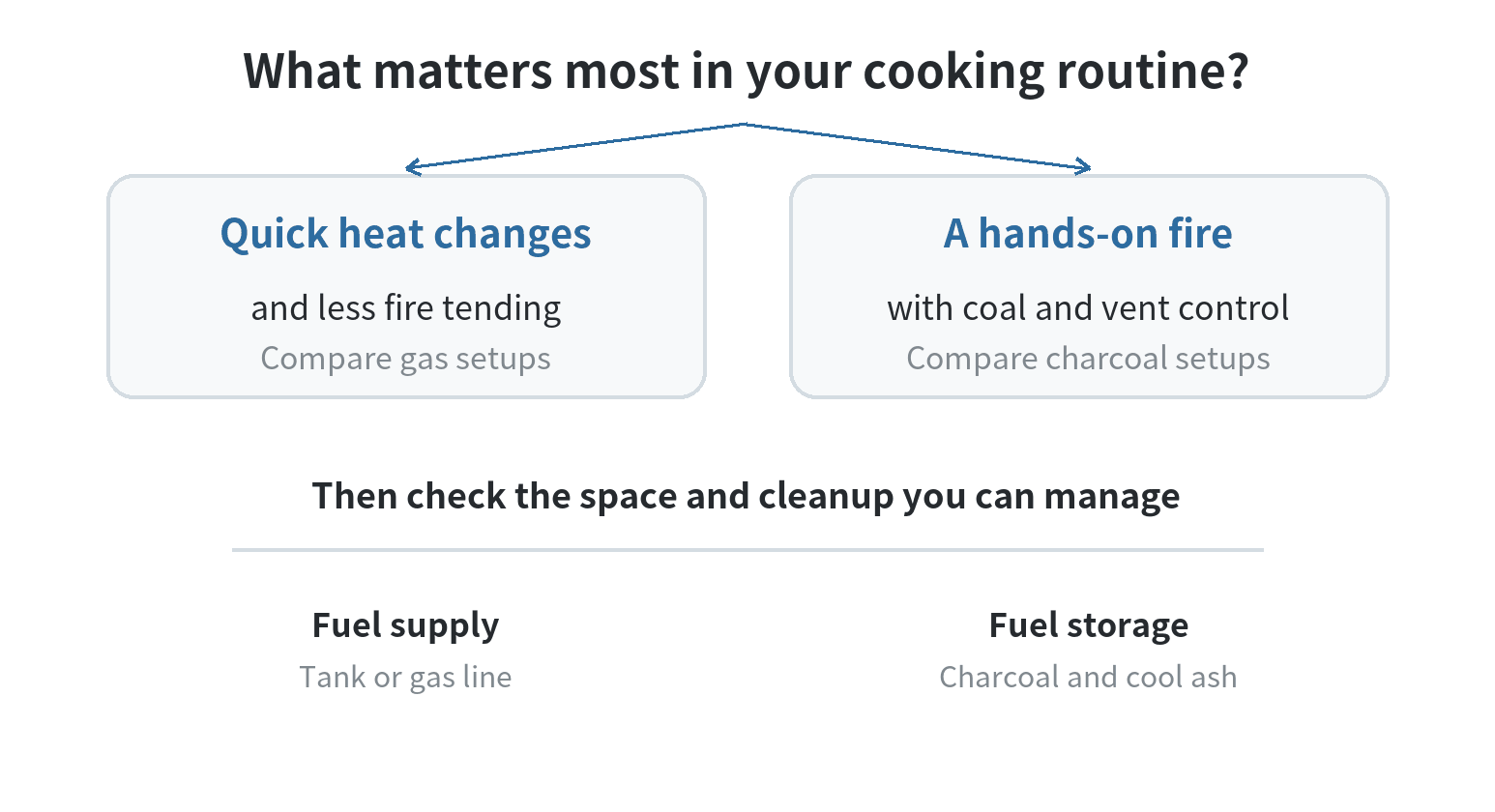
If you want to open the lid, set the burners, and move on to preparing food, gas fits that rhythm.
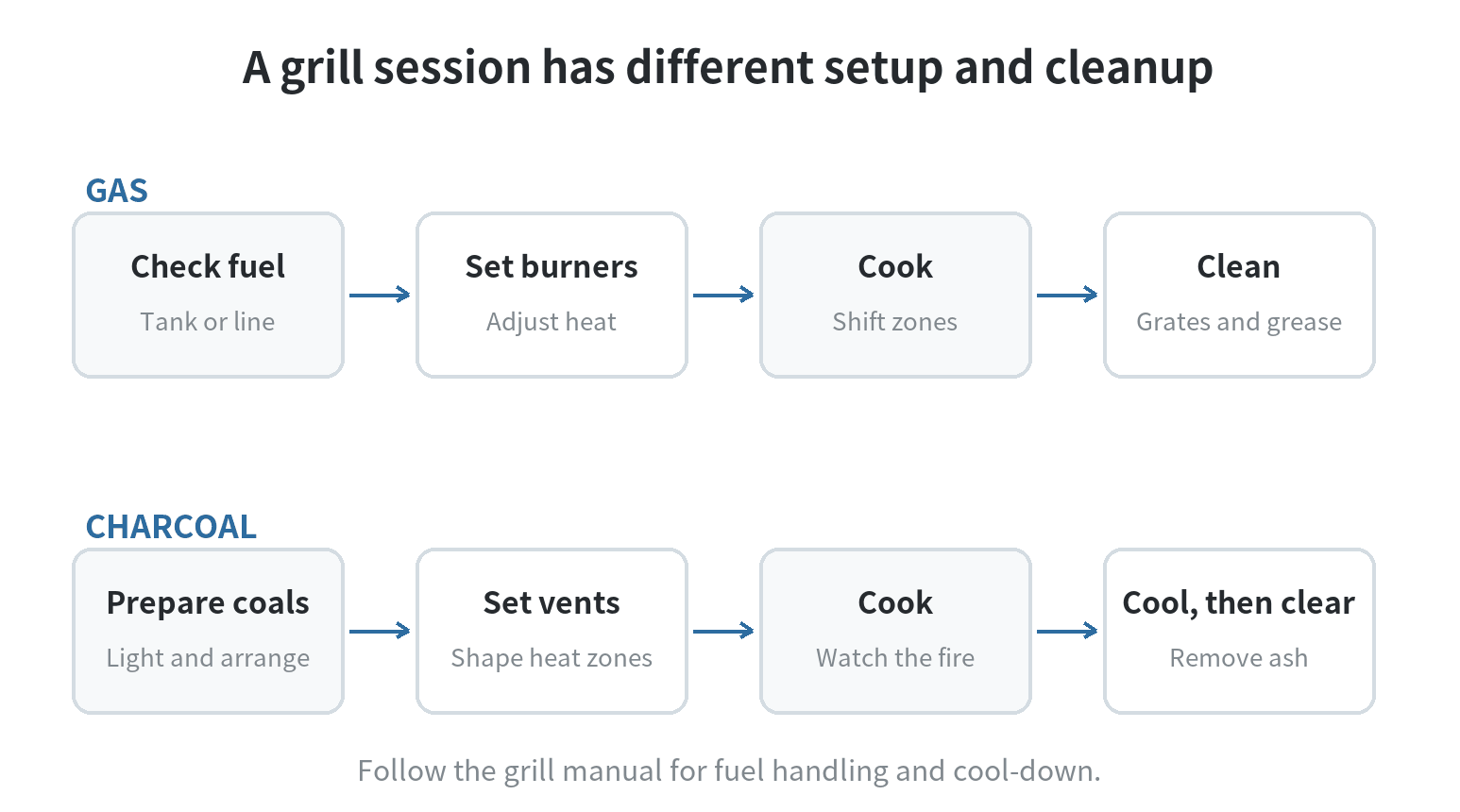
You still need to check the fuel supply and clean the cooking surface, but there are no coals to light or ash to clear.
Charcoal makes the fire itself part of the cooking session.
You arrange fuel, give it time to become ready, then adjust vents and food placement as the fire changes.
Some cooks enjoy that hands-on process; if you want the grill to demand less attention, it may feel like extra work.
In a small household, that distinction can matter more than cooking capacity.
Picture a weeknight when you have one pan to wash and dinner already needs your attention.
Picture a weekend when you would gladly stay outside and tend the fire.
Your honest answer points toward a fuel type before you compare shelves, side burners, or cart designs.
| Decision point | Gas | Charcoal |
|---|---|---|
| Heat adjustment | Turn burner knobs | Adjust vents and coal placement |
| Getting ready to cook | Connect the fuel supply and preheat | Light and arrange the coals |
| Smoke character | Wood can be added on compatible setups | Smoke comes from the coal fire and cooking setup |
| After cooking | Clean grates and manage grease | Clean grates and remove ash when cool |
| Mobility and setup | Depends on propane tank or gas-line arrangement | No gas connection; fuel must be carried and stored |
Match heat control to the food you make
Gas gives you a direct control at the grill: turn a knob to change a burner’s output.
Weber describes separate burner controls as a way to adjust heat zones.
That can help when you want one area hotter and another gentler, though the actual layout and control response depend on the grill design.
With charcoal, the fire sits below the grate.
You can place coals under one area and leave another area without coals, creating direct and indirect zones. Air vents also affect the fire.
Weber’s guidance notes that more airflow feeds the coals, so temperature changes call for adjusting the vents and watching how the fire responds.
Either setup can cook over direct heat or give food a cooler area away from the strongest heat.
The difference is how you create and maintain those zones. Gas favors turning controls; charcoal asks you to plan coal placement and airflow.
A grill thermometer helps you track the cooking temperature whichever fuel you choose.
For burgers, vegetables, and other food you cook on a hot grate,
focus on usable grate space and how easily you can move food away from a flare-up.
If you cook larger pieces slowly, check whether the grill can hold an indirect zone with the lid closed.
The fuel label alone does not tell you how well a specific model manages those tasks.
Set expectations about smoke and flavor
Charcoal gives food contact with a coal-fired cooking environment that can add a smoky character.
Flavor is personal, and the wood, seasoning, marinade, and cooking method also shape what reaches the plate.
A preference for smoky flavor can point toward charcoal, but it does not mean every meal will taste the same.
A gas grill does not rule out adding wood smoke.
Weber’s gas-grilling instructions describe using wood chips with a smoker box or a suitable foil pan arrangement.
That adds a step and requires following the grill’s own manual; it is not the same routine as lighting charcoal.
If smoke flavor is the main reason you are considering charcoal, decide how much effort you want to spend tending the fire.
If your priority is a simple grilled taste and easy heat changes, gas may match better.
Neither fuel guarantees a particular result: food thickness, distance from heat, lid position, and timing still affect cooking.
Compare the work after dinner
Both grills need attention after cooking. Clean the grates and deal with grease or food residue according to the owner’s manual.
A gas grill also has burners, a fuel connection, and grease-catching parts to inspect as its maker directs.
Charcoal adds ash management. Weber’s charcoal-care guidance says to clear accumulated ash and old charcoal so vents remain open.
Let the grill and ash cool as the manual directs before emptying the catcher.
If you do not want to store or dispose of ash, that recurring step may outweigh the hands-on appeal of the fire.
Consider where each task will happen. A gas setup needs a suitable place for its tank or a fixed gas connection.
A charcoal setup needs a dry place for fuel and a safe place for a cooled ash catcher.
The manuals for the grill and fuel equipment set the handling and storage instructions.
Before choosing, check the space where the grill will stand and the rules that apply to that location.
For an apartment, rental property, or shared outdoor area, ask which grills and fuel storage are permitted.
Ask the property manager or local authority if the rules are unclear; a grill comparison cannot decide what applies at your location.
Use a short decision test before comparing models
Write down what you cook, how much time you want to spend getting the fire ready, and which cleanup steps you will accept.
If your answers favor quick adjustment and a lighter after-dinner routine, compare gas models.
Check fuel setup, burner layout, grate access, and parts you can maintain.
If you prefer tending a fire, compare how easily a charcoal grill lets you place coals for direct and indirect cooking.
Check how its vents adjust and how its ash catcher is emptied.
Follow the grill maker’s instructions and recipes for the fuel and grill you choose.
For a simple example, imagine cooking vegetables and chicken on the same evening.
A gas grill lets you adjust burners and shift food between heat zones.
A charcoal grill lets you arrange a hotter coal area and a cooler space, while you manage the fire as it changes.
Neither route removes the need to monitor food and use the grill’s instructions.
Then compare size, materials, storage, and maintenance details on the exact grill.
A wide cooking surface is useful only if it fits your space and the amount of food you cook.
If you are undecided, choose based on the task you want to make easiest:
controlling heat during dinner or managing fire and smoke as part of the meal.
For the rest of your outdoor setup, see our summer outdoor checklist.
After choosing a model, our product registration guide covers the ownership record.
Last updated: 2026-10.
FAQ
Can I use propane in a natural gas grill, or vice versa?
No, not as-is. A grill is built for a specified fuel, and propane and natural gas are not interchangeable.
Weber says its models use a specified fuel, while Char-Broil says conversion requires a dual-fuel model and its specified kit.
Read the exact grill label and manual before connecting a supply.
How do briquettes and lump charcoal differ for backyard grilling?
Briquettes are more uniform in shape, while lump charcoal has irregular pieces and can light hotter and faster.
Weber’s charcoal-fuel guide describes these differences; follow the grill manual and recipe for fuel amounts and placement.
Can I use a charcoal grill for indirect or low-and-slow cooking?
Yes. Charcoal grills can be set up for indirect cooking, with the food away from the main fuel area.
Weber’s charcoal handbook describes this method for longer cooking; use the instructions for your specific grill to arrange fuel and airflow.