Choose the roof style that fits how long the gazebo will stay assembled, then check the exact footprint, anchoring instructions, wind and snow ratings, and local permit rules before settling on a size. A fabric top can be removed on some models; a hardtop stays in place and needs a model-specific weather rating. The words “hardtop” and “soft-top” alone do not tell you how a structure handles your yard’s conditions.
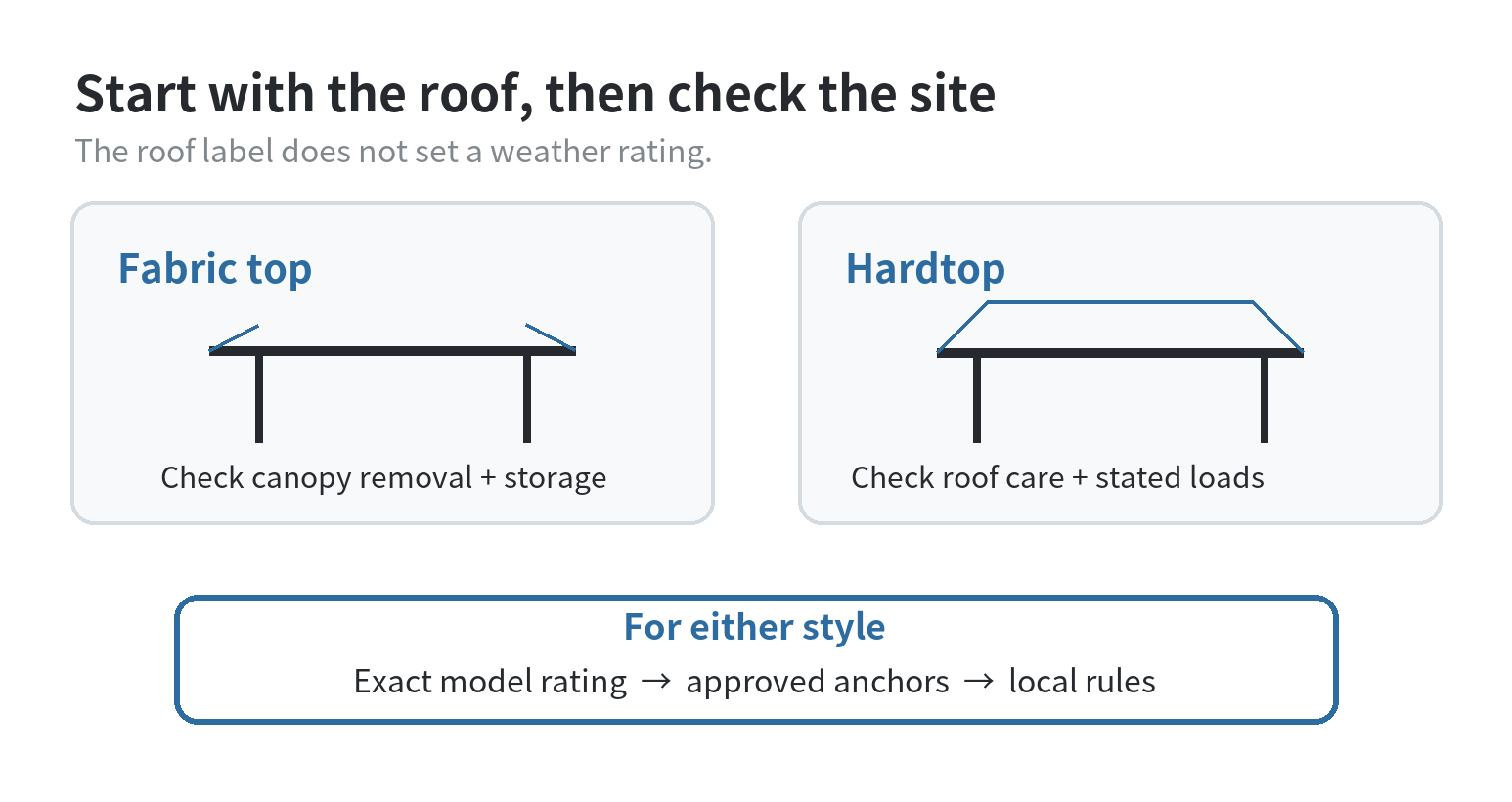
Choose by what you want to take down
A soft-top gazebo uses fabric over a frame. Some canopies detach for storage, and the care instructions may tell you to remove the fabric during windy weather. That makes storage and seasonal handling part of the choice. Check whether the canopy is removable, how it attaches, whether replacement fabric is available, and what the manual says about rain, snow, and wind. “Water-resistant” does not necessarily mean waterproof; a fabric-top manual describes its fabric as water resistant and warns it may leak during precipitation.
A hardtop uses rigid roof panels or metal sections attached to the frame. It is not a fabric cover you can fold away, so look for specific instructions about snow accumulation, roof clearing, drainage, and wind exposure. A ventilated or double-layer roof describes its construction; it does not establish a load rating for your location.
Use the product’s manual and installation guide for the exact model. Manufacturer documents can give different measures: one hardtop declaration states wind and snow zones, while a separate manufacturer page reports wind speed and total roof load. Those figures use different units and may describe different setups. Compare them only when the maker explains the test conditions and confirms the rating applies to the assembled gazebo and its required anchors.
| Question | Fabric top | Hardtop |
|---|---|---|
| Roof material | Fabric canopy | Rigid panels or metal roof |
| Seasonal handling | May be removable; follow that model’s instructions | Fixed roof; check care and weather directions |
| Weather information to find | Canopy removal, wind limits, rain and snow instructions | Wind and snow rating, roof clearing and drainage directions |
| Best first question | Where will the canopy be stored? | What rating and foundation does the manual specify? |
The table narrows the format, not the final model. A fabric roof is not automatically safer in wind, and a rigid roof is not automatically suitable for snow. For example, one fabric-top care guide says to remove the canopy in windy conditions and to disassemble the unit before severe weather; a separate hardtop instruction guide warns that heavy roof snow can make it unsafe to stand below. Follow the exact document that came with the model.
Check weather ratings as a matched set
Look for a stated wind rating, snow-load rating, and any instructions to remove a canopy, clear the roof, or take the structure down. If the listing gives only broad phrases such as “all-weather” or “heavy-duty,” open the manufacturer’s manual or ask the manufacturer for the rating in writing. Do not infer a rating from roof material, post thickness, or a product photo.
Read what the number measures. A wind-speed figure, a snow load across the whole roof, and a load per square foot are not interchangeable. Note whether the rating assumes a particular foundation, anchors, assembly method, or exposure. A gazebo secured to a concrete slab may have different anchoring requirements from one set on soil or a deck; use only the installation method the manual approves for that surface.
Inspect the instructions for seasonal steps, too. A canopy that must come off before strong wind is a recurring task. A hardtop manual may require keeping the roof clear of snow or leaves. If you cannot carry out the specified steps safely or consistently, choose a different format or placement. The manufacturer’s directions define the limits for that model.
Size the footprint, not just the roof
Start with the assembled width and depth, then measure the ground where each post or base plate will sit. A listed roof dimension can extend beyond the posts, so check both the overall roof and the post-to-post dimensions. One fabric-top manual, for example, identifies a 10-by-12-foot gazebo; use the assembled measurements for the model you are considering to trace the ground footprint.
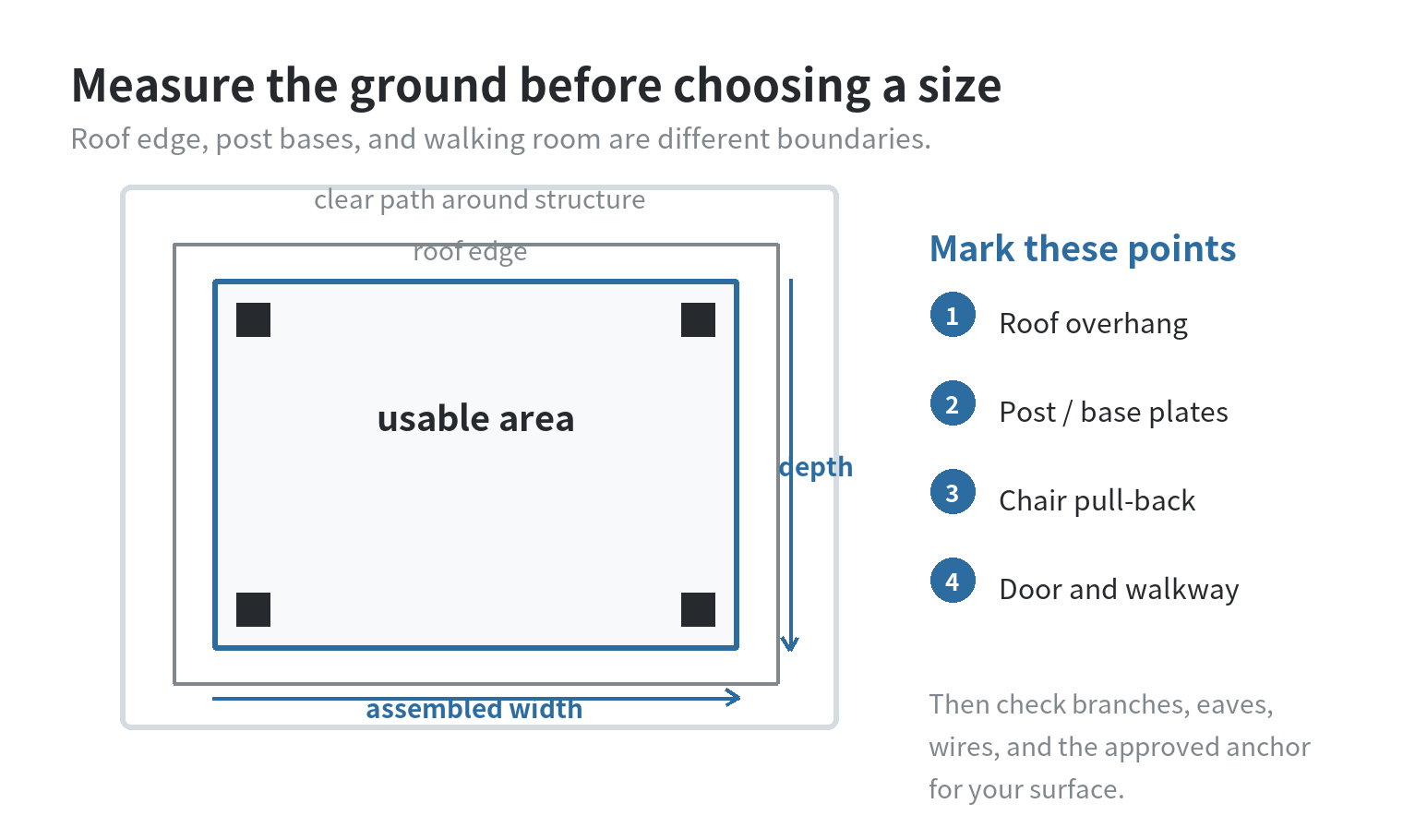
Mark the proposed rectangle with painter’s tape, string, or a garden hose. Put chairs or a table inside the outline at their real size, then leave a route for people to pass and for the door, grill, or gate to open. Check the path from the house and keep roof edges clear of branches, eaves, overhead wires, and utility equipment. The assembly manual can also require extra work space around the frame; include that space before deciding the gazebo fits.
For a deck, confirm that the posts land where the structure can be anchored and that the deck surface and framing suit the installation. For a slab, check the approved anchors and the location of any buried lines before drilling. A model may include stakes intended for soil but require different fasteners on a solid surface. Do not substitute an anchor based on appearance or convenience.
Check usable interior dimensions as well as the outside size. A roof can overhang the posts, and braces or curtains can reduce the clear area. Check the opening height at the posts, not only the roof peak: a sloped roof can leave less clearance at the edges than at the center. Compare the lowest beam with the tallest chair or hanging light in your planned layout. If you plan to place a dining set under it, sketch the table and chairs inside the post rectangle, including room to pull each chair out. This catches a fit problem that a simple roof-area number misses. Also check where water leaves the roof: gutters and downspouts can send runoff toward a door, a seating area, or a neighbor’s property. Add that route to the sketch and make sure it has somewhere suitable to drain.
Ask the building office before assembly
Permit requirements are local. The International Residential Code includes permit exemptions for some detached accessory structures, but local jurisdictions apply their own rules. City pages illustrate why the local answer matters: Mokena, Illinois says a permit is required for gazebos, while Gaithersburg, Maryland provides a gazebo permit application and instructions for homeowner or contractor projects. Ask your city or county building department about permits, zoning setbacks, lot coverage, height limits, and any homeowners association review before ordering materials or setting posts.
Give the office the product dimensions, whether the gazebo will be freestanding or attached, the proposed surface, and the site plan. Ask whether it needs a building permit, separate electrical permit for lights or a fan, inspections, or specific foundation details. Keep the response with the assembly documents. If a rule is unclear, ask which page or application the office wants you to use.
Keep a short model checklist
Before making a final choice, write down the answers to these questions: Is the roof fabric or rigid? What are the overall and post-to-post dimensions? What wind and snow ratings does the exact model state? What anchors and surface does the manual require? What weather steps does the maker specify? Has the local building office confirmed the permit and setback requirements?
That checklist keeps size and roof style tied to the same real installation. If any answer is missing, pause on that detail and get the manual or local guidance before planning the base. The right gazebo is the one whose footprint, upkeep, anchoring, and stated weather limits work together in your yard.
FAQ
Can a gazebo be installed on a wood deck?
Only if the manufacturer’s instructions give an approved deck anchoring method. Confirm that the post locations and fasteners work with the deck structure before installation.
Does a hardtop gazebo need snow removal?
Follow the exact model’s manual. Some hardtop instructions tell owners to clear accumulated snow, and the stated load capacity is not a substitute for those care directions.
Can a soft-top gazebo stay outside all winter?
Check the canopy and frame instructions for winter storage, wind, rain, and snow. Some fabric canopies are removable, while the frame may have separate seasonal directions.
Does a small gazebo avoid a permit?
Not everywhere. Ask the local building department how it treats your proposed structure, including its size, placement, and whether it is attached to a home.
Last updated: 2026-10