Choose an electric fireplace by working backward from the wall and outlet you have, then check the heater’s rated watts and the maker’s claimed room coverage. A wide display can fit a large wall while still drawing the same electrical load as a smaller unit, so appearance, heat output, and installation are separate decisions.
Start with the installation manual for the exact unit. Electric fireplace styles can be wall-mounted, built into a wall, or housed in a mantel or media console; each design has different dimensions, vent locations, clearances, and wiring instructions. The advice below helps you compare those details before committing to a location.
Measure the wall before comparing widths
Measure the available wall width and height, then mark the full body dimensions with painter’s tape. For a recessed model, use the rough-opening dimensions, not just the visible glass width. The installation manual may also specify depth, framing, and clearance above the unit. A fireplace that fits the opening on paper can still conflict with a stud, outlet, baseboard, or planned mantel.
Check what the tape outline overlaps: nearby doors, furniture, TV brackets, shelving, and the walking path. Confirm where the cord exits and how far it must reach without crossing a walkway. If a built-in installation needs new wiring or changes to a wall, ask a qualified electrician or contractor to review the plan before cutting or wiring.
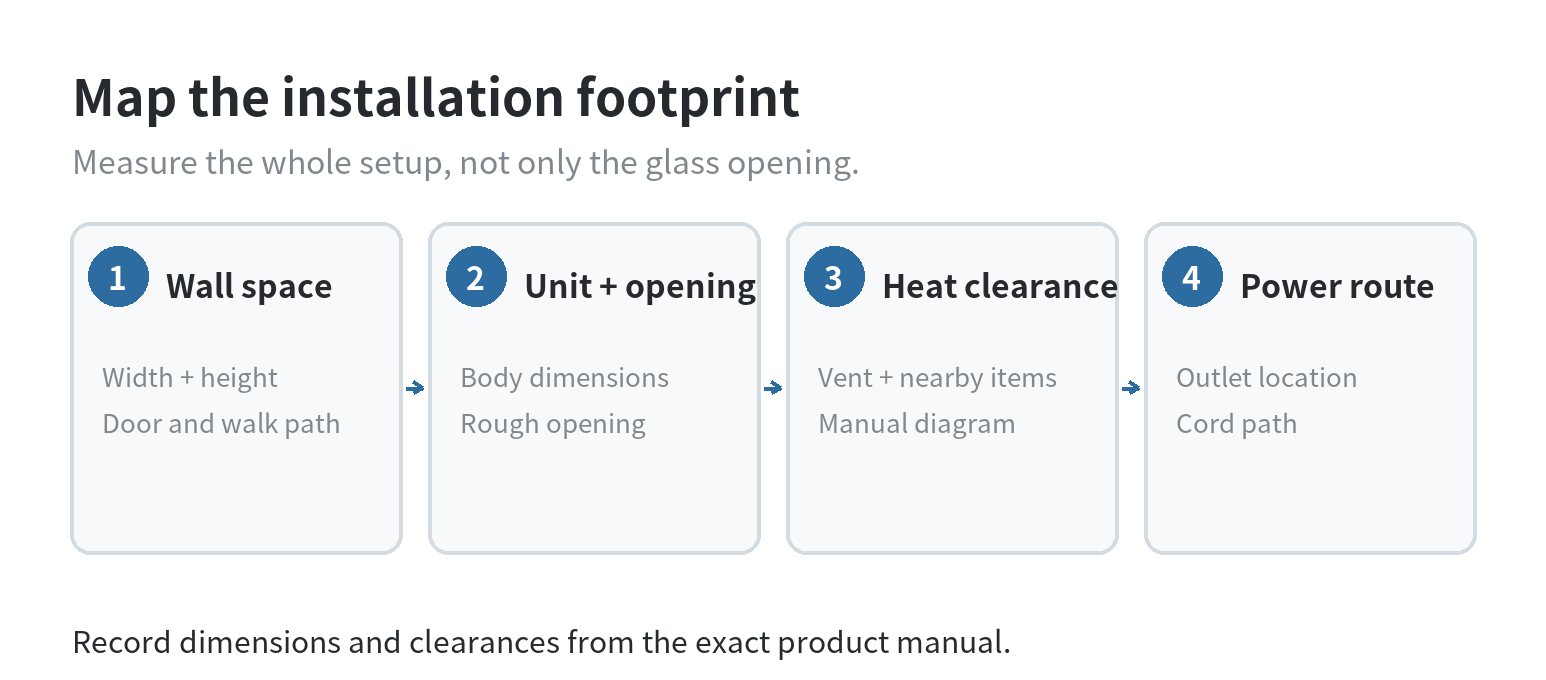
Style changes the measuring task. A wall-hung unit needs a secure mounting surface and room for the bracket. A mantel or console needs floor space and enough clearance around the heater outlet. A recessed firebox needs its specified opening and an unobstructed path for intake and exhaust air. Check whether a model is designed for the installation type you want; a wall-mounted version is not automatically approved for a built-in opening.
Read watts and BTU as two views of the heater
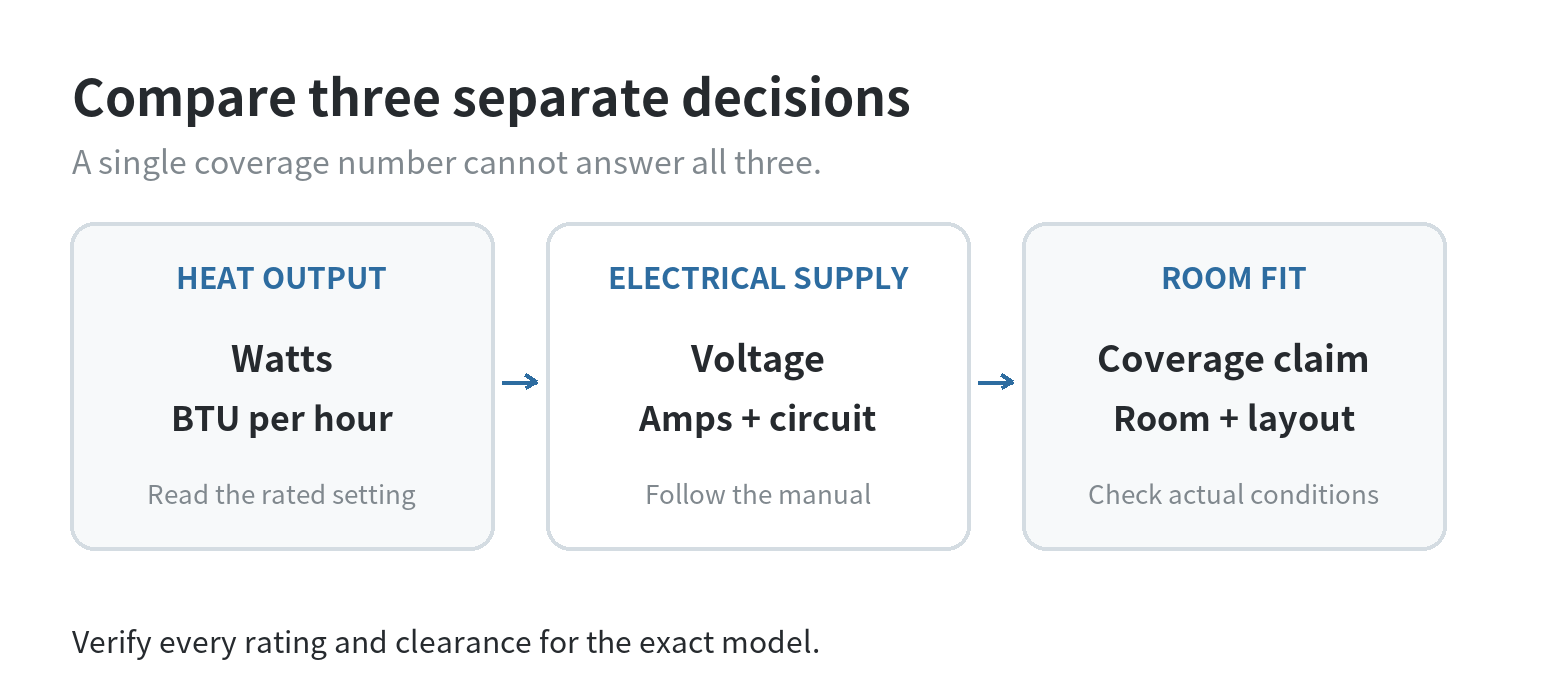
Watts describe the electrical input; BTU per hour describes heat output. Product specifications often list both. For example, manufacturer pages list 1,500 watts and about 5,000 BTU per hour for one wall-mounted fireplace, while a second manufacturer lists a 1,500-watt mantel fireplace at 5,100 BTU per hour. Those are example specifications, not a rating shared by every unit. One manufacturer’s listed fireplace specifications and another manufacturer’s product specifications show how published ratings can differ.
A 1,500-watt resistance heater corresponds to roughly 5,118 BTU per hour using the U.S. Energy Information Administration conversion of 3,412 BTU per kilowatt-hour. Treat that as a unit conversion, not a promise that a particular room will reach a set temperature. EIA lists the electricity conversion; the cited wall-mounted model and mantel model publish ratings in the same range.
| Specification | What to compare | What it tells you |
|---|---|---|
| Watts | Maximum heater draw and lower settings | Electrical demand while heat is running |
| BTU per hour | Rated heat output | Heat delivered by the heater at its stated setting |
| Room coverage | Manufacturer’s stated square footage | A model-specific estimate; compare the assumptions and room conditions |
Square-foot coverage is not a standard room guarantee. Published claims vary: one manufacturer lists 400 square feet for a 1,500-watt wall-mounted model, while another lists up to 1,000 square feet for a 1,500-watt mantel fireplace. The first coverage figure and the second manufacturer’s figure should be read as product-specific claims. The Department of Energy identifies home size, insulation, heating use, and local climate as factors in heating-system selection; consider those room conditions when interpreting a fireplace coverage claim. DOE’s heating and cooling guide explains those sizing factors.
Check the circuit before settling on a heat setting
Read the nameplate and manual for voltage, amperage, and circuit requirements. As an example, a 1,500-watt load on a 120-volt supply works out to 12.5 amps by the power formula. One manufacturer’s manual specifies a grounded 120-volt, 15-amp circuit for its model; another manufacturer’s instructions also call for a 15-amp, 120-volt circuit. The first manual’s electrical section and the second set of instructions show why you should check the exact product requirements.
A circuit can serve other rooms and outlets, so the breaker label alone may not tell you what else is connected. Manuals differ on whether a dedicated circuit is required or preferred, as shown in one manufacturer’s installation manual and another manufacturer’s instructions. If the manual calls for one, the breaker trips, or you are unsure how the circuit is wired, have an electrician assess it. Plug the unit directly into the outlet when its instructions require that; the cited fireplace manual and manufacturer troubleshooting guidance prohibit extension cords or power strips for their specified products.
For context on whole-home surge protection and electrical planning, see the site’s whole-house surge protector guide.
Place it where heat and airflow have room
Do not choose a height from a photo. Find the manual’s clearance diagram and measure from the reference points it names, such as the glass front, vent, ceiling, mantel, or combustible material. The measurements are model-specific: one wall-mounted unit’s manual sets different distances above the fireplace for the ceiling and nearby objects than another model’s manual. The wall-mounted model’s placement diagram and a separate model manual illustrate why a generic clearance number is not a substitute.
Keep the intake and exhaust openings clear. Avoid a position where a sofa, curtain, shelf, or stored item can block the vent or sit within a required clearance. If the heater blows upward, check how warm air may reach a TV, mantel, or artwork above it; use the specific manual’s spacing directions for those objects. Some models let the flame display run with the heater off; confirm that feature in the exact product specifications. A manufacturer’s listed operating features describe that option for its model.
Before mounting, check the wall structure and mounting instructions. For a wall-hung unit, find the bracket layout and fastener instructions before drilling; a recessed installation needs the specified rough opening and framing conditions. Do not treat drywall anchors, decorative trim, or a visual fit as proof that the unit is supported correctly. If the manual requires hardwiring, new circuits, or wall alterations, use a qualified professional for that work.
When comparing safety equipment in the same room, the site’s smoke alarm buying guide covers alarm placement. Keep the fireplace’s own clearance and installation instructions as the source for fireplace placement.
Use a short checklist before choosing a model
- Write down the available wall or floor footprint, including the depth and rough opening if recessed.
- Compare rated watts, BTU per hour, voltage, amperage, and the circuit instruction in the manual.
- Use room-coverage figures as estimates, not guarantees; consider how the room connects to adjoining space.
- Confirm vent direction, clearances to the ceiling and nearby objects, mounting support, and cord routing.
- Check that the desired flame-only or heat setting is listed for that exact model.
A good match is one whose dimensions fit the intended location, whose heater rating suits the role you expect it to play, and whose electrical and clearance requirements work in your home. If a spec sheet and manual conflict, ask the manufacturer which revision applies to the exact model before installation.
Last updated: 2026-10
FAQ
Can an electric fireplace run on a standard household outlet?
Some plug-in models are designed for a grounded household receptacle, but check the exact manual for its voltage, circuit rating, and direct-plug instructions. One manufacturer’s wall-mounted manual and another manufacturer’s overview describe plug-in models. A unit that needs hardwiring or a different circuit should be installed according to its instructions by a qualified electrician.
Does a wider electric fireplace produce more heat?
No. Width describes the unit’s physical size, while watts and BTU per hour describe its heater rating. Compare those specifications separately: a 36-inch unit and a 60-inch unit are each listed at 1,500 watts.
Can I put a TV above an electric fireplace?
Only if the specific fireplace and TV installation instructions allow the arrangement and their clearance requirements can both be met. Check the fireplace vent direction and the manual’s distance to a TV or mantel before locating either device.
Is a recessed fireplace the same as an electric fireplace insert?
Not necessarily. “Recessed” describes an installation position, while an insert is a product designed for an existing fireplace opening. The listed insert model and recessed or wall-mounted model show how manufacturers identify those installation types. Check the product’s listed opening dimensions before planning an installation.