
A French drain is a gravel-filled trench that uses a perforated pipe to collect subsurface water and move it toward an outlet. The core supplies are drainage pipe and fittings, clean drain rock, water-permeable filter fabric, and a way to discharge the water safely. Choose those pieces only after you know where the water enters, where it can go, and what local rules allow.
That list is a starting point, not a fixed kit. A shallow yard drain, a foundation footing drain, and an infiltration trench have different depths, fabrics, outlets, and maintenance needs. Fairfax County describes a gravel-and-pipe assembly for yard runoff, while the U.S. Department of Energy’s Building America Solution Center describes a foundation drain at footing level. Those designs should not be treated as interchangeable (Fairfax County drainage guidance; Building America Solution Center footing-drain guide).
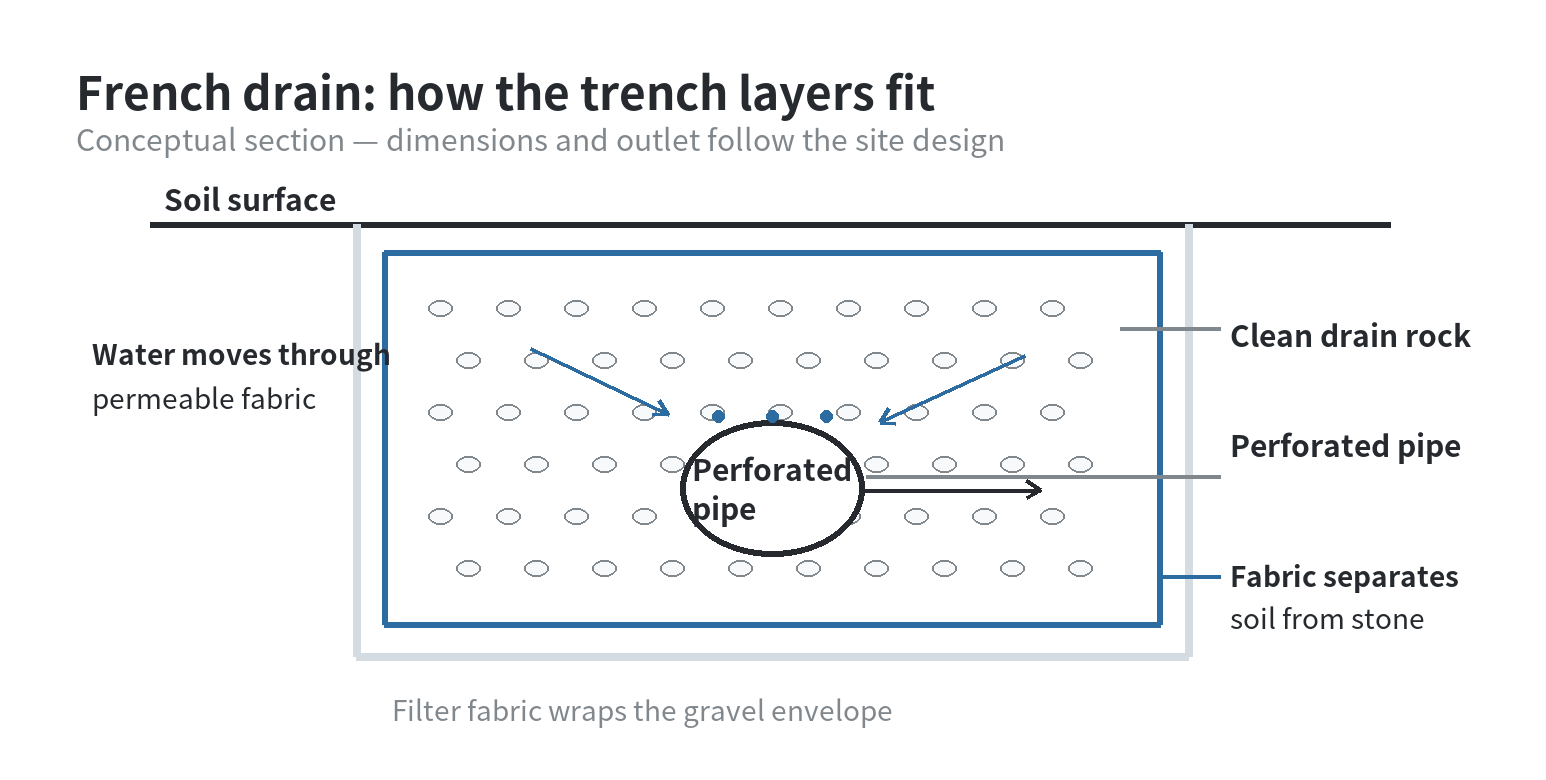
Start with the water route, not the shopping list
Walk the area after rain and mark where water collects, the route it could follow, and a lower, lawful discharge location. A French drain gathers water along a perforated section; a solid pipe carries collected water onward. The receiving point matters as much as the trench because water still needs somewhere appropriate to go. Fairfax County defines the drain as a pipe surrounded by gravel and lined with fabric that conveys runoff to a suitable outlet (county guidance).
Drainage around an exterior fixture is a separate problem from moving water through a yard trench; the site’s outdoor faucet drainage guide explains the fixture’s own drain path.
Before choosing materials, check whether the water comes from a roof downspout, a low spot, groundwater, a leaking buried line, or a combination. A surface inlet or catch basin can collect visible runoff; a French drain handles water entering the gravel trench. The county guide treats catch basins and French drains as distinct drainage components, and notes that a basin can connect to a buried drain pipe (Fairfax County drainage guidance). If water appears near a foundation or the source is unclear, pause and identify the drainage problem before buying a full set of supplies.
What each supply does in the trench
| Supply | Role | What to check |
|---|---|---|
| Perforated drain pipe | Collects water from the gravel along the trench. | Pipe diameter, material, perforation pattern, and whether the selected design needs a separate solid outlet pipe. |
| Clean drain rock | Creates open space around the pipe so water can reach it. | Washed, consistent stone without soil-like fines; size must match the project specification. |
| Drainage geotextile | Separates soil from the stone while allowing water through. | Use drainage fabric suited to soil and system design; decorative weed barrier is not automatically an equivalent. |
| Fittings and cleanout access | Connect pipe sections and provide a route to inspect or clear the line. | Match fittings to pipe type and diameter; plan bends and access before trenching. |
| Outlet protection | Provides a stable endpoint for discharged water. | Confirm the discharge point is allowed and will not erode soil or send water onto neighboring property. |
Washed drain rock is different from ordinary mixed gravel: the Snohomish County infiltration guidance says washed rock has fine sediment removed and warns that pea gravel can clog a perforated pipe in that system. It also calls for nonwoven drainage geotextile and lists pipe, fittings, yard drains, and access ports as separate materials (Snohomish County guidance). These are useful material descriptions, but the county’s infiltration system is not a universal specification for every yard drain.
Match the pipe and fabric to the design
Do not choose a pipe from diameter alone. Confirm that it is perforated where it needs to collect water, that its connectors fit the pipe, and that the far end transitions to a solid pipe when the design calls for water to travel beyond the collection trench. A retailer’s aisle label may group corrugated pipe, rigid pipe, catch basins, and fittings together; they serve different jobs. The Federal Building America guide shows perforated footing drain connected to a nonperforated discharge pipe (Building America Solution Center).
Filter fabric belongs between the soil and drainage stone in many trench designs, but the fabric type and placement matter. The Snohomish County instructions specify nonwoven geotextile for their infiltration system and distinguish it from landscape fabric. A foundation drain guide from the Building America Solution Center also shows fabric enclosing the gravel bed. Read the project specification and product label together; “fabric” on a package does not establish that it is suitable for a buried drainage assembly (Snohomish County; Building America Solution Center).
Estimate quantities after the layout is set
Sketch the trench path and note its length, planned width and depth, pipe route, turns, inlet, and outlet. Use the plan’s dimensions to ask a supplier for rock volume and fabric coverage, including enough fabric to close over the stone if the design calls for a soil-covered trench. Pipe length must cover the perforated collection run plus any solid conveyance run. Do not buy against a generic “standard” trench measurement: Fairfax County gives a typical yard-drain trench range, while the footing-drain guide specifies a different excavation for a foundation assembly (Fairfax County; Building America Solution Center).
For a simple quantity check, separate the materials into collection run, outlet run, stone envelope, fabric wrap, connectors, and surface finish. Ask whether rock is sold by bag, cubic foot, or bulk volume, and whether pipe is sold by length or coil. Those units affect how you compare estimates; they do not determine the right system design. Keep the sketch and written measurements with the materials list so a second supplier can quote the same scope.
Before finalizing the list, check the pipe label and fitting label as a pair. A connector that looks similar can be intended for a different pipe material or diameter. Count each turn, branch, inlet, and change from perforated collection pipe to solid outlet pipe on the sketch, then match those points to fittings. Also decide how the trench surface will be finished: exposed stone and a soil-covered trench use different fabric closure and top-layer details. The project guide and local design instructions should resolve those choices before materials are ordered.
Check the slope, outlet, and local requirements
Gravity drainage needs a continuous route that falls toward the outlet; a low spot in the pipe can hold water instead of carrying it along. Fairfax County describes a French drain as conveying water to a suitable outlet (county guidance). Confirm the required grade and outlet design for your site before buying pipe, since a materials list alone does not establish that the route will drain.
Before digging, contact 811 to have underground utilities marked, then check local rules on grading, drainage connections, and discharge. Snohomish County says property owners may need to contact utility providers directly to locate private lines (county guidance). Do not route water onto a neighbor’s lot or into a storm system until the responsible local authority confirms the outlet is permitted.
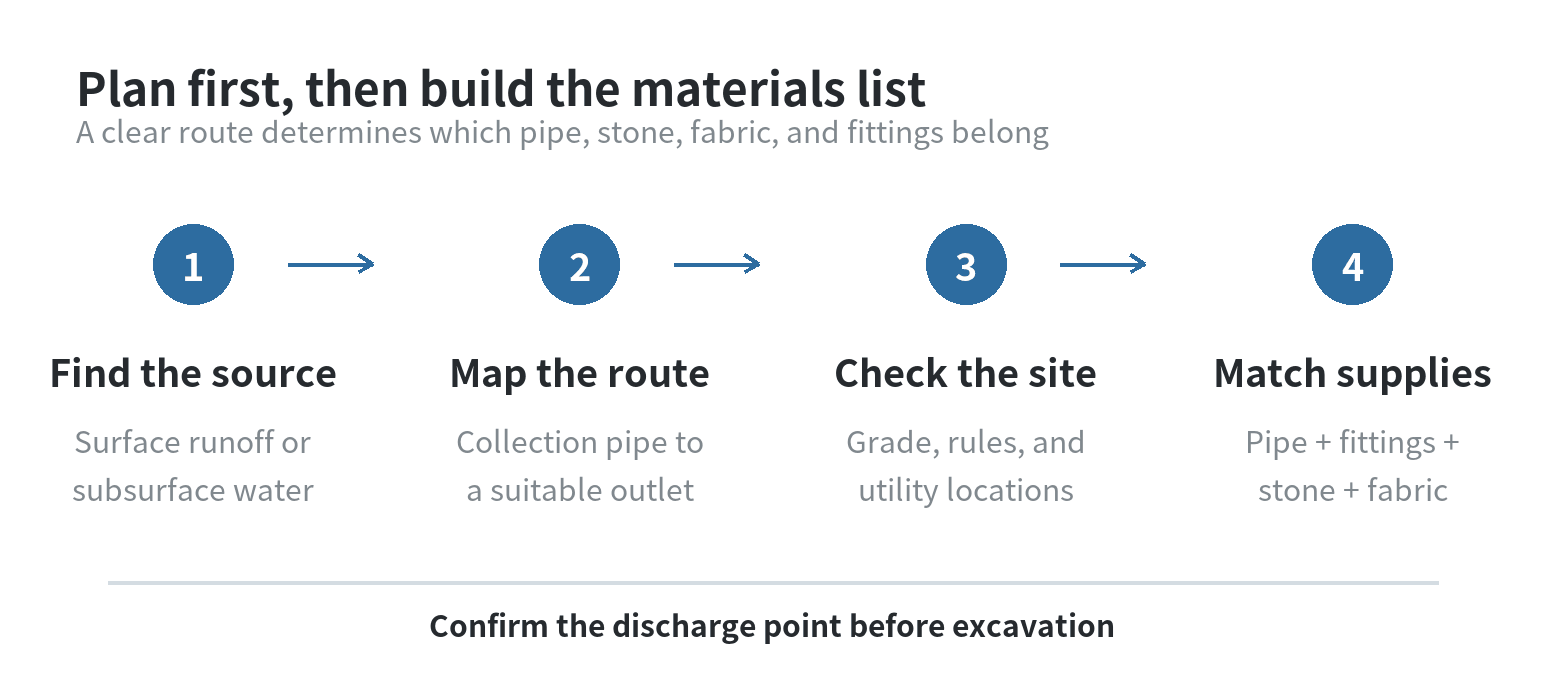
When a materials list is not enough
A materials list does not diagnose the source of water or determine whether a foundation detail, soil condition, or outlet can accept the flow. The Building America guide ties foundation drains to the footing and a defined discharge route (Building America Solution Center). If water is entering a basement, affecting a foundation, or crossing property lines, have a local drainage professional review the source, route, and outlet before excavation.
Where drainage sits behind a retaining wall, the site’s retaining-wall drainage notes explain why that structure’s aggregate and outlet belong to its own design.
When you compare material lists, ask the installer or supplier to identify the pipe’s collection section, the solid discharge section, stone gradation, fabric type, connectors, access points, and outlet protection. Have them explain which design assumptions came from your site and which came from a product label. A clear list makes it easier to spot a missing transition or incompatible fitting before the trench is open.
Last updated: October 2026.
FAQ
Can a French drain connect to a downspout?
It can be part of a broader drainage layout, but a catch basin or solid pipe may be the component that carries roof runoff to the outlet. Fairfax County describes downspout connections and catch basins as possible parts of a drainage system, so confirm the inlet and outlet design locally (Fairfax County guidance).
Is landscape fabric the same as drainage geotextile?
No. Snohomish County specifies nonwoven drainage geotextile for its infiltration system and says not to substitute landscape fabric in that design. Check the material required for your project rather than relying on a similar-looking package label (Snohomish County guidance).
Can I use any gravel left over from another project?
Check the drain design before reusing stone. Snohomish County’s infiltration guidance specifies washed drain rock and warns against pea gravel in that system because it can clog the perforated pipe (county guidance).
When should I call a drainage professional?
Ask for a site review when the water source is uncertain, a foundation is involved, or no clear permitted outlet is available. The materials and route depend on the drainage condition and the way water can leave the property.
Last updated: 2026-10