Chain, belt, and direct-drive openers move a garage door in different ways, and that difference affects the sound you hear and the parts moving overhead. If the garage sits below a bedroom or shares a wall with living space, start by comparing the drive design and motor setup; if noise matters less, compare the opener’s compatibility and safety features instead. The drive label alone does not tell you whether a unit fits your door.
What the drive mechanism actually moves
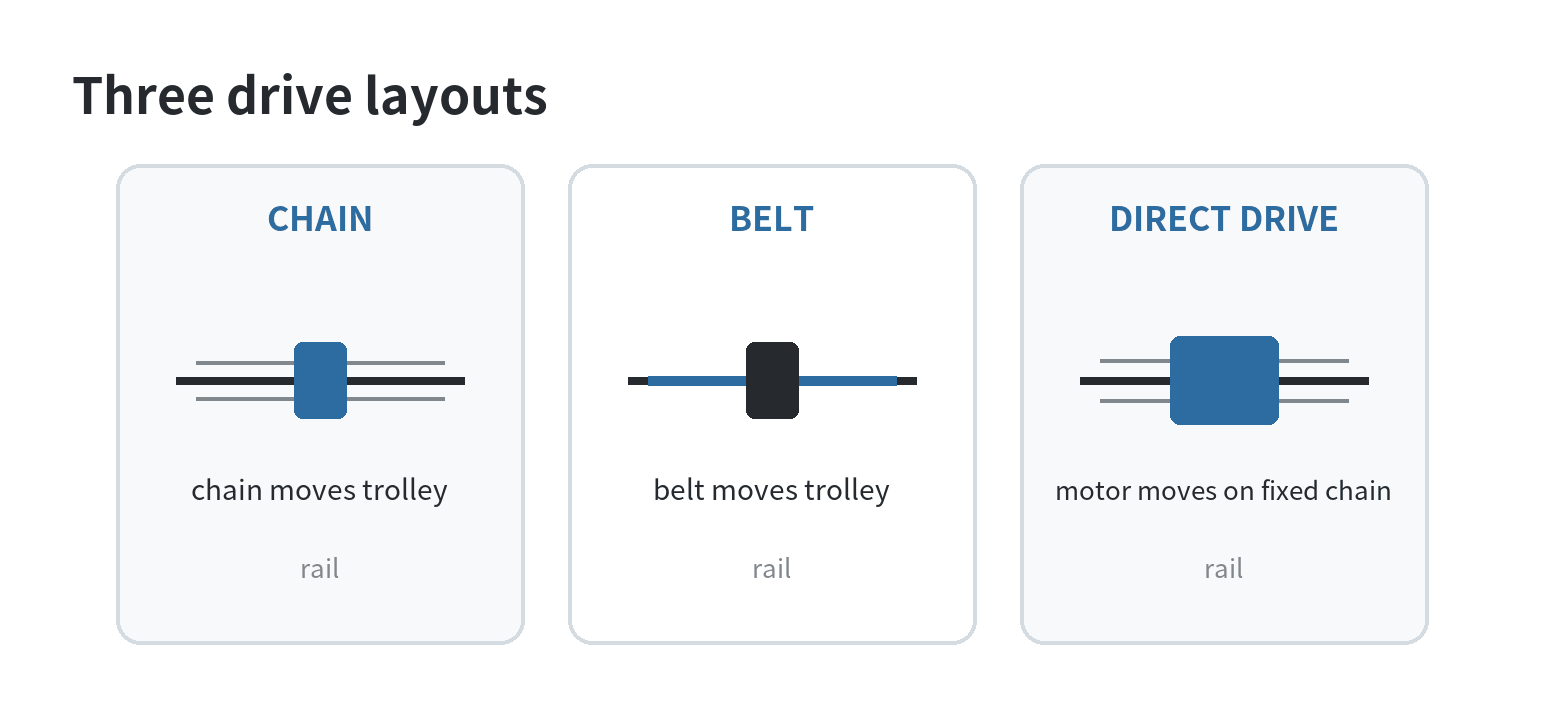
A typical ceiling-mounted opener uses a motor, a rail, a moving trolley, and an arm connected to the door. With a chain or belt design, the drive moves the trolley along the rail. In a direct-drive design, the motor carriage travels along a stationary chain in the rail. Manufacturer descriptions from Chamberlain and Sommer explain these arrangements. The label can refer to different layouts: one wall-mounted opener is listed as direct drive, while the traveling-carriage design is another use of the term. Compare the mechanism drawing for the exact model.
The opener guides the door through its travel; the door’s spring system counterbalances its weight, as Genie explains in its maintenance guidance. That is why a drive-type comparison cannot replace checking door compatibility. Door construction, size, balance, and the opener’s listed capacity all matter. If a door is heavy, sticks, or moves unevenly by hand, ask a qualified garage-door professional to assess the door before choosing an opener.
Compare the three drive types by what you will notice
| Drive | What moves | Useful comparison point | Check before choosing |
|---|---|---|---|
| Chain | A chain pulls the trolley along the rail. | The chain is metal and can make more operating noise than a belt setup. | Ask what lubrication and tension checks the specific manual calls for. |
| Belt | A reinforced belt moves the trolley along the rail. | Manufacturers describe belt systems as quieter because the drive avoids metal-on-metal contact along the rail. | Confirm the belt material, door compatibility, and maintenance instructions for the model. |
| Direct drive | The motor carriage travels along a fixed chain in the rail. | The motor is the moving carriage; the chain remains stationary. | Check how the carriage mounts, what rail length is included, and which doors the unit supports. |
These are design tendencies, not a guarantee that one opener will sound a certain way in every garage. Motor type, installation, door balance, tracks, rollers, and how the opener is attached to the ceiling can also affect sound and vibration. A quiet drive cannot silence a rattling door or loose hardware. If noise travels into a room, consider the whole door-and-opener assembly rather than treating the drive label as the only cause. Genie also describes belt systems as quiet and chain systems as durable.
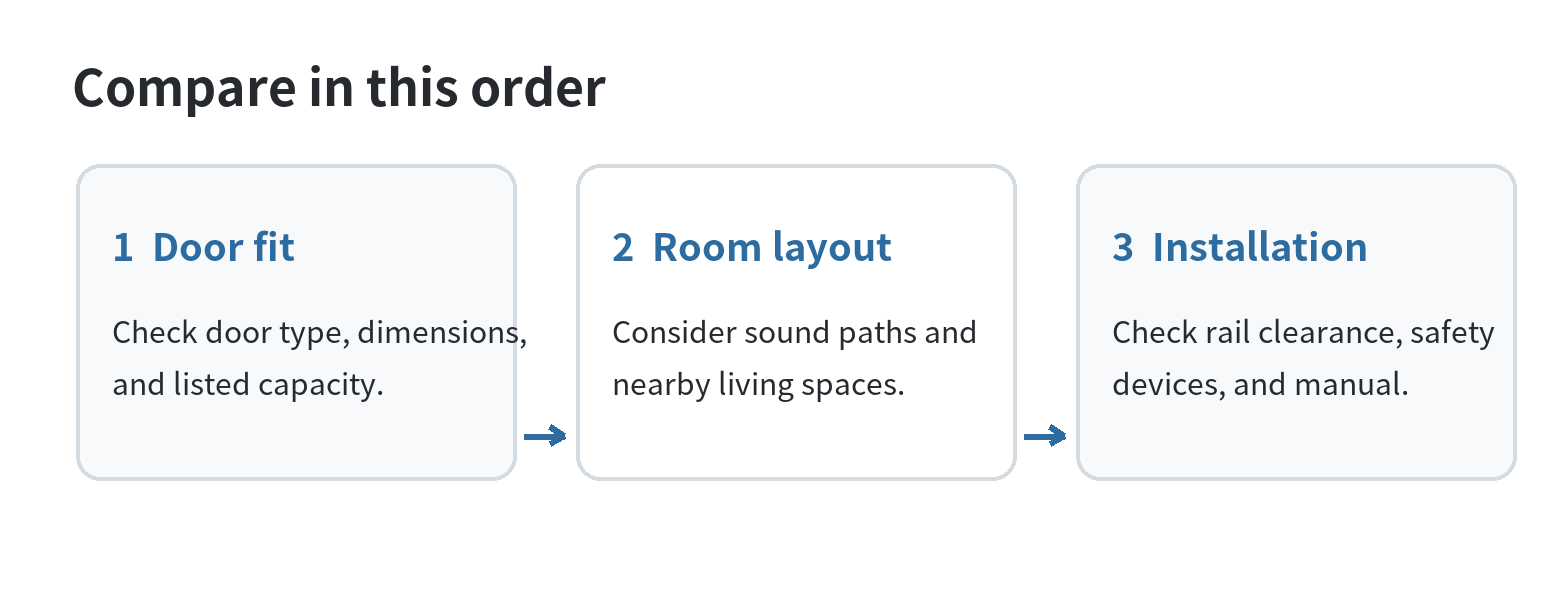
When two listings seem close, compare them against the same door details and the same installation constraints. Put the manual’s compatibility, rail dimensions, safety equipment, and maintenance instructions side by side. That keeps an advertised quietness label from outweighing a fit issue, and it makes clear which differences come from the drive and which come from other model features.
Chain, belt, and direct drive are also not the same thing as motor power. A chain unit is not automatically stronger than a belt unit, and a direct-drive label does not establish a door’s weight limit. Compare the manufacturer’s compatibility chart and capacity information for the particular opener and your door. If the documentation does not clearly cover the door’s construction and dimensions, get that match confirmed before installation.
Match the design to the garage layout
Start with where the noise goes. If a bedroom is above the garage or a living room shares a wall with it, belt-drive designs are worth comparing because manufacturers describe them as quieter than chain systems. Direct drive is another layout to investigate when the moving motor carriage and fixed chain arrangement suit the available rail space. Check the unit’s installation manual for clearances and mounting points; the mechanism name alone does not confirm a fit.
If the garage is detached or far from occupied rooms, you may care more about the opener’s stated door compatibility, included controls, and maintenance steps than the sound of its drive. Chain designs use a familiar moving chain, while belt models use a reinforced belt. Either way, look up the exact model’s manual so you know which parts need inspection and what products, if any, the manufacturer specifies for maintenance.
Also check what sits above the door. Ceiling storage, a low ceiling, exposed beams, and the position of the torsion hardware can affect whether a rail-mounted unit can be installed as shown. Direct-drive designs still use a rail and need suitable mounting points. Do not assume that “direct” means the opener has no overhead rail or will work with every garage layout.
When comparing specifications, keep the door details in one note: sectional or one-piece construction, approximate width and height, and whether the opener maker lists that type as compatible. Then compare the installation drawing with the garage itself. A broad compatibility statement does not tell you whether your door’s size, track arrangement, or available mounting space matches the model.
Ask what comes in the box and what must match the existing setup. The included rail length, sensor arrangement, wall control, and any required adapters can differ by model. Confirm the full model number rather than comparing two listings by a shared family name. For a replacement, check whether existing accessories are named as compatible in the new opener’s manual; a familiar shape or connector is not enough to establish compatibility.
A door that is hard to lift by hand or drifts when partly open needs attention as a door system, not a more powerful opener guessed from a product label. Genie’s maintenance guidance says an unbalanced door can create a safety hazard and directs readers to a dealer for spring adjustment. Leave spring work to a qualified person; choosing among chain, belt, and direct drive does not correct a balance problem.
Check the safety system separately from the drive
Chain, belt, and direct drive describe how the door moves; they do not replace the opener’s entrapment-protection features. The Consumer Product Safety Commission says automatic residential garage-door operators must meet the federal safety standard in 16 CFR Part 1211. UL Solutions explains that the U.S. rule references UL 325 entrapment-protection provisions in its UL 325 overview.
Before comparing models, check that the product documentation identifies the required monitored safety devices and explains how they work with that opener. Photoelectric sensors detect an interruption across the door opening; the operator’s instructions explain what the unit should do when the beam is blocked. CPSC and UL provide the standard context, while the manufacturer’s manual gives the model-specific setup and test directions.
Follow the safety test in the manual for the exact opener and door. Genie’s maintenance guidance describes separate mechanical-reversal and photo-eye checks, and says a failed test needs repair. LiftMaster also outlines photo-eye and reversal checks in its safety information. If the door does not reverse as its manual describes, stop using automatic operation and arrange service. Do not adjust springs or force settings based on a general buying guide.
A short checklist for comparing listings
- Door match: Record the door type, dimensions, and any known balance or operating problem; compare them with the manufacturer’s compatibility and capacity details.
- Room location: Note whether a bedroom or living space is above or beside the garage. Treat noise descriptions as a factor to compare, not a promise about your finished installation.
- Space: Measure the ceiling and the area above the door, then compare those measurements with the installation manual’s rail and mounting requirements.
- Safety: Confirm the documentation covers entrapment protection, sensor installation, and the manufacturer’s test procedure.
- Upkeep: Read the exact manual for inspection, lubrication, and service instructions. Chain and belt units do not necessarily share the same maintenance steps.
For example, imagine a garage directly below a bedroom, a standard sectional door, and enough ceiling room for a rail. That homeowner could compare the door’s documented compatibility across all three mechanisms, then give greater weight to the belt’s noise characteristics. If the same garage were detached, sound might move lower on the list, while fit, instructions, and safety checks would still need attention.
Keep the model number and manual with your household records after installation. When you need service or a replacement remote, the model information helps you find instructions that match the opener actually installed. If you do not know the door’s weight or balance, do not estimate it from appearance; have the door assessed and use the opener maker’s compatibility information.
FAQ
Will changing from a chain drive to a belt drive fix every garage noise?
No. A belt may reduce noise from the drive, but door rollers, tracks, mounting, and door balance can also make sound. Identify whether the noise comes from the opener or door, and follow the equipment manual or ask a qualified technician to inspect it.
Does direct drive mean the opener has no rail?
No. The label can refer to different layouts: Sommer describes a traveling motor carriage on a fixed chain, while a wall-mounted model from another manufacturer is also listed as direct drive. Compare the mechanism drawing and installation manual for the exact model, including its rail and mounting requirements.
Can I install a different drive type without changing the garage door?
Possibly, but compatibility depends on the door and opener model. Compare the manufacturer’s door requirements and installation clearances before choosing a replacement; the drive type by itself does not confirm compatibility.
Which safety feature matters with any drive type?
Check the opener’s entrapment-protection devices and test procedure. The safety system is separate from whether a chain, belt, or moving motor carriage drives the door.
Last updated: October 2026.
Last updated: 2026-10