Garage floor epoxy kits do not share one prep recipe or one “safe to park” date. Start by identifying whether your slab is bare, sealed, newly poured, or already coated; then follow the instructions for the exact kit. The coating day is the last step in a schedule that also includes cleaning, rinsing, drying, mixing, and keeping vehicles off the floor.
Check the slab before planning a coating day
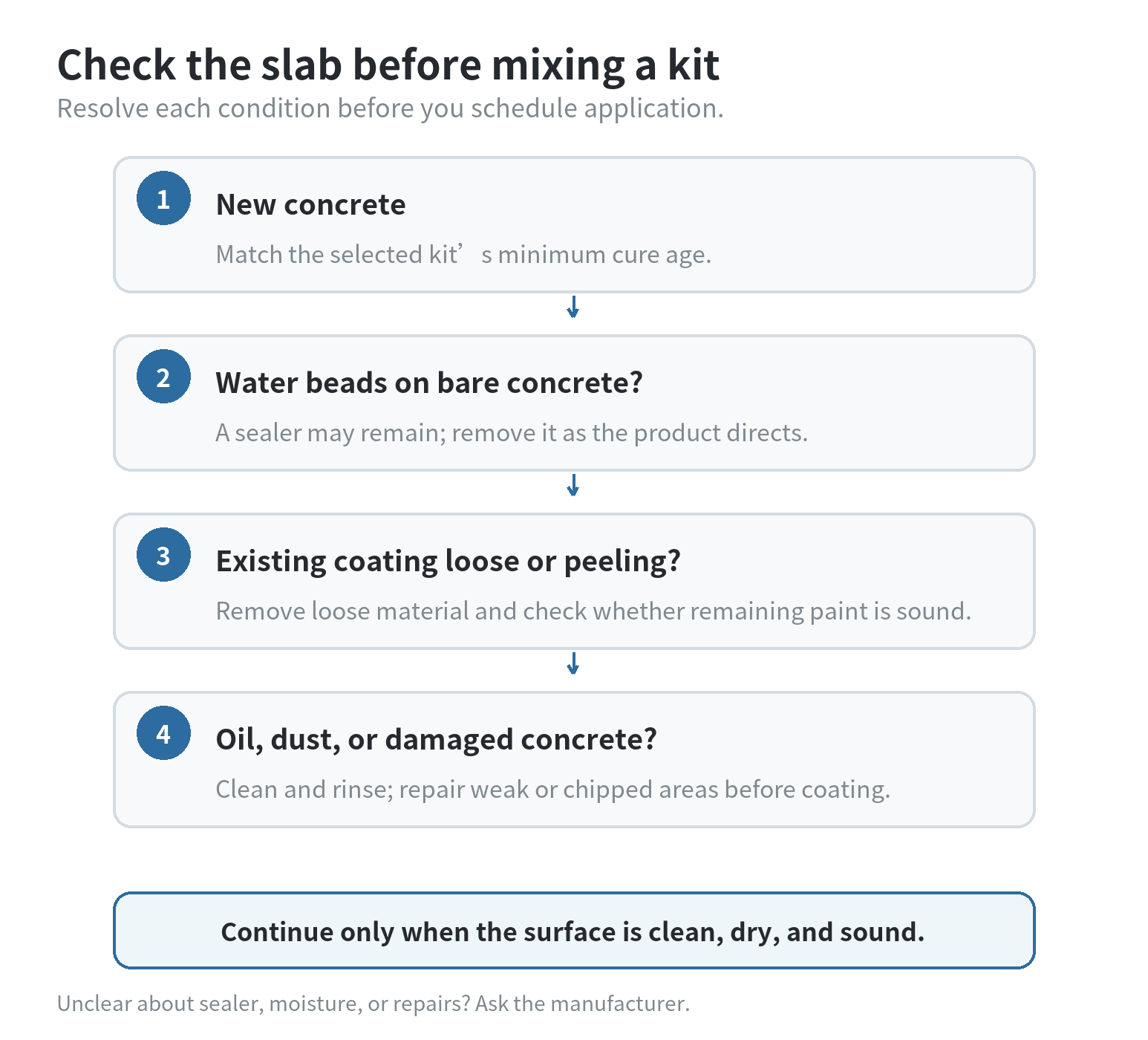
Look at the concrete before opening the kit. Rust-Oleum’s instruction sheet says its coating should wait at least 28 days after a new pour; QUIKRETE’s two-part kit data sheet requires concrete and concrete repairs to cure for 30 days before epoxy application. Those instructions differ, so use the requirement printed for the product you have, not the shorter number from another kit. (Sources checked October 14, 2026.)
On bare concrete, drip a little water in several places. Rust-Oleum says beading can indicate a sealer that may interfere with application. The same instruction sheet calls for checking dampness with plastic taped over a 2-by-2-foot section for 24 hours; droplets under the plastic or darkened concrete indicate trapped moisture. If either test raises a concern, stop and ask the manufacturer how that surface should be handled.
For an already painted floor, inspect for peeling, chips, or loose edges. Rust-Oleum’s label says to remove loose paint and test the remaining coating’s adhesion; if more than one quarter of the paint lifts in its specified tape test, remove the old paint before coating. That test belongs to that manufacturer’s directions. Don’t transfer it to another product without checking that product’s label.
Clean bare concrete and coated floors differently
Remove stored items and sweep grit from the work area. If the garage needs a bigger clear-out first, see our garage storage layout guide. On bare concrete, the Rust-Oleum instructions call for degreasing oil spots, applying the supplied etching solution as directed, scrubbing, rinsing thoroughly, and letting the slab dry. QUIKRETE’s two-part kit includes cleaner, etcher, and degreaser; its data sheet says to read the included application and safety instructions before beginning. Follow the sequence and dilution on your own kit; keep the etching solution out of the coating unless the kit explicitly directs otherwise.
A previously coated floor needs a different check. QUIKRETE says painted concrete must be secure and not oil-based before its kit is applied. For a separate overview of repair material categories, see our concrete mix guide. Rust-Oleum’s instructions say to remove loose or peeling material and prepare sound existing paint as directed. If the floor has a glossy sealer, flaking paint, or soft concrete, don’t cover it to save time. Resolve the surface condition first or contact the coating manufacturer with a clear description of the existing finish.
Rinsing and drying take calendar time. Plan space to squeegee or mop water away and leave the garage empty until the surface is fully dry. Don’t mix the coating while the slab is still damp just because the air feels dry. The label’s surface condition and weather limits govern when application can begin.
Make room for the label’s temperature and safety limits
Check the temperature range, humidity limit, and forecast in the kit instructions before choosing a day. Rust-Oleum’s instruction sheet lists an application air-temperature range of 60–85°F, relative humidity below 80%, a minimum floor temperature of 55°F, and a post-application low-temperature restriction. QUIKRETE lists an application range of 50–90°F and says not to apply if rain, heavy dew, or temperatures outside that range are expected within the following 24 hours. These are instructions for the cited products, not universal epoxy limits. If the forecast falls outside the range printed on your kit, move the work date instead of trying to heat or cool the slab with an improvised method. (Manufacturer instructions checked October 14, 2026.)
Read the product label and safety data for every component, including cleaner or etcher. Rust-Oleum’s base and activator safety sheets call for avoiding inhalation and wearing protective gloves, clothing, and eye or face protection; the product instructions also warn about lead dust if you sand or scrape old paint. QUIKRETE’s kit sheet specifies nitrile or neoprene gloves, rubber boots, and goggles for the cleaner, etcher, and degreaser; it warns that this included cleaner is corrosive. Rust-Oleum’s activator safety sheet says to use the product outdoors or in a well-ventilated area. Follow the actual labels for the products in your work area and keep children away from open containers.
Mix only when the floor and work area are ready
Suppose cleaning requires a degreaser, an etch, and a full rinse. Reserve a prep block before the coating session: you still need the slab to dry, the tools and stored items moved, and the work area within the product’s application limits. If rinsing or weather delays that sequence, postpone mixing. Keep the batch’s limited working window for spreading the coating instead of waiting on unfinished prep.
Before combining components, set out the stirrer, roller, tray, brush, decorative flakes if included, and a clear route out of the garage. Read the mixing order and working-time limit first. Rust-Oleum’s instructions warn that its activated coating must be used within the listed pot life; temperature changes that working time. That makes “I’ll mix it, then finish moving things” a poor sequence. Finish cleaning, masking, staging, and ventilation before opening the activator.
Check the coverage estimate against the actual floor area and the kit label’s surface assumptions. Rust-Oleum says rough or porous concrete may require more coating than smooth concrete. Repair loose or chipped concrete before coating, as its instructions direct. If the package does not cover the measured area under your floor conditions, pause and confirm the quantity with the manufacturer rather than stretching a mixed batch thinly across the slab.
Work in the order the instructions give. The mixing clocks differ too. Rust-Oleum’s instruction sheet sets a temperature-dependent wait before rolling and a limited pot life; QUIKRETE says its coating is ready to use immediately after mixing. Those directions were checked October 14, 2026. Follow the timing for the kit in your hands. Don’t add water, solvent, or extra activator unless the product directions specifically tell you to do so.
Schedule foot traffic and parking as separate milestones
“Dry” does not automatically mean ready for a car. Product directions can distinguish light foot traffic, normal or heavy foot traffic, furniture, and vehicle tires. Rust-Oleum lists light foot traffic at 12–16 hours, normal foot traffic at 24–48 hours, and full cure plus vehicle traffic at 3 days. QUIKRETE lists light foot traffic and light items for the next day, with driving after 3 days. Both instruction sheets say temperature and humidity can affect the wait. These are manufacturer examples checked October 14, 2026; the exact kit label decides your schedule.
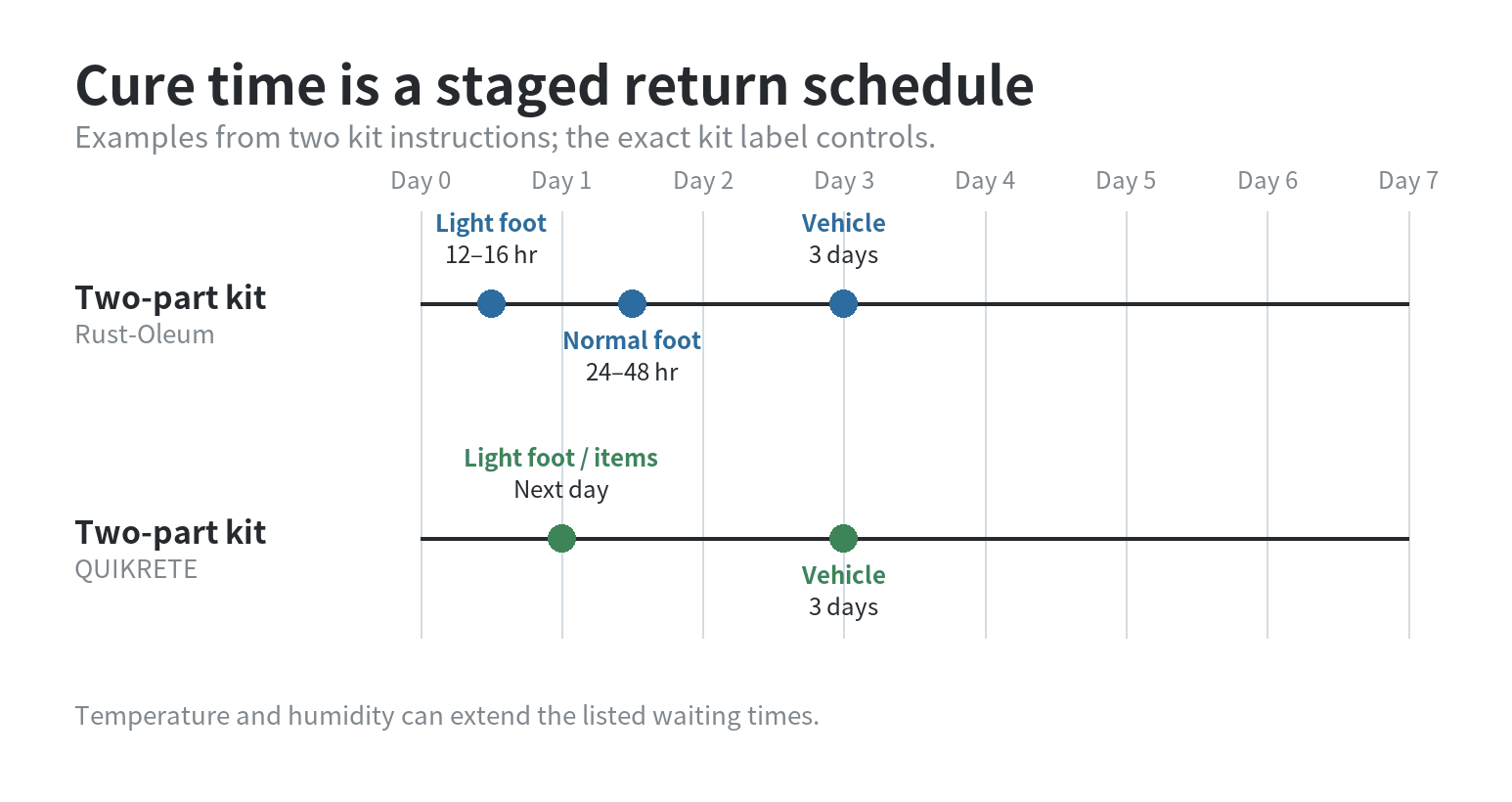
Put the return date on your calendar before starting. If you need the car for work the next morning, choose a different application window. Rust-Oleum and QUIKRETE both say temperature and humidity can affect their listed dry times. A weather delay is a reason to extend the waiting period, not to assume the coating has reached its vehicle-traffic stage.
Keep the floor clear through the relevant milestone. Carrying a light item across it, moving a cabinet, and parking a vehicle are different loads, so use the category printed in the instructions. If the label’s schedule is unclear, contact the manufacturer and ask specifically when light walking, heavy items, and vehicle tires are allowed for that product and the conditions during application.
FAQ
Can I use the same garage floor epoxy kit on an outdoor driveway?
Do not assume it is suitable. Rust-Oleum’s cited kit is for covered garages, while QUIKRETE says its epoxy coating is not recommended for outdoor uses such as driveways. Check the intended-use section on the exact kit label (checked October 14, 2026).
Can I return a loaded tool chest when light foot traffic is allowed?
Wait for a heavy-item or furniture milestone if the kit lists one. QUIKRETE’s cited sheet permits light items the next day; that timing does not state when a loaded tool chest can roll onto the floor.
Can I mix two kits together to save time on a large floor?
Only if the kit instructions describe that batch method. Rust-Oleum’s cited sheet says not to mix more than one kit at a time; follow the exact kit instructions for larger areas.
Last updated: October 2026
Last updated: 2026-10