
A frost-free outdoor faucet can still freeze if it cannot drain. Its shutoff valve sits inside the heated part of the wall, so the exposed tube empties after you close the handle; a connected hose or poor downward pitch can trap water instead. Arrowhead Brass’s repair guide explains those conditions. Before replacing one, check where the leak starts, whether the tube drains, and whether the replacement matches the wall and plumbing connection.
“Frost-free” describes a design with installation and use conditions, not a faucet that can stay full of water through a freeze without consequence. The diagram below shows the shutoff point inside the heated wall and the drain path through the exposed tube to the spout.
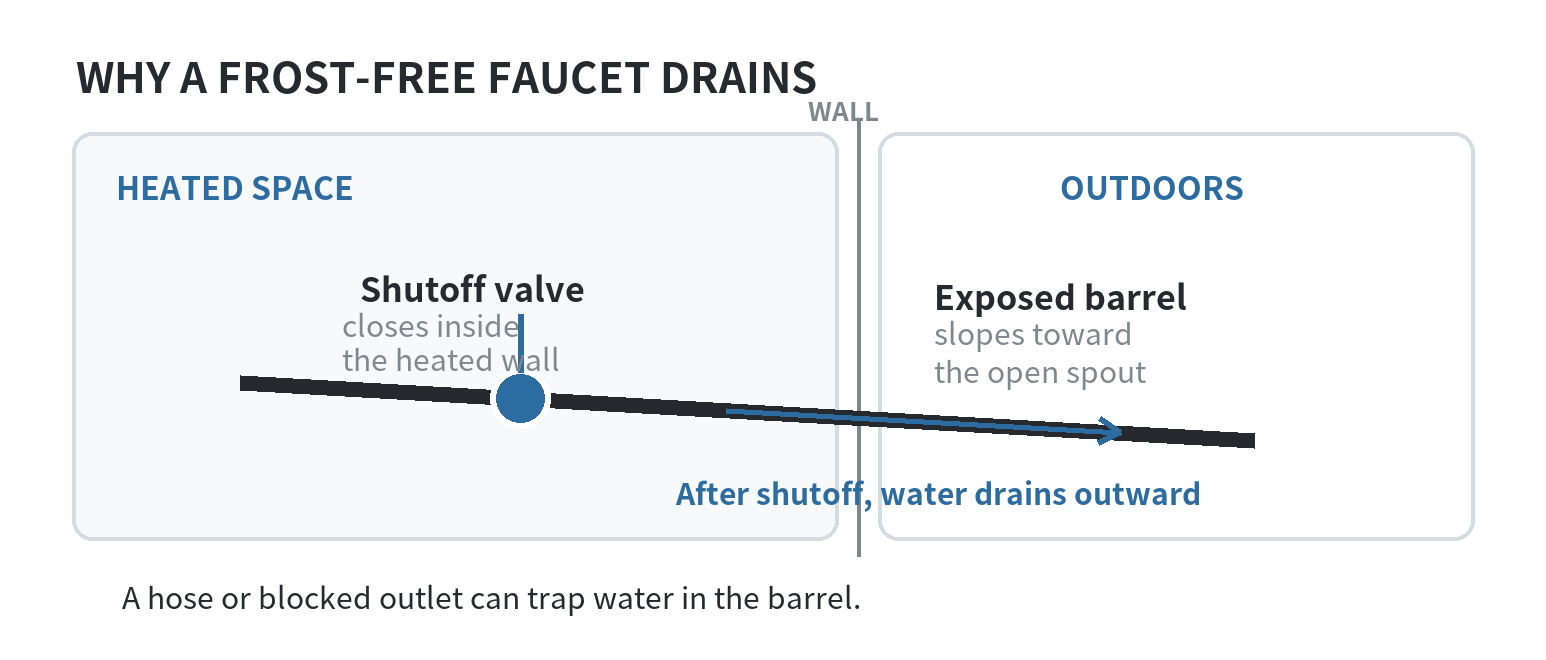
What “frost-free” changes inside the wall
The key difference is where the shutoff closes: a frost-free wall faucet uses a longer stem to close a valve farther inside the building. When you turn the handle off, the short exposed section can drain through the spout instead of remaining full of pressurized water in cold air. The barrel length you need depends on the finished wall thickness and the inlet connection, as shown in Woodford’s Model 17 dimension sheet.
Gravity does the draining. The faucet body and supply tube need a slight downward pitch toward the outdoor nozzle, and the nozzle needs to remain unobstructed. Woodford’s Model 14 and 17 installation sheet calls for a downward pitch and says the water-supply connection must be in a heated space. PRIER describes its freezeless hydrant as shutting off inside the heated part of the structure. PRIER’s technical notes give the same drain arrangement.
The hose matters because it can hold water at the outlet and block the drain path. Detach the garden hose before freezing weather, then close the faucet and let the barrel drain. Do not leave an attachment on the spout unless the faucet maker’s instructions specifically say that setup drains correctly. Woodford warns that a hose left connected can trap water; PRIER lists an attached hose and improper pitch among causes of freeze damage. Woodford’s mechanism guide and PRIER’s troubleshooting guide support that winter routine.
Water can drip from the barrel as it drains after shutoff. PRIER says its C-144 hydrant may drip for up to 60 seconds after shutoff; a drip that continues beyond that can point to a worn bibb washer. Leakage from behind the handle can come from packing around the stem, and Woodford identifies the packing nut as an adjustment point for leakage. Follow the exact model’s service instructions because parts and construction differ.
Read the leak before deciding to replace it
Start by locating the water, not by buying a new faucet. Dry the visible area, turn the faucet on and off, then inspect around the handle, vacuum-breaker cap, spout, and the interior connection if it is safely accessible. A leak at the handle or a worn seat washer may call for a model-specific repair. Water appearing inside the wall or on the indoor side is more serious: freezing can split the faucet’s internal tube, and continued operation can send more water into the wall.
PRIER’s troubleshooting guide distinguishes packing leaks and post-shutoff drips from water leaking inside the house, which it associates with a ruptured internal tube. It advises against operating a hydrant in that condition and directs the owner to arrange repair. Arrowhead Brass says a damaged seat that continues leaking after stem repair can require faucet replacement; a handle, packing, or washer fault may be repairable. For additional context on a small leak elsewhere in a plumbing fixture, see this site’s guide to minor plumbing leaks.
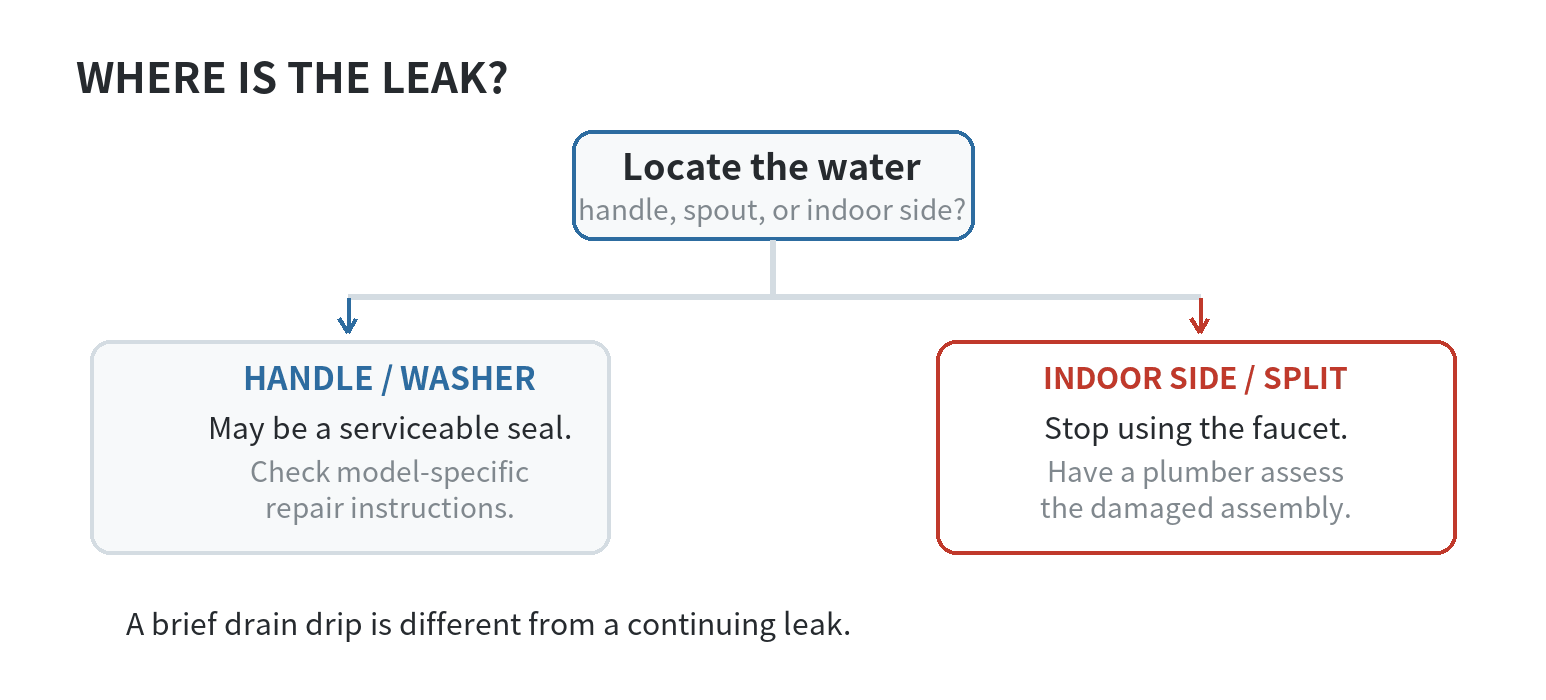
Stop using the faucet if water is escaping inside the structure. If the shutoff for that branch is identifiable and can be reached safely, close it; otherwise contact a plumber promptly. Avoid opening walls or removing a connected faucet based only on the outside symptom. A frost-free faucet passes through the building envelope, and its connection, pipe material, access, and drainage all affect the repair.
Replacement makes sense when the body or internal tube is cracked, when the maker’s instructions identify the assembly as beyond repair, or when compatible repair parts cannot be identified. A drip at the spout alone does not prove that the entire faucet has failed. The manufacturer’s support page may list a washer or packing kit for that exact model; compare the model marking and part diagram before treating a small seal problem as a full replacement.
Match the new faucet to the wall, pipe, and outlet
Measure the route through the wall and identify the supply connection before selecting a replacement. Frost-free faucets come in different barrel lengths and inlet styles. Woodford’s Model 17 specification sheet shows why these measurements are linked: the overall length depends on wall thickness and inlet option, and the order specification calls for the model, inlet, and wall thickness. Do not assume a faucet with the same exterior shape has the same connection or reach.
| Check | Why it matters | What to record |
|---|---|---|
| Wall depth | The shutoff must sit on the heated side, and the barrel must reach it. | Finished wall thickness and the old faucet’s marked length. |
| Inlet connection | Different models connect to supply piping in different ways. | Connection type, pipe material, and accessible joining point. |
| Drain direction | The exposed tube must empty out through the spout. | Whether the faucet slopes outward and whether trim or siding changes that angle. |
| Backflow feature | Protection varies by model and intended use. | What the current faucet provides and what the model documentation specifies. |
For example, if a house has thick siding and a deep wall, the visible faucet may look like a short model while its barrel extends well inside. Record the full wall build-up, not only the framing depth. If a shutoff valve is installed indoors for seasonal draining, note its location and access too. A licensed plumber can identify a hidden connection, confirm the fit, and check that the faucet drains after installation.
Before discussing a replacement, take a photo of the outside flange, record any model or length marking, and note the pipe material and connection if visible from an accessible indoor panel. These details help distinguish a matching barrel from one that only looks similar outside. Do not remove insulation or open a finished wall just to identify a fitting; have a plumber inspect concealed connections.
Backflow protection is a separate feature from freeze protection, and Woodford’s Model 14 and 17 instructions show that anti-siphon protection varies by model. Check the documentation for the exact model and intended use instead of inferring protection from the faucet’s length or handle.
A short cold-weather routine prevents trapped water
After outdoor watering, close the handle, remove the hose and any outlet attachment, and give the faucet time to drain. Store the hose where it can empty rather than leaving it connected as temperatures drop. Remove accessory devices too: Arrowhead lists irrigation timers, hose splitters, and add-on backflow preventers as attachments that can trap water. If water does not drain, the faucet is mounted level or pitched inward, or a fitting is blocking the outlet, do not count on the “frost-free” label to compensate. Ask a plumber to check its angle and installation.
For routine maintenance, watch for water around the handle, vacuum breaker, and indoor connection when the faucet is operated. A loose or worn seal may be serviceable; a split tube or leak inside the wall needs prompt attention.
FAQ
Can a frost-free faucet freeze if a hose stays attached?
Yes. A connected hose can hold water in the faucet and prevent the exposed barrel from draining. Woodford and PRIER both warn that a hose left on in freezing conditions can contribute to freeze damage. Remove the hose before cold weather and follow the instructions for the exact model.
Is a short drip after turning off the faucet a sign it needs replacement?
No. Water draining from the barrel can drip after shutoff. PRIER says its C-144 may drip for up to 60 seconds after shutoff; use the model’s service instructions to distinguish drainage from a continuing washer leak.
How do I know what length replacement faucet fits my house?
Measure the finished wall depth and identify the supply inlet and pipe connection. Manufacturer specification sheets tie the barrel length to wall thickness and connection option. If the connection is hidden, have a plumber identify it before selecting a replacement.
What should I do if water leaks from the indoor side of the faucet?
Stop operating it and arrange a plumbing inspection. PRIER associates indoor leakage with a ruptured internal tube; the leak may be concealed in the wall, so the faucet needs repair or replacement assessment.
Last updated: 2026-10. Manufacturer installation and troubleshooting guidance checked October 5, 2026, against Woodford’s installation sheet and PRIER’s support page.