Choose a fire pit by fuel first: wood needs space for logs and ash handling, a propane model needs room for its cylinder, and natural gas needs a compatible connection. Then check the exact model’s clearance and installation instructions against your local fire rules. A low price or attractive bowl cannot solve a fuel or placement mismatch.
Start with the place it will sit
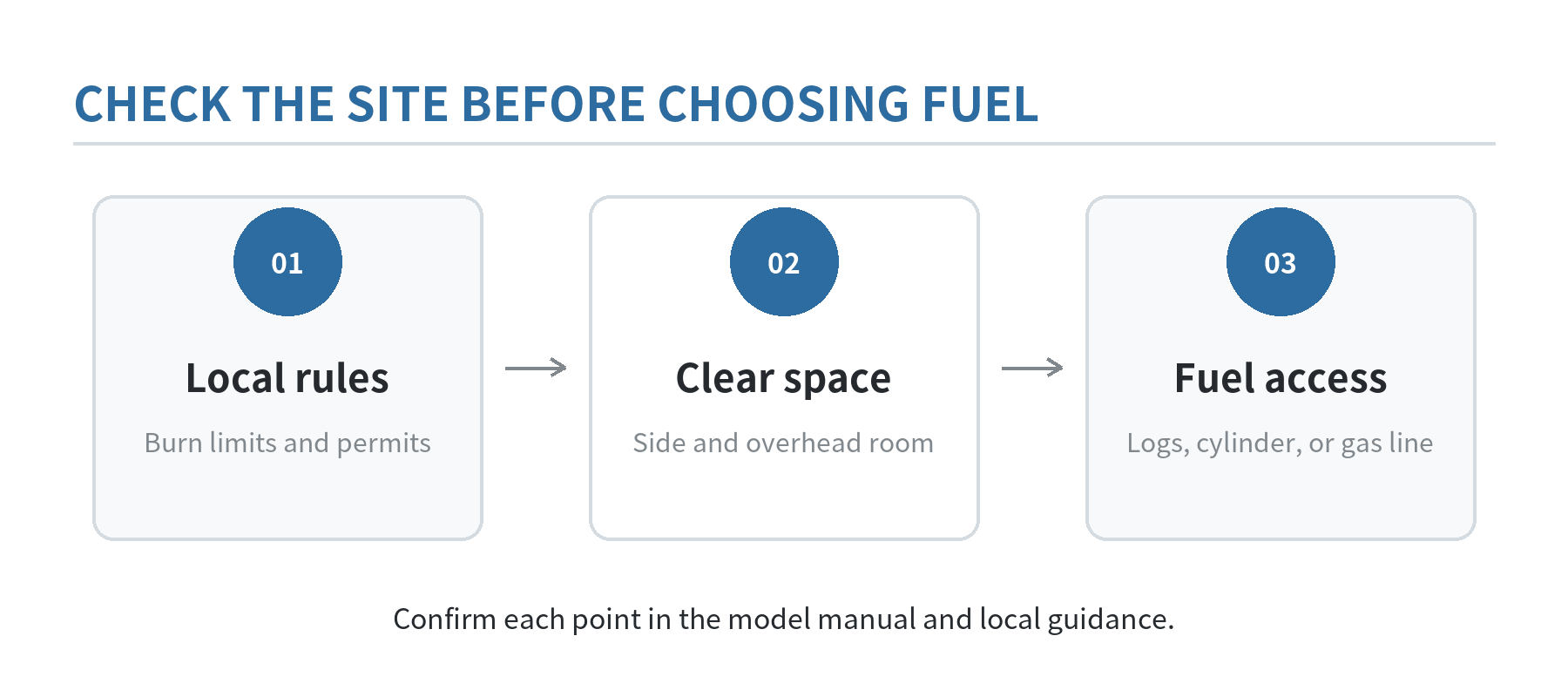
Measure the usable area, including chairs, walkways, roof edges, fences, and branches. Fire needs clear space above it as well as beside it. NFPA’s consumer guidance says to use chimineas and similar personal fireplaces outdoors and at least 10 feet from a home or anything that can burn; USFA’s fire-pit pictograph says to keep fire pits, wood piles, and propane tanks 10 to 30 feet from the home (checked October 14, 2026). Those are safety references, not a substitute for the clearance printed for a specific product or a local code.
Sketch where the pit and seating would go before settling on a diameter. Include the path a person will use to tend the fire, the route for carrying fuel, and a spot where a tank can remain upright and accessible. If the only open space is under a patio roof, beside a wooden railing, or on a balcony with a building restriction, pause and verify the rules before comparing models.
Compare the appliance’s full footprint, not only the fire bowl. Note the legs or base, the cylinder compartment if there is one, the hose exit, and the space needed to open an access panel. EPA’s backyard-fire guidance asks people to consider neighbors and wind direction (checked October 14, 2026). If smoke would drift toward a nearby seating area or open window, put that concern into the fuel decision.
Wood suits a fire you tend by hand
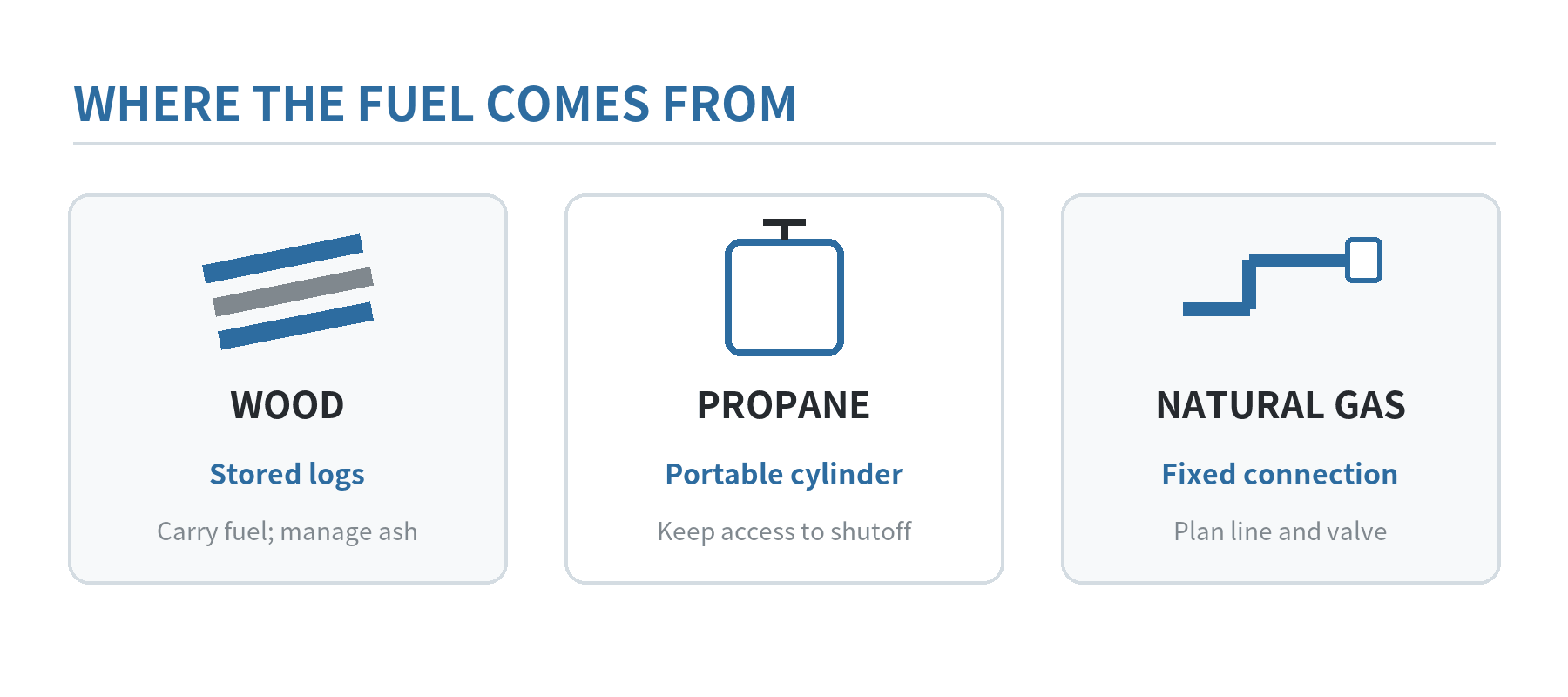
A wood-burning pit gives you a flame built from logs, but you also handle firewood, smoke, sparks, and cooled ash. Leave dry storage space outside the pit’s clearance area and decide where ash will cool before use. A screen can limit flying embers, but it does not replace clearance or supervision.
EPA’s Burn Wise backyard-fire guidance recommends seasoned, dry wood and says a moisture meter reading of about 20 percent is best; it also advises against burning green wood, construction waste, plastic, garbage, or yard waste (checked October 14, 2026). Its separate wood-moisture handout explains that wet wood produces more smoke and less heat. If you do not want to store or carry wood, clean ash, or manage smoke direction, a gas model may fit your routine better.
Before choosing a wood model, check its bowl depth and opening against the log lengths you can store and handle. Look for a stable base, a fitted spark screen if supplied, and a cover that matches the bowl. For a deeper look at the surrounding area, see our article on planning a fire-pit area; it covers the site layout, while this guide focuses on the fuel and appliance decision.
Propane keeps the fuel supply with the pit
A portable propane unit connects to a cylinder, so it does not need a permanent gas line. That can make it a candidate for a patio where a fixed connection is unavailable, provided the model is approved for that location and your local rules allow it. The cylinder still takes up space, needs a stable upright position, and must remain accessible for shutoff and replacement.
Check the appliance’s fuel label, cylinder size requirement, hose routing, and instructions for storing or disconnecting the cylinder. The Propane Education & Research Council’s portable-cylinder safety guide says to follow the cylinder’s handling and storage directions and to use a cylinder with an overfill prevention device. Do not assume that a propane appliance can run on natural gas by swapping a hose.
Think through the whole setup: where the cylinder sits, whether the door or cover closes around it as designed, and how the hose stays clear of walking feet and hot surfaces. PERC distinguishes portable units connected to a small tank from built-in units connected to a propane supply line. A compact footprint on a product page does not include the space needed around the fuel source.
Natural gas trades a tank for a fixed connection
A natural-gas fire pit uses a gas line, which avoids keeping a portable cylinder beside the appliance. It makes sense to compare this type when a suitable line already serves the outdoor area or when a planned installation can accommodate one. The line route, shutoff, pressure, and installation requirements become part of the project.
Fuel type must match the appliance setup. A manufacturer help page for its fire-pit tables describes models configured for propane and natural gas with model-specific conversion instructions; a separate fire-feature installation manual says to confirm gas compatibility and have gas connections installed by a qualified installer (both checked October 14, 2026). These instructions differ by product, so treat a conversion as an option only when the exact manufacturer manual lists an approved kit and procedure. A gas line is not a reason to improvise a conversion.
If the yard has no suitable connection, ask a qualified installer what line work and shutoff placement the proposed appliance requires before comparing the equipment. If the connection would cross a walkway or require substantial site changes, a cylinder-fed model or a wood pit may be simpler to evaluate. A contractor can confirm whether the planned location and local requirements allow the installation.
Compare the work that comes with each fuel
| Fuel | What the site needs | What you handle after use | Check before selecting |
|---|---|---|---|
| Wood | Open-air placement, log storage, and room for tending | Logs, smoke, sparks, and cooled ash | Allowed burn days, screen, bowl size, and log fit |
| Propane | Outdoor placement plus room for the specified cylinder | Cylinder access, shutoff, and replacement or refill plan | Fuel label, approved cylinder, hose path, and storage directions |
| Natural gas | Outdoor placement plus a compatible gas connection | Valve access and upkeep listed in the manual | Fuel compatibility, line requirements, installer, and shutoff |
This table compares operating needs rather than product performance. For any gas unit, record the listed fuel, input rating, required clearances, ignition type, and whether a conversion kit is approved. For wood, record the opening dimensions and the instructions for extinguishing, cleaning, and storing the unit. Compare like with like only after those details fit your yard.
A useful comparison sheet has one row per model and columns for overall dimensions, clearance, permitted surface, fuel source, ignition, shutoff access, and cleaning instructions. Use the product manual where the listing leaves a blank; a missing clearance in a short description is not evidence that no clearance applies. Keep the manual with the appliance so the instructions remain available when you set it up or store it.
Our broader yard-project planning article covers how to map an outdoor project before choosing materials. Use that planning step here to mark the fire pit, seating, fuel storage, and walking routes on one sketch.
Make the final check before settling on a model
Read the complete manual, not only the listing summary. Confirm that the pit is intended for outdoor use, that the chosen surface and overhead clearance meet the manual, and that your local fire department or air-quality agency has no current restriction. EPA says local requirements for backyard burning vary by area and directs readers to state and local government for a determination; NFPA’s guidance also says to comply with official burn bans (checked October 14, 2026).
Write down three answers: which fuel your site can support, which maintenance tasks you accept, and which listed clearances your yard can meet. If any answer is uncertain, keep comparing the installation requirements before selecting a style. Last updated: October 2026.
FAQ
Can I convert a propane fire pit to natural gas later?
Only if the exact manufacturer provides an approved conversion kit and instructions for that model. A fire-feature installation manual warns users to verify gas compatibility and use a qualified installer, so check the manual before treating conversion as a future option.
Can I use a gas fire pit on a covered patio?
Check the model’s manual and the rules for your location before planning that placement. Fire-feature instructions can prohibit operation under an overhang, and clearances vary by model; an outdoor label alone does not answer the covered-patio question.
What should I check if wood smoke bothers nearby homes?
Check the wind direction, local air-quality alerts, and burn restrictions before using a wood-burning pit. EPA advises against backyard fires on air-quality alert days and says local requirements vary, so a gas-fueled option may be worth comparing where allowed.
Does a natural-gas fire pit need less planning than propane?
It removes the portable cylinder from the setup but adds a fixed gas connection to plan. The line, shutoff, fuel compatibility, installation, and local requirements still need to fit the appliance and site.
Last updated: 2026-10