Choose a portable air purifier by matching its smoke CADR to the floor area it will serve, then check ceiling height, layout, and the speed you can live with. CADR is a particle-cleaning rate, not a promise that one unit covers an entire open floor or handles every kind of pollutant. Measure the actual space first; the number printed on a box only helps when its room-size assumptions match your room.
Measure the room the purifier will actually serve
For a rectangular room, multiply the inside length by the inside width. A 12-by-15-foot bedroom is 180 square feet. Use the room where the purifier will run, rather than the full home’s square footage: portable units are designed for a room or defined area, as the EPA explains in its home air-cleaner guide, checked October 12, 2026.
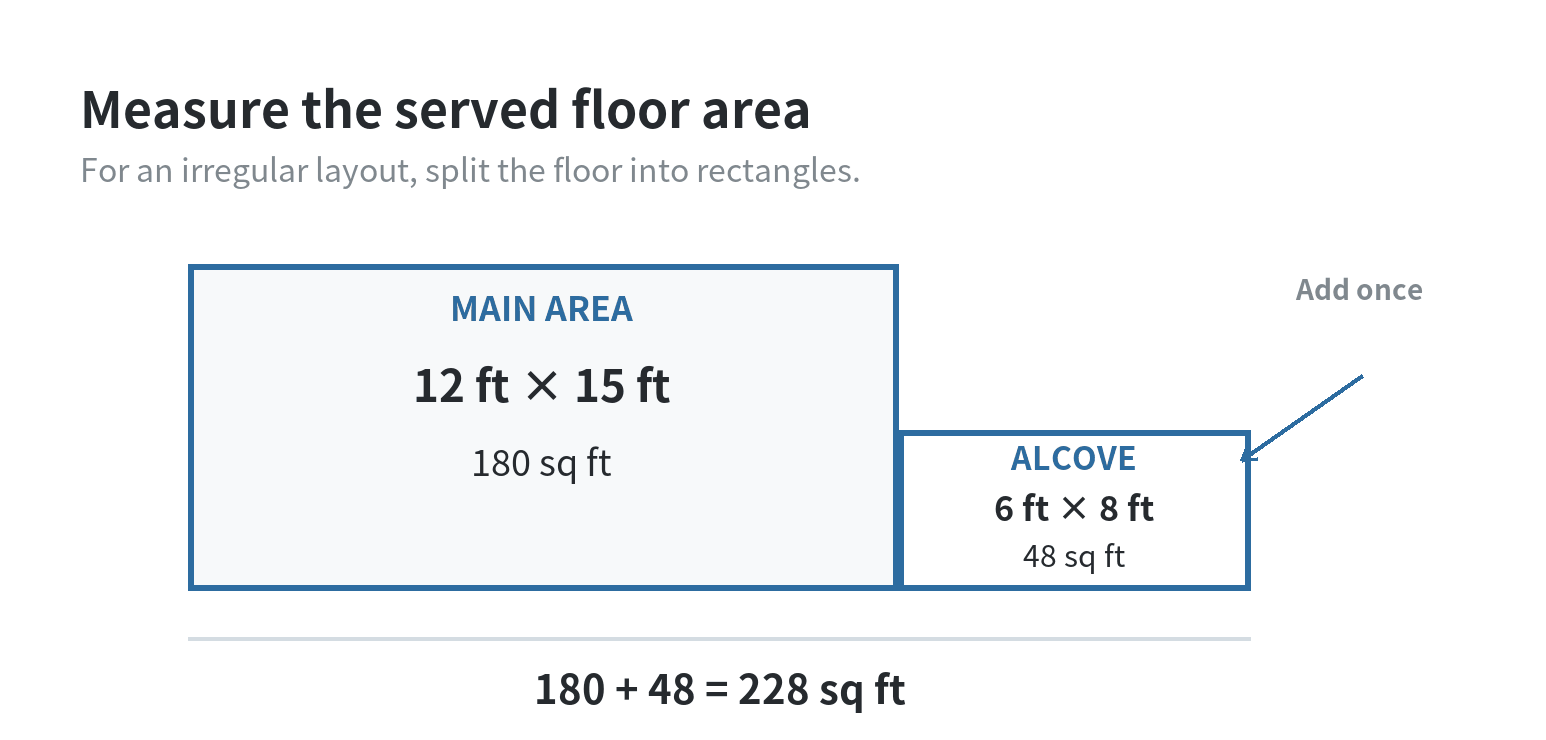
For an L-shaped room, split the floor into rectangles, calculate each piece, and add the results. For example, a 12-by-15-foot main area plus a 6-by-8-foot alcove totals 228 square feet. Do not count the same floor twice where the shapes meet. The first diagram shows the measurement method.
Decide where the boundary is before choosing a CADR. A purifier in a bedroom with the door shut serves a different area from one in a living room connected to a dining nook and hallway. If air can move through an open doorway, those connected spaces may be part of the area you expect the machine to handle. EPA guidance says to count the entire space served in an open floor plan.
Write down the ceiling height as well. Common room-size guidance assumes an 8-foot ceiling. If yours is higher, the same floor area contains more air; EPA and AHAM both advise considering a unit rated for a larger area. Use the maker’s stated coverage for the listed ceiling condition rather than treating square footage as a ceiling-independent figure.
Read CADR as three particle ratings
CADR means clean air delivery rate. EPA describes it as a way to compare how quickly a portable cleaner filters particles; packaging may list separate scores for smoke, dust, and pollen. These are not three room-size ratings. They tell you how the device performed for different particle examples, so compare the category relevant to your shopping question.
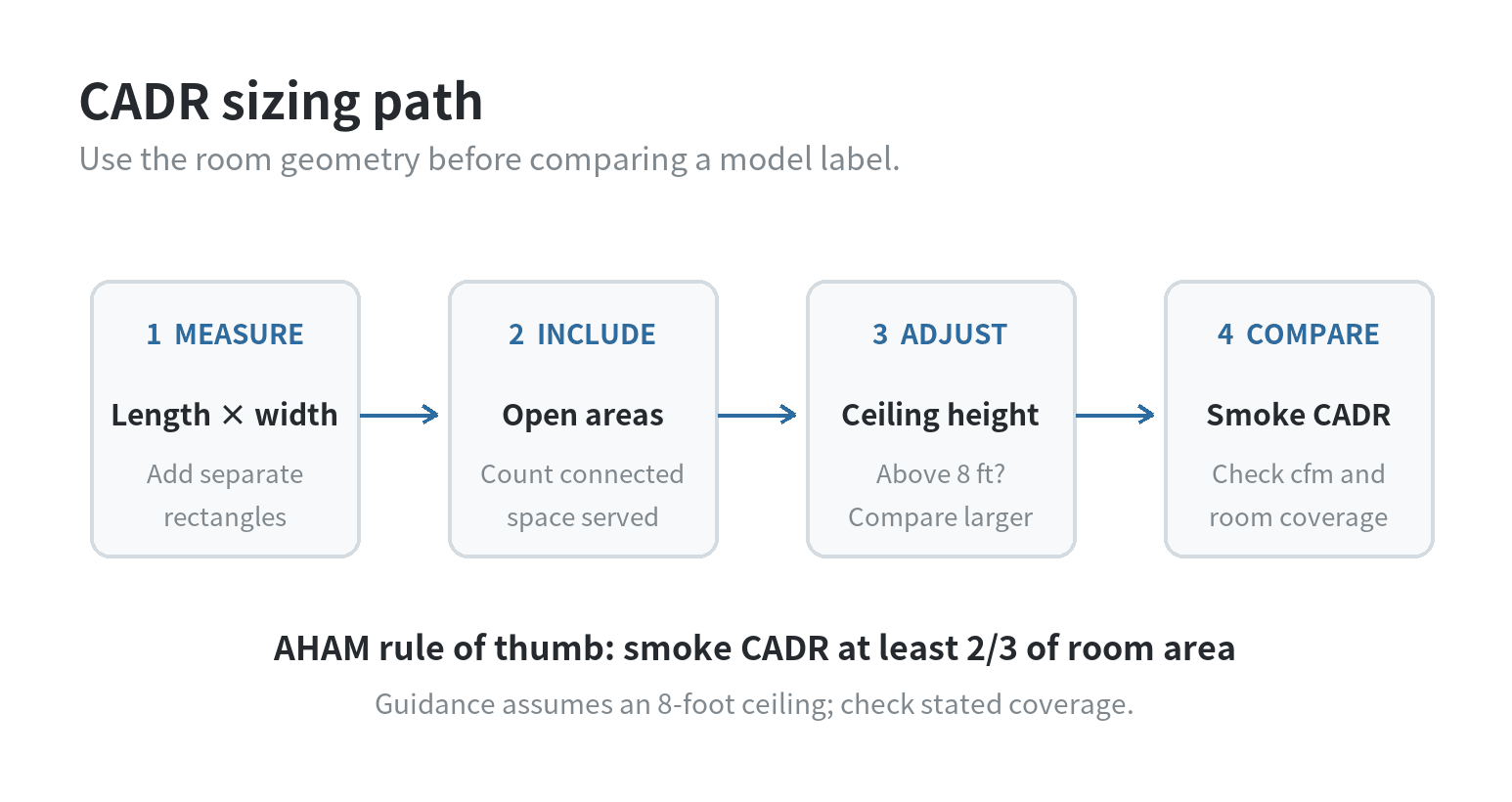
Start with smoke CADR when applying AHAM’s two-thirds sizing rule. AHAM’s guidance, checked October 12, 2026, says the smoke CADR should be at least two-thirds of the room’s square footage for its general rule of thumb. For a 180-square-foot room, that works out to 120 cfm. EPA’s sizing chart uses 65 cfm for 100 square feet and scales in the same range; both sources base their guidance on an 8-foot ceiling. Treat this as a comparison threshold, then check the specific unit’s listed room size and test information.
The arithmetic makes the label easier to interpret:
- Measure 180 square feet.
- Multiply by two-thirds: 180 × 2 ÷ 3 = 120.
- Compare the result with the unit’s smoke CADR in cfm and its stated room coverage.
Do not compare one unit’s smoke number with another unit’s pollen number as if they were the same test. EPA says the three CADR particle types represent different particle sizes, and the rating is generally measured at the highest fan speed. A number tied to top speed may not describe the setting you expect to use during reading, sleep, or conversation.
Adjust the comparison for ceilings and connected rooms
Use the measured floor area as a starting point, not the final answer. If the ceiling is above 8 feet, move up to a room-size rating intended for a larger space or compare a higher CADR. The AHAM Verifide label and EPA guidance both flag ceiling height as a factor; neither says that a room’s floor dimensions alone describe its full air volume.
Open layouts need the same care. Add the connected areas that share air with the placement area, then compare against that larger total. A purifier tucked at one end of a long connected layout may not circulate air evenly through every corner, so also consider where the air intake and outlet sit and whether a wall, curtain, or furniture blocks them. EPA advises keeping airflow unobstructed.
For a multi-room home, decide whether you need coverage in one room at a time or in several separate rooms. A portable room unit is not the same as a central HVAC filter. EPA describes portable cleaners as serving a single room or area and central filters as serving air moving through the home’s system. If more than one closed room matters, compare the capacity and placement of separate room units rather than assuming a single room-size label applies throughout the house.
Check what the rating does not answer
CADR applies to particles, not gases. EPA says its CADR system rates particle removal; if gas or odor filtration matters for your household question, look for an activated-carbon or other gas-targeted filter and read the product label. EPA also notes that there is no widely used performance rating system for portable gas-filter performance. Avoid treating a large CADR as proof of gas-removal capacity.
Look at the replacement-filter details before settling on a model. EPA says filters need replacement and directs readers to the product’s packaging or label for what it targets. Find the replacement part number, filter type, and manufacturer’s stated service instructions, then check whether replacements are available through an e-commerce platform. Do not assume that two filters with the same general label fit the same housing.
Also compare operating conditions, not only the highest-speed rating. EPA says higher fan speeds and longer run times increase the amount of air filtered. If a product lists sound ratings by speed, compare the setting you can reasonably leave on with the CADR information provided for that setting. If it only shows a top-speed CADR, keep that limitation in mind as you compare the room coverage claims.
For an installed HVAC filter, use the system’s own size and compatibility instructions; a portable purifier and furnace filter answer different needs. Our furnace-filter sizing guide explains how dimensions and system limits factor into that separate choice. The home maintenance checklist covers where HVAC filters fit into routine equipment notes.
Use a short checklist before comparing listings
- Measure the floor area the purifier is expected to serve; split and add irregular shapes.
- Include connected open areas and record ceiling height.
- Compare smoke CADR with the area-based guide and the unit’s own stated coverage.
- Check the dust and pollen CADR separately if those are the particle categories you want to compare.
- Read filter type, replacement details, sound information, and placement instructions.
- Confirm whether the label reports performance at the fan setting you are likely to use.
That sequence helps you narrow options without mistaking a large “up to” area for a guarantee about every floor plan. If the listed room size omits ceiling assumptions or the product does not show the CADR category you need, use the manufacturer’s documentation to resolve the gap before comparing it with another model.
FAQ
Does a larger CADR mean the purifier is always a better fit?
No. A higher CADR indicates a faster particle-cleaning rate, but room area, ceiling height, airflow placement, and the fan setting still matter. Compare the rating to the space and the listed operating conditions.
Should I use the smoke CADR or the pollen CADR for a bedroom?
Use smoke CADR for AHAM’s general two-thirds room-sizing rule, then compare the pollen score separately if pollen is the particle category you are evaluating. The CADR scores represent different particle examples.
Can one portable purifier cover two rooms with a closed door between them?
Do not assume so. EPA describes portable cleaners as designed for a single room or area; compare the unit’s stated coverage with each space and consider a separate placement for a room behind a closed door.
Can CADR tell me whether a purifier removes cooking odors?
No. CADR rates particles, while EPA says gas filtration calls for a filter designed for gases, such as activated carbon. Check the product’s gas-filter description separately.
What should I do if the label lists a room size but no ceiling height?
Check the manufacturer’s product documentation for the room-size assumptions and CADR test details. EPA and AHAM sizing guidance assumes an 8-foot ceiling, so higher rooms need a larger-area comparison.
Last updated: 2026-10