Artificial turf is easier to plan when you treat the roll, the base, and the drainage route as one project. Before choosing a listing, decide where the turf will go, measure the area, and confirm that the exact product’s installation guide matches your ground and intended use. A roll that fits the color and footprint can still need a different base, seam method, or infill than you expected.
Use this guide to compare artificial turf sold through a major home-improvement retailer without assuming every item is a landscape lawn system. Product pages can include rugs, mats, putting surfaces, and cut-to-length turf. The label and manufacturer instructions tell you which one you are looking at and what the installation actually requires.
Start with the surface you want to cover
Write down whether the project is a yard, a small patio, a pet area, or a practice surface. Those uses place different demands on the backing, drainage path, edge restraint, and infill. For example, a loose mat on a balcony is a different installation from a landscape area excavated and rebuilt with compacted aggregate.
Separate the product from the project. A listing may say “outdoor” or show a yard scene, but that wording does not establish that the item is designed for a full lawn installation. Listings checked October 12, 2026 include both small turf rugs and wide rolls, while manufacturer product pages distinguish lawn, pet, and putting applications. Check the actual product description and installation document for the item you are considering (example turf rug listing; manufacturer product and installation resources).
Also look at the surface beneath the turf. A bare soil yard, a concrete patio, a balcony, and a roof deck do not share the same drainage or fastening details. Shawgrass separates site preparation for lawn installations from glue-down guidance for hardscape and rooftop settings; its instructions are application-specific (Shawgrass installation guidance). If the instructions do not describe your surface, pause before treating a loose-lay or lawn method as interchangeable.
Read the listing as a set of fit checks
Compare the specifications that affect coverage and installation, not just the product photo. The listing should tell you the piece or roll dimensions, pile height, backing details, intended use, and whether the manufacturer provides an installation guide. A putting surface, for instance, may be described for golf practice rather than general lawn coverage; verify the intended use before comparing it with landscape turf (putting-turf listing).
| Check | What to confirm | Why it affects the plan |
|---|---|---|
| Format | Mat, fixed-size rug, or cut-to-length roll | Determines whether seams or trimming enter the layout |
| Intended use | Landscape, pet area, putting, or another stated use | Connects the product to the task it was designed for |
| Backing and drainage | Perforations, drainage notes, and required surface | Water still needs a path through or away from the installation |
| Installation guide | Base, edge fastening, seams, and infill directions | Materials and steps can differ across turf systems |
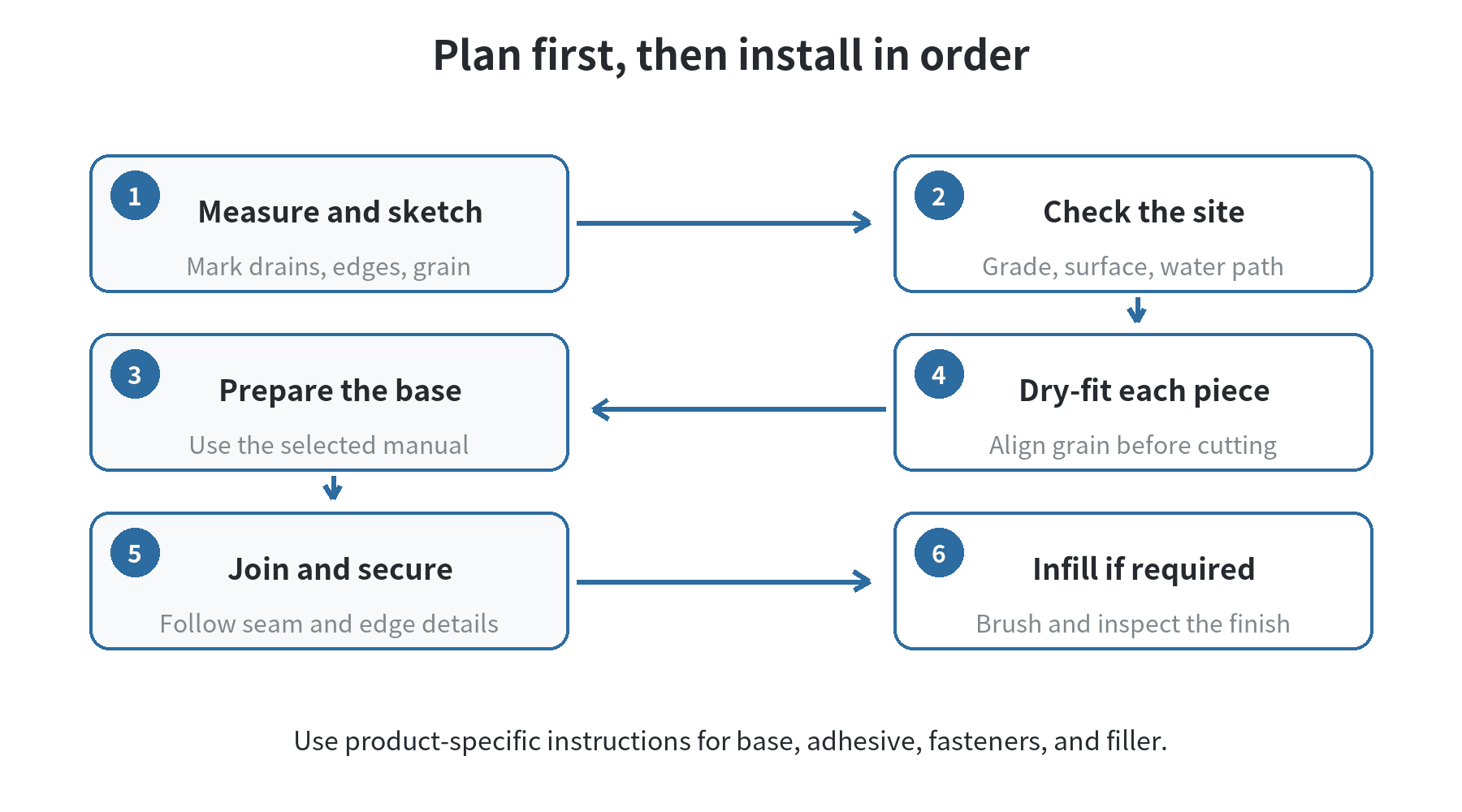
Use the product dimensions to sketch the area and mark seams before you calculate how much material to use. A simple rectangle can be mapped as length multiplied by width; an L-shaped yard is easier to split into rectangles and add together. For a sample 12-by-18-foot rectangle, the surface area is 216 square feet. That is a planning example, not an order quantity: the roll width, grain direction, cuts, and seam layout affect how much material you need (manufacturer measurement guidance).
Draw the turf grain as arrows on the sketch. Product makers describe a blade direction because the pile lies in a direction; pieces that meet at a seam need their grain aligned. ProSyn-Turf’s manual directs installers to match the grain across pieces and plan cuts to reduce waste (ProSyn-Turf installation manual). Measure from fixed edges, mark obstacles, and note gates, drains, tree trunks, and sprinkler heads before finalizing the layout.
Plan the ground before unrolling turf
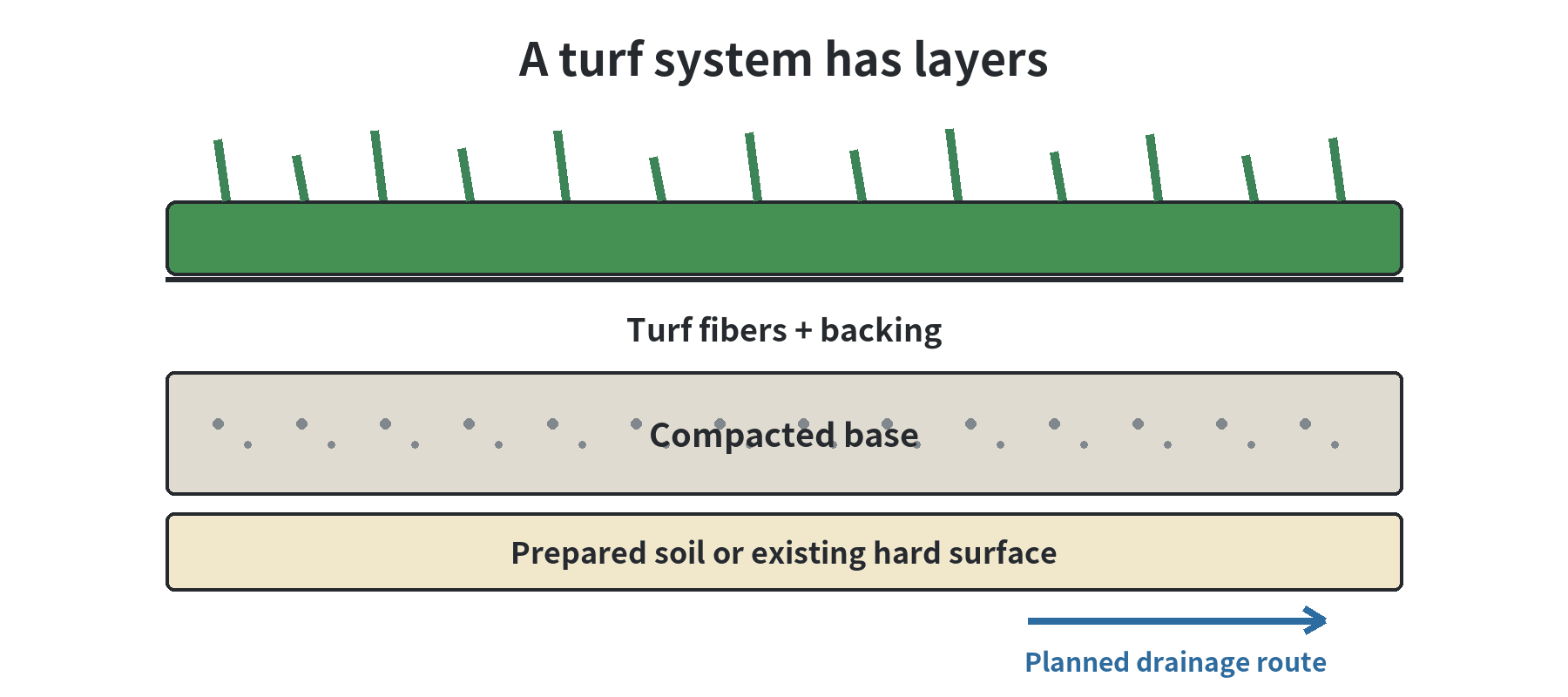
For a ground-level landscape, installation manuals describe clearing existing vegetation, shaping a base, compacting it, and setting a grade so water can move toward a drainage area. Exact excavation depth, aggregate blend, barrier placement, and compaction method vary by system and site. Evergrass specifies a crushed-gravel base and a slope toward drainage; ProSyn-Turf gives its own sequence and material recommendations. Follow the instructions for the selected turf rather than combining numbers from different guides (Evergrass installation guide; ProSyn-Turf installation manual).
Check how rainwater currently crosses the site. Walk the proposed area after rainfall and note low spots, runoff from a roof or path, and the direction water leaves the yard. Turf backing with drainage openings cannot correct a base that holds water or a site with nowhere for runoff to go. The Synthetic Turf Council’s base-system guidance explains that the base is part of the system design, while ASTM’s test method measures permeability in synthetic turf playing-field systems; neither establishes a single base recipe for every residential yard (Synthetic Turf Council base-system guidance; ASTM F2898 scope).
For hard surfaces, read the specific glue-down or loose-lay instructions and inspect existing drains before covering the area. Do not block a drain or cover a cleanout simply because the turf can be cut around it. If the surface is a roof, balcony, or shared building area, check building rules and the surface maker’s limits before adding materials or adhesive.
Ground prep can call for excavation, hauling, a plate compactor, cutting tools, and help moving a heavy roll. A basic deck layout checklist covers measuring a separate outdoor project, and the retaining-wall guide explains how grade and drainage affect yard work. If your turf area depends on changing a slope, drainage route, irrigation line, or roof surface, get the relevant site requirements clear before materials arrive.
Dry-fit, align, seam, and secure
When the base or hard surface is ready, unroll and position the turf before cutting. Let it relax according to its manual, keep the grain pointing the same way across each piece, and check how edges meet borders and drains. Cut from the backing side when the guide calls for it, since the stitch rows are easier to see there. Keep blades and hands clear of the cutting path.
Where pieces meet, test the seam before applying adhesive or fasteners. The manufacturer’s method may call for seam tape and adhesive, staples, nails, or another system. ProSyn-Turf describes joining two panels over seam material and waiting for glue to dry before infill; Evergrass also specifies tape and turf adhesive. Those are product-specific instructions, so do not swap adhesives or fasteners based on another turf guide (ProSyn-Turf seam instructions; Evergrass seam instructions).
Fasten perimeter edges using the method and spacing in the selected guide. Keep fasteners below the exposed fibers and avoid creating a dip or raised edge. At a wall, paver border, or edging board, leave the transition the way the manufacturer describes; a neat-looking edge does not replace secure fastening.
Use infill only when the product calls for it
Infill is not a universal material or step. Turf makers specify whether a product needs infill, which type to use, how to apply it, and what equipment suits the pile. One installation guide warns against ordinary sand and gives a product-specific material list; another names a particular filler and tells installers to brush it into the fibers. Follow the exact product guide and label, including whether the seam adhesive must dry first (ProSyn-Turf infill directions; Evergrass infill directions).
Before spreading anything, confirm compatibility with the backing, intended use, and drainage design. Do not estimate a fill amount from a different turf’s pile height or from a generic project calculator. Work in the increments and with the spreader or broom named by the maker, then inspect for bare areas, clumps, exposed seams, and blocked drainage openings.
Resolve these questions before choosing a roll
Ask the manufacturer or installer for the product’s current installation sheet if the listing does not answer a planning question. Confirm whether the item is intended for a whole-yard installation, what base it requires, how the backing drains, whether seams need adhesive, and whether infill is required. Save the answer with the product details so a later change in model does not quietly change the installation plan.
Pause if the manual does not cover your surface, if water already ponds at the site, or if the work touches utilities, irrigation, a roof assembly, or a shared property. Those are project conditions to resolve before cutting turf. A professional installer can review the site and explain which parts of the job are included, such as excavation, base work, seams, infill, and cleanup; the artificial-grass installation service description, checked October 12, 2026, lists those as distinct work phases (installation service scope).
Last updated: 2026-10
FAQ
Can I put artificial turf directly over concrete?
Only if the selected product’s instructions allow that surface and explain how to handle drainage and attachment. Shawgrass publishes separate glue-down guidance for hardscape and rooftop installations, so check the exact surface method before proceeding.
Does every artificial turf need infill?
No. Infill type and use depend on the turf system. Check the product manual for whether infill is required, which material is compatible, and when it may be applied.
How do I estimate turf for an irregular yard?
Split the outline into rectangles, measure each one, and add the areas. Then map the roll width and grain direction onto the sketch to plan seams and trimming before deciding the material quantity.
Should I install artificial turf over a drain?
Keep access to drains and cleanouts, and preserve a path for surface water. Check the drainage layout and product guide before placing turf over or beside any opening.