Choose a furnace filter by matching the slot’s dimensions first, then select a MERV rating that the equipment can handle. The size printed on the old frame is the best starting point; a higher rating does not make a filter the right choice if it will not fit or restrict the system beyond its limits.
The two checks answer different questions. Dimensions tell you whether air will pass through the filter rather than around a gap. MERV describes particle capture under a standardized test. Keep them separate while comparing filters, and use the furnace or air handler manual when you need the system’s maximum supported resistance.
Read the old filter before comparing labels
Turn the system off according to its manual, remove the existing filter, and look along its cardboard or plastic frame. The frame may show a nominal size, an actual size, or both. Write down the width, height, and depth exactly as printed before you look at listings; do not rely on a remembered label or on the size of the grille opening.
Nominal size is a rounded name for a size class. Actual size is the filter’s measured outside dimension. The Air Filter Buying Guide explains this distinction, and the EPA’s home air-cleaner guide separately says to check the fit in the slot: the filter should sit snugly without leaking air around it and without bending or crushing. Both pages were checked October 5, 2026.
For example, if your old frame says “16 × 25 × 1,” treat that as the label to match, not as proof that every filter sold under the same label has identical outside measurements. Compare the product’s listed actual dimensions with the old frame and the available slot. If you cannot find a printed size, measure the old filter’s outside width, height, and depth with a tape measure. Keep width and height in the same order used by the product listing.
Do not force a thicker filter into a one-inch slot. The filter guide notes that available depths vary and that systems are not all built for deeper filters. A filter that bows, catches on the rack, or leaves visible space at the edge is not a clean match. Return to the equipment documentation or ask a qualified HVAC technician to identify the correct size when the rack or frame is damaged, modified, or missing.
Use dimensions as a fit check, not a performance score
Compare three measurements: width, height, and depth. Width and height describe the face of the filter; depth describes how far it extends into the slot. A product page may show a familiar nominal number in a large label and the actual measurements in smaller text. Read both before deciding whether it matches your existing setup.
A small gap around the frame gives air a path around the filter media. An oversized frame can jam or bend, while an undersized one may not seal at the edges. The EPA’s guide says a properly sized filter should fit snugly and should not need to be bent or crushed. The retailer’s sizing guide likewise directs readers to check the size printed on the frame. Those are practical fit checks, not reasons to substitute the grille measurement for the filter measurement.
If the filter is already out, check whether the slot itself has a size label. If that label conflicts with the old filter, photograph both and consult the furnace manual or an HVAC professional before replacing it. This is especially useful if a previous owner changed the rack, or if the filter looks bowed and you cannot tell whether that shape is intentional.
What MERV tells you about a filter
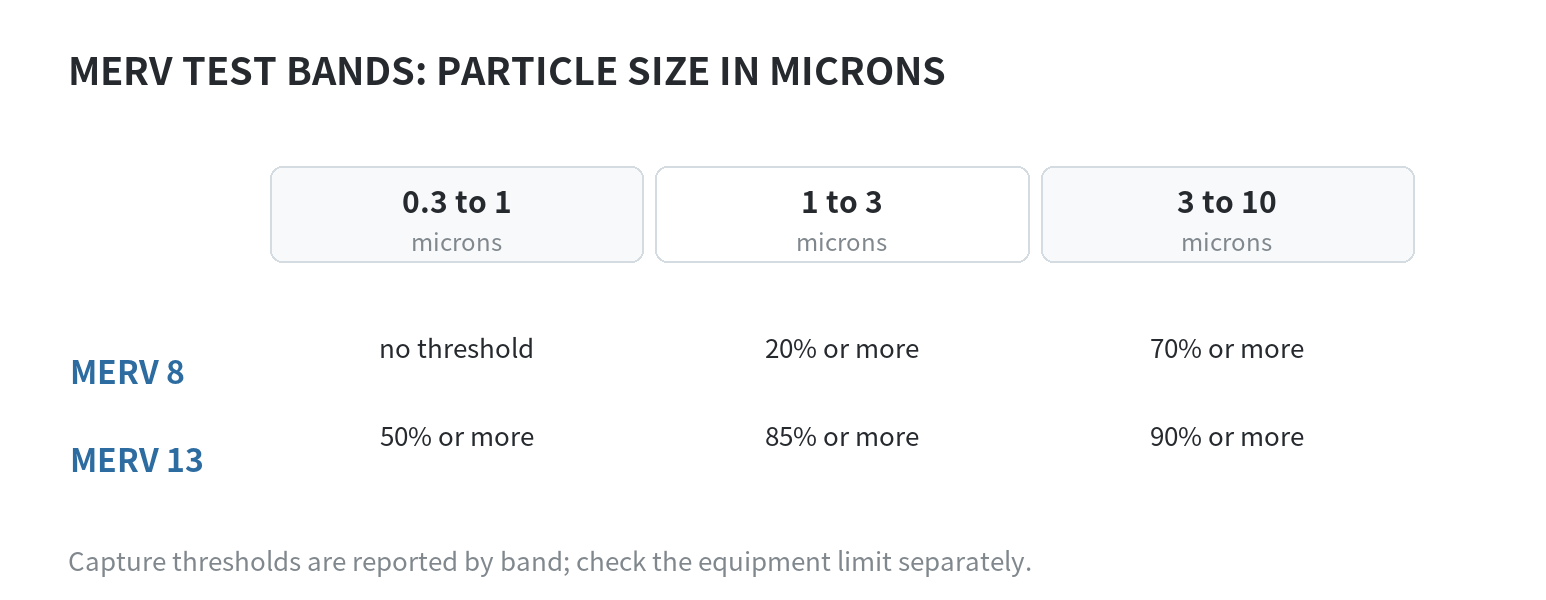
MERV means Minimum Efficiency Reporting Value. EPA says the rating reports a filter’s ability to capture particles from 0.3 to 10 microns, and ASHRAE Standard 52.2 groups its test across three ranges: 0.3–1, 1–3, and 3–10 microns. EPA and ASHRAE pages checked October 5, 2026 describe MERV as a test-based rating, not a direct promise about every home or every operating condition.
EPA’s published rating table shows how the thresholds change. A MERV 8 filter is tested for particles in the 1–3 and 3–10 micron ranges; a MERV 13 filter also has thresholds in the 0.3–1 micron range. These figures refer to average capture efficiency for the specified particle-size bands under the rating method. They do not mean the filter captures every particle of that size in every pass.
Read a MERV label as a comparison within the stated test, not as a stand-alone instruction to choose the highest number. EPA’s guidance says to use a filter with at least MERV 13 or the highest rating the system fan and filter slot can accommodate. ASHRAE also cautions that increasing MERV can increase airflow resistance and says to consult the equipment manufacturer about the system’s supported limit.
Check the system limit before moving up a rating
Find the furnace or air handler model number and read the manual’s filter guidance. Look for a maximum MERV rating or a maximum allowed pressure drop. If the manual names an approved range, stay within it. If it gives no filter rating, use the manufacturer’s support information or ask a qualified HVAC technician to check the system rather than guessing from the filter’s thickness or price.
That extra check matters because a filter’s material and pleat design affect resistance as well as capture. ASHRAE’s residential filtration FAQ explains that a higher MERV filter can increase airflow restriction and recommends checking the equipment maker’s guidance. EPA’s home guide, checked October 5, 2026, also frames MERV 13 as a target only when the system can accommodate it. The two recommendations point to the same decision: system compatibility comes before rating preference.
Do not infer compatibility from a filter that physically slides into the slot. Fit answers whether the dimensions line up; the manual answers whether the fan and equipment can operate with that filter’s resistance. If the manual is unavailable, record the model number and ask the manufacturer or an HVAC technician for the allowable filter specification.
Compare candidates with a short checklist
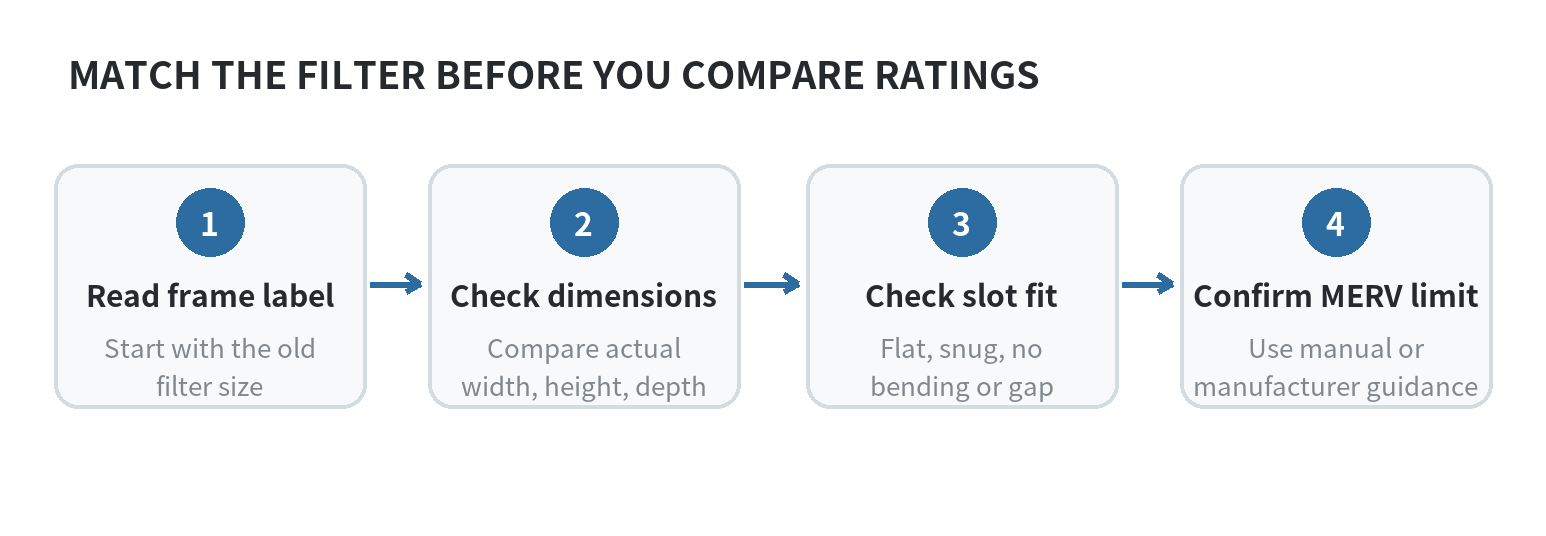
Use this order when reading product listings. It keeps a size mismatch from being hidden by a bold rating label.
- Match the printed size: begin with the nominal label on the old frame.
- Confirm actual dimensions: compare width, height, and depth with the old filter and slot.
- Check the frame fit: it should sit flat and snug, without a gap or force.
- Read the equipment limit: use the manual or manufacturer guidance for allowable MERV or resistance.
- Compare MERV after compatibility: choose within the rating the system can accommodate.
- Follow the manual for replacement: use the interval and installation direction specified for your system and filter.
For a broader look at heating and cooling equipment, see the site’s overview of system service options. If you are also tracing airflow through the house, the article on attic insulation and ventilation covers that separate part of the building envelope.
Keep a photo of the old frame label and the equipment model number with your maintenance notes. When the next replacement is due, those details let you compare sizes and rating limits without depending on memory. If the written label, slot, and equipment manual disagree, pause the comparison until the system’s correct specification is confirmed.
FAQ
Can I use the grille opening to choose a furnace filter size?
No. The filter fits the filter rack or slot, which can differ from the visible grille opening. Read the old frame label and compare its actual dimensions with the slot; EPA’s guide says the filter should fit snugly without gaps, bending, or crushing.
What if the filter has no size printed on its frame?
Measure the old filter’s outside width, height, and depth, then compare those measurements with the system manual and the candidate’s actual dimensions. If the old filter is damaged or distorted, use the equipment model number to confirm the rack specification with the manufacturer or an HVAC technician.
Does a MERV 13 label mean the filter is right for every furnace?
No. EPA recommends MERV 13 or the highest rating the system can accommodate; the furnace manual or manufacturer guidance sets the equipment limit. Check that limit before changing ratings.
Which way should the arrow on a replacement filter point?
Point the arrow in the direction air flows, toward the furnace or blower. Carrier’s furnace filter instructions and Trane’s filter guide give that direction for their systems (checked October 5, 2026); use your own equipment manual if it shows a different arrangement.
Does a thicker filter automatically have a higher MERV rating?
No. Thickness describes the filter’s depth, while MERV describes tested particle capture. Check the frame size and rating separately, and confirm that the slot is designed for that depth.
Last updated: October 2026.
Last updated: 2026-10