For a roof tarp, compare material, finished dimensions, reinforcement, and the maker’s stated weather limits. A “heavy-duty” label does not tell you whether a tarp fits a roof, sheds water in the intended setup, or can be attached safely. If a storm has damaged your roof, use a qualified roofing professional for the roof assessment and covering plan; do not climb up to measure or install a tarp yourself.
What a roof tarp can and cannot do
A tarp is a temporary cover that can limit additional exposure while a damaged roof awaits repair. It does not restore shingles, flashing, roof decking, or structural support. The U.S. Army Corps of Engineers describes its Operation Blue Roof covering as temporary protection for damaged roofs until permanent repairs can be arranged. That distinction matters: a sheet over the opening is not a repair specification or a promise that the home is weather-tight.
Start with the problem the cover is meant to address. A small puncture, a missing section of roof covering, and a broad area with damaged framing are different jobs. The condition beneath the visible opening can also change the plan. A roofer needs to assess the surface and the safe attachment method before anyone selects a tarp by size alone.
A visible opening does not establish whether the framing can support a temporary cover. USACE’s Blue Roof criteria require the roof framing to support its sheeting and provide safe shelter after installation. The roof’s condition therefore belongs in the coverage plan. For a separate overview of roof shingle ratings, see the site’s guide to reading roof-shingle wind ratings; a shingle rating does not determine how a temporary tarp should be installed.
Compare the material by its stated construction
Polyethylene, canvas, and vinyl-coated fabric are not interchangeable labels. The material guides from KT Canada and Western Tarpaulin describe different constructions and use cases, while the manufacturer Puyoung explains that product performance depends on details such as coating, weight, UV treatment, and construction. Treat the table as a starting point for questions, not a ranking.
| Material description | What the product documents may tell you | What to confirm for roof use |
|---|---|---|
| Woven polyethylene | Whether it is coated, UV treated, and reinforced at the edges | Water-resistance claim, outdoor-use limits, finished size, and tie points |
| Canvas | Fiber, treatment, and whether it is described as water-resistant or waterproof | How the specific treatment handles rain and prolonged exposure |
| Vinyl-coated fabric | Base fabric, coating, seams, and stated outdoor application | Weight, handling requirements, edge reinforcement, and approved fasteners |
Do not assume that every canvas tarp repels water, that every polyethylene tarp has the same UV protection, or that “vinyl” alone establishes a weather rating. Western Tarpaulin lists canvas options with different treatments and vinyl-coated fabrics for different applications. KT Canada describes heat-sealed seams and UV-stabilized polyethylene on its own product page. Those are product-specific descriptions, not universal material guarantees.
For a roof cover exposed to sun and rain, ask for the exact product sheet and care instructions. Check whether the maker specifies an outdoor duration, water performance, UV treatment, seam construction, or limits on use in wind. If the document only says “heavy duty,” request the missing details from the manufacturer before comparing it with another tarp.
Separate the claims as well: water resistance addresses rain, while UV treatment addresses sunlight exposure. A specification for one does not establish the other.
Read the specification, not just “heavy duty”
Product descriptions may use fabric weight, thickness, denier, weave count, or a duty class. Puyoung’s tarp guide lists these as possible specification fields and warns that weight alone is a limited comparison across makers. Numbers can describe different things, so compare the same field and unit only when the manufacturer explains what it measures.
Check the whole construction, not one headline number. Look for finished dimensions, reinforced hems, grommets or other stated attachment points, seam type, and any included edge rope. A stronger-looking center panel does not tell you whether the edge can carry the load of the proposed fastening method. Ask how the exact product is designed to be secured and whether the answer matches the roofer’s written plan.
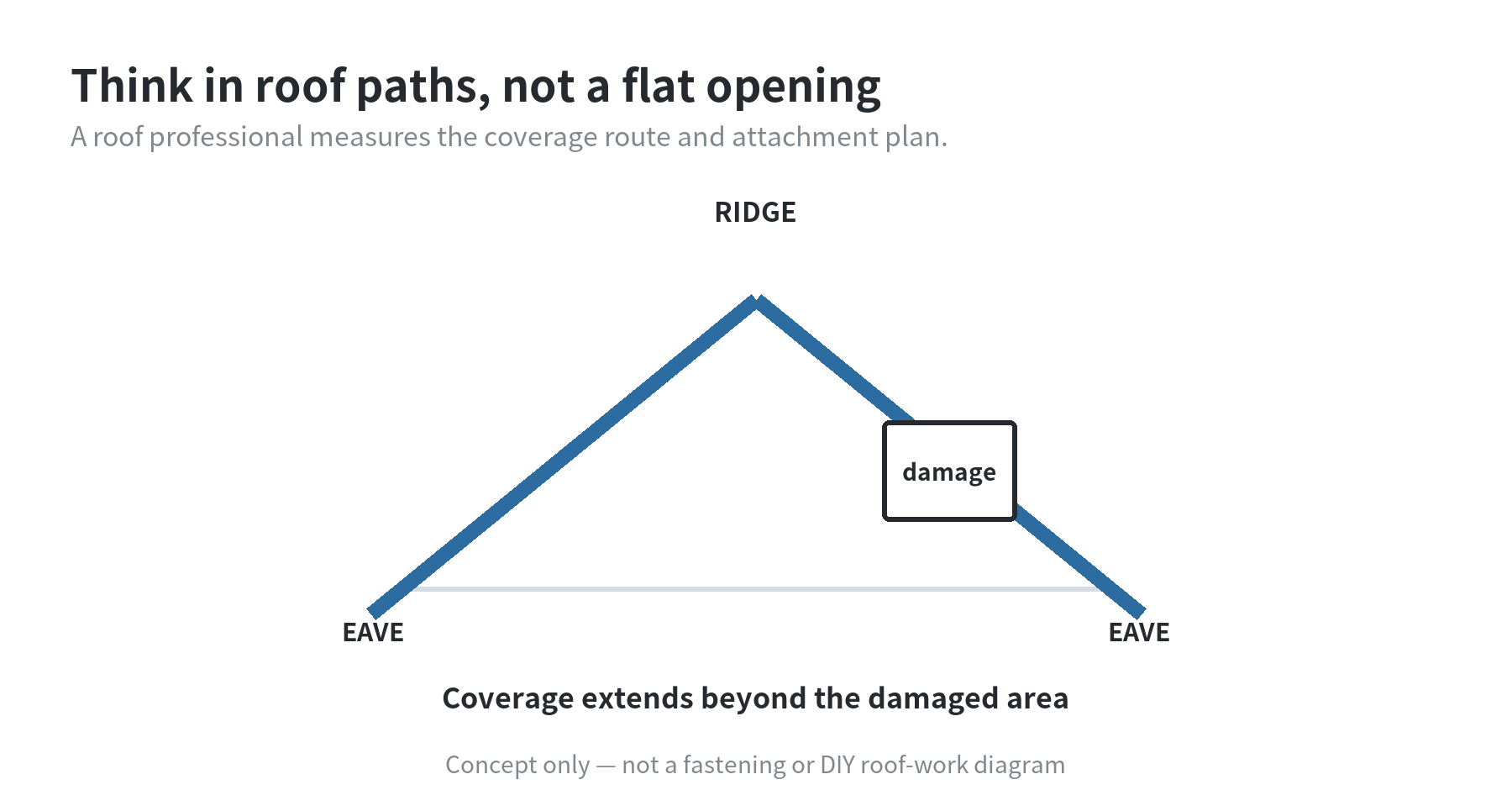
Also confirm how the listed size is measured. A flat tarp dimension is not automatically the same as the surface area needed on a sloped roof. The coverage route can cross a ridge, run down a roof plane, and extend beyond the damaged area. Ask the roofer to specify the required finished dimensions and attachment details in writing, then compare those details with the product sheet.
Use the roof shape to check fit
A tarp sized only to the visible hole can leave the path of rain exposed. The roof professional’s measurements should account for the surface that needs coverage, the roof’s slope and edges, and the attachment points that the structure can support. Do not estimate those distances from a ladder, a window, or the roof itself.
For a simple comparison, write down the dimensions and construction specified by the roofer, then check each candidate document against the same list. Confirm whether dimensions are finished dimensions, where reinforcement sits, and what fastening hardware is part of the product. If a listing omits one of those items, treat it as unanswered rather than guessing from a product photo.
The U.S. Army Corps of Engineers notes that its temporary-cover program cannot use the same approach on every roof material; it lists roof types that its contractors cannot cover and says some other roof types are evaluated case by case. That is a reminder that surface material and attachment method matter. Do not assume a tarp-and-fastener combination suits slate, tile, metal, or an unfamiliar roof assembly.
Roof access is a separate safety decision
A tarp that fits on paper does not make roof work safe. OSHA’s Roof Tarping (Blue Roof) Safety fact sheet tells employers to assess roof stability first and keep workers off a damaged roof until its structural strength has been determined. It also says not to install a tarp during a windy or rainy storm. OSHA’s roof-repair guidance describes fall-protection planning, equipment, and training as parts of roof work.
A safe roof installation requires more than a tarp and fasteners. From the ground, you can document visible damage, keep people clear of the affected area, and gather the product sheet for the contractor. Leave roof inspection, measurements, fasteners, and installation to a qualified professional with a plan for access and fall protection.
If severe weather is ongoing, wait for official guidance before inspecting the property. The National Weather Service advises people to stay informed after severe weather, watch for hazards such as downed power lines, and stay out of damaged buildings. If your roof or ceiling looks unstable, prioritize people’s safety and contact local emergency services or a qualified professional as appropriate.
For broader home-safety planning, the site’s home-maintenance safety checklist covers when a task needs safer access or professional help. A tarp selection is only one part of storm response; it cannot replace a roof inspection or permanent repair.
A short list to take to the roofer
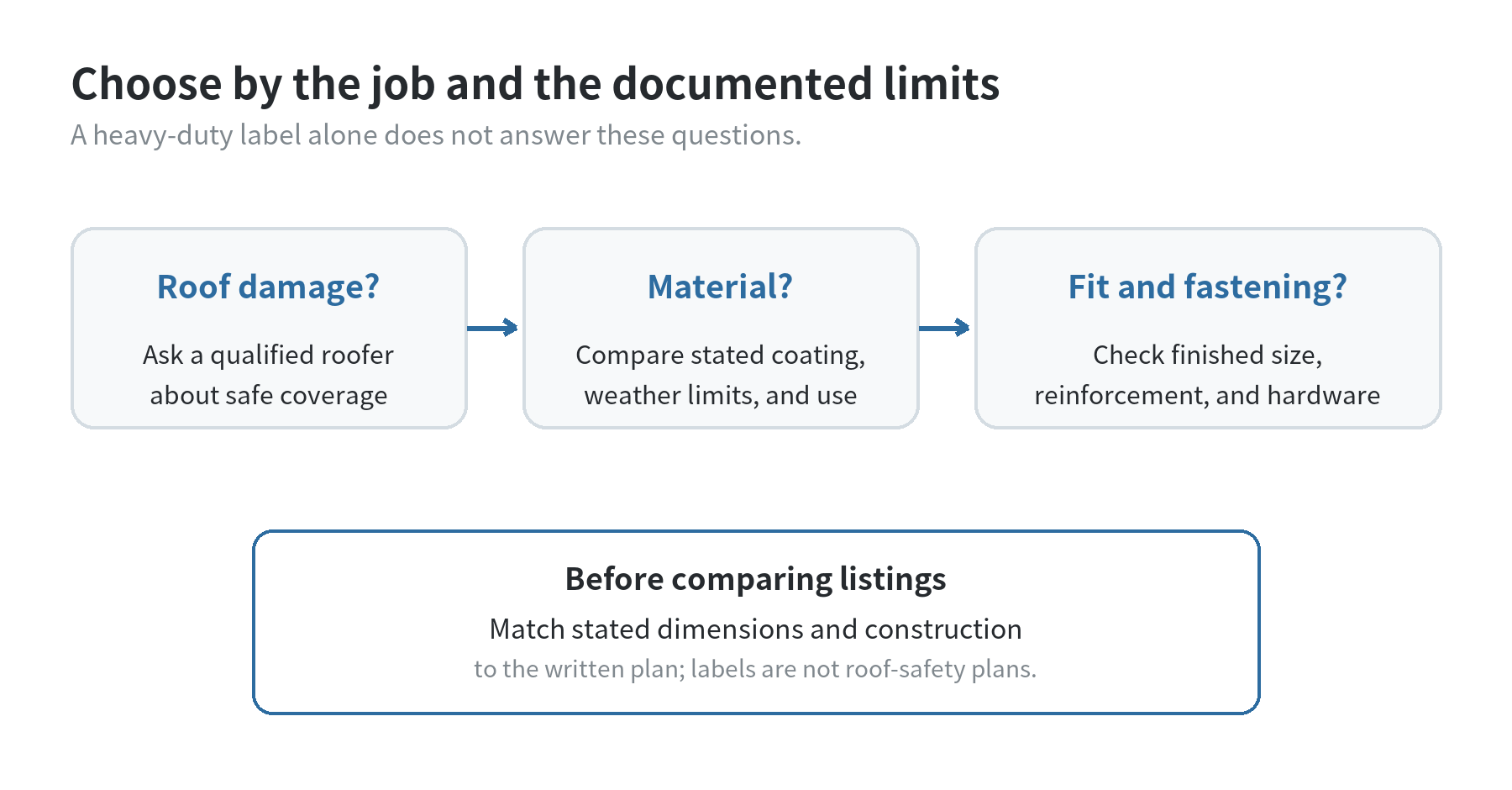
Before comparing individual tarps, ask for clear answers to these points:
- What roof area needs temporary coverage, and what finished dimensions should the tarp have?
- Which material construction and weather limits suit the planned exposure?
- What edge reinforcement and attachment points does the written plan require?
- Does the manufacturer approve the stated use and fastening approach for this product?
- Who will inspect, install, and later remove the temporary cover?
Keep the answers with the exact product sheet, not a general category description. If dimensions, use limits, or fastening details are missing, ask the manufacturer or roofer to resolve that gap before deciding. Compare the documented fit and construction, and leave roof access and installation to the people responsible for the safety plan.
FAQ
Can a tarp stay on a damaged roof until the next season?
Use the exact product’s stated exposure limits and the roofer’s plan to decide how long a temporary cover can remain. A generic “heavy-duty” label does not establish a service duration. The U.S. Army Corps of Engineers describes its blue-roof cover as temporary protection until permanent repair arrangements can be made.
What if two tarp listings use different measurement units?
Do not compare the numbers until the product documents identify the same property and unit. Puyoung’s manufacturer guide lists weight, thickness, denier, and weave count as separate specification fields, so a larger number in one field cannot be read as a direct match for a number in another.
What does denier tell me when comparing tarp listings?
Denier describes the linear density of yarn, not a complete roof-tarp rating. Puyoung’s manufacturer guide defines the term and also lists construction details such as weight, thickness, and weave count; compare the exact product sheet rather than treating one number as a complete measure of durability.