If your brush pile contains thin twigs, a corded electric chipper may fit the job; if it includes thick limbs or sits far from an outlet.
Look at gas models.
Start with the widest branch you need to process, then compare that diameter with the exact machine’s rated capacity.
Power source alone does not tell you what size wood a chipper accepts.
Measure the branch, not just the trunk
Keep those groups apart while working. This makes preparation visible and reduces the chance that an oversized limb reaches the feed area by mistake.
Clear a walking path around the pile so branches can be carried without stepping over loose material.
When trimming a fork, make sections that can be handled and fed in the position described by the machine manual.
Use a tape measure or ruler on the thickest part of the limbs you plan to feed.
Check near knots, bends, and forked joints, since these can be wider than the straight section.
The guide “Best Wood Chipper for DIY Mulch” explains that capacity also reflects the feed opening.
And that a small push-fed machine may need forked branches broken down before feeding.
Write down three things before comparing machines: the largest diameter, whether branches are straight or forked, and how much material you have.
A machine rated for a certain diameter is not a promise that every branch of that width will feed smoothly.
Wood shape, the condition of the cutting parts, and the machine’s feed design matter too.
For example, imagine a cleanup pile with a stack of 1-inch twigs, two limbs near 2.5 inches, and three forked pieces.
A small machine might handle the twigs but leave you to cut down the wider limbs first.
If the wider pieces dominate the pile, compare models rated for that size and check whether their openings accommodate the forks.
This example is a sorting method, not a machine rating: replace the sample measurements with your own pile’s widest branches.
What the diameter rating tells you
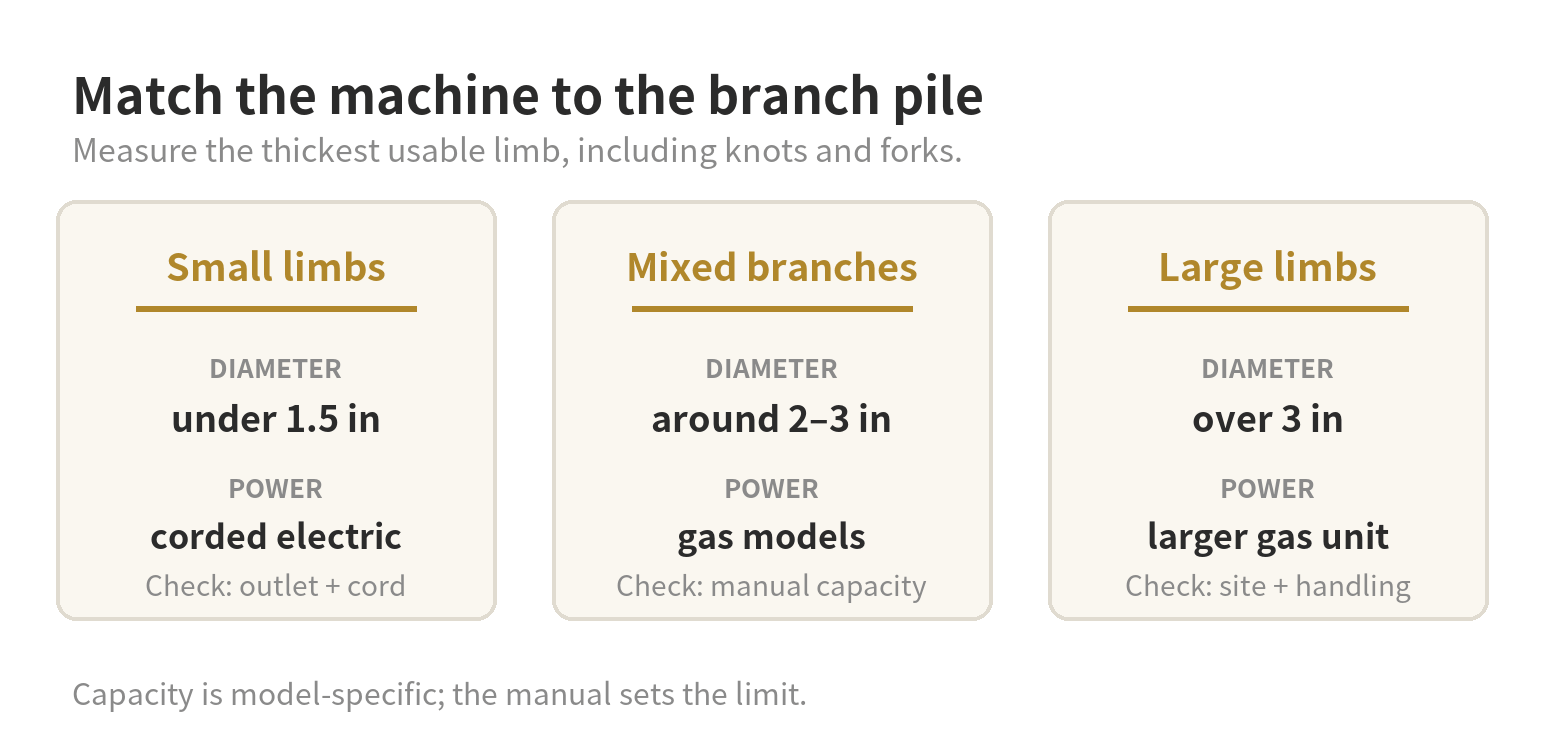
The capacity figure is a limit for a particular machine, not a universal rating for all electric or gas chippers.
The guide “Best Wood Chipper for DIY Mulch” describes light-duty homeowner machines around 1.5 inches, while larger gas-powered chipper-shredders handle broader diameter ranges.
Broader diameter ranges.
Specific manuals show why you must verify the model: the Sun Joe CJ602E manual lists a 1.5-inch recommended diameter.
While the Brush Master CH6/CH8 manual gives limb-chute limits that depend on the model.
Do not measure a branch only at its narrow tip. A limb can fit at one end and jam where a knot or fork reaches the chute.
For a forked piece, check the widest part that must pass through the opening.
If it exceeds the manual’s limit, cut it into smaller pieces with an appropriate tool before feeding it; do not force it into the chipper.
Also separate chipping capacity from shredding capacity.
A chipper chute may accept branches, while a separate hopper handles leaves and soft yard waste.
The Brush Master manual distinguishes its limb chute from its leaf funnel and sets a different size limit for each opening.
Check which opening the stated capacity belongs to.
Electric or gas: decide by the work area
Map the route from the pile to the machine before choosing a corded unit.
Identify the outlet, the full cord path, and places where the cord could cross a walking route or become caught under branches.
Check the manual’s cord gauge and length guidance against that route; a cord that reaches is not automatically suitable.
Read the engine instructions for fuel, starting, shutdown, and storage.
Narrow access or an uneven work area can make setup difficult even when the machine’s branch rating fits.
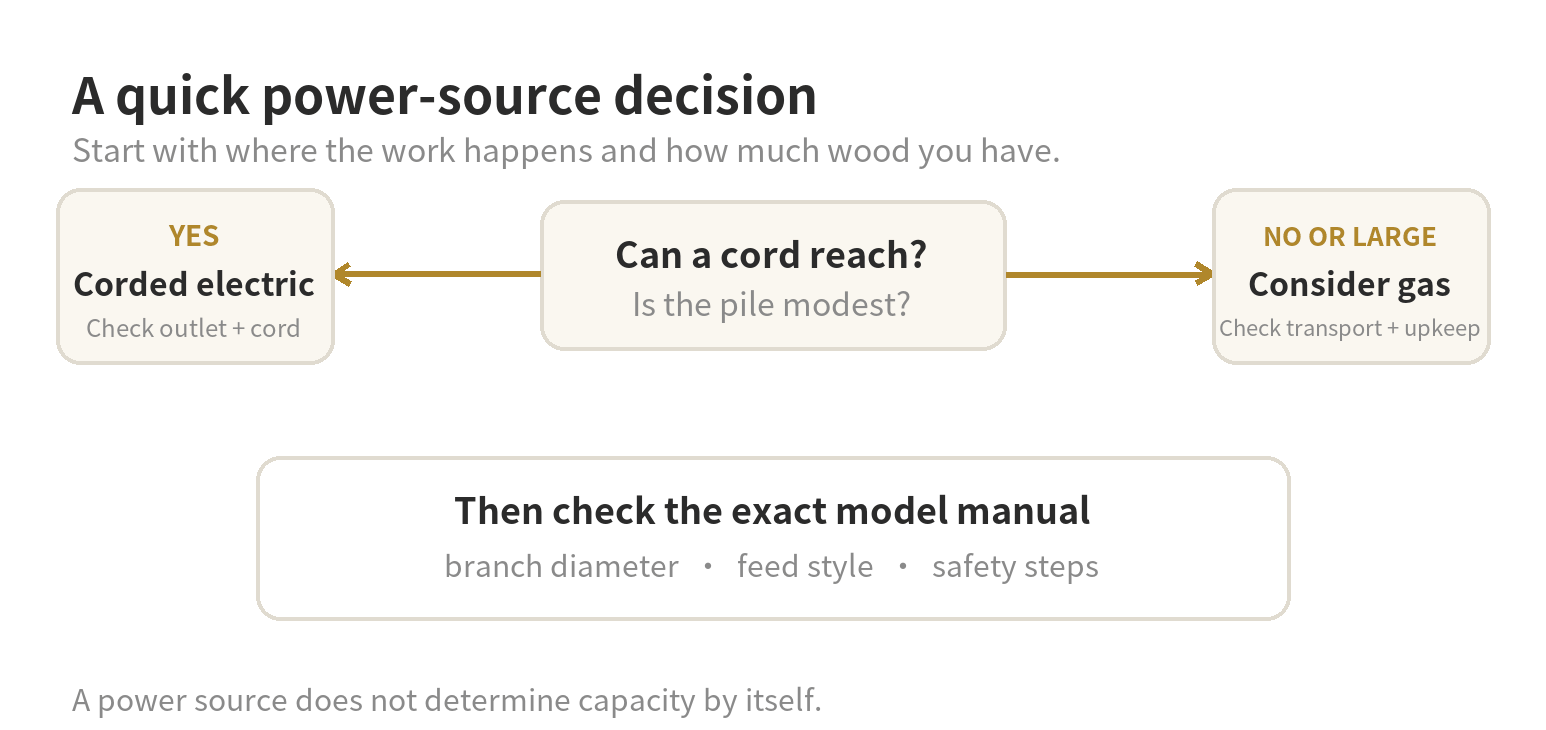
A corded electric model makes sense when the pile is near an outdoor outlet and the work is limited to the branch sizes the model supports.
The guide “Best Wood Chipper for DIY Mulch” describes upright electric chippers as suited to shrubs and small trees.
Its electric chipper manual specifies an outdoor-rated extension cord and calls for checking that the cord is heavy enough for the product.
That means the available outlet and the manual’s cord requirements belong in your decision, alongside diameter.
A gas model can be a better fit when the work area is away from household power or the branches require a larger machine.
But “gas” does not automatically mean high capacity: check the model’s rated diameter, feed opening, and whether it is push-fed or self-feeding.
Gas engines also add fuel handling and engine maintenance to the work.
The Brush Master manual includes fuel and engine procedures; read the complete manual before operating that equipment.
Feed style changes the job
Estimate the work by grouping branches into similar sizes instead of treating the pile as one task.
A few thick limbs may take more cutting and repositioning than many thin twigs.
This helps you decide whether to prepare thick pieces first, process smaller material separately.
Or choose equipment that accepts more of the pile as collected.
Place the collection container where the discharge can reach it without blocking footing or access to the machine.
Keep the next branches beside the work position so the operator can select a piece without reaching across a moving feed opening.
Manual-feed machines rely on the operator to guide material through a chute, with a supplied paddle when specified in the manual.
A self-feeding design uses the machine’s feed mechanism to pull material inward. Neither label changes the listed maximum diameter.
Before choosing, check the machine’s instructions for how to position branches, whether forks need trimming, and whether pushing or forcing material is prohibited.
Forcing material.
Think about the whole pile, not just one impressive limb.
If a pile consists mainly of narrow branches with a few pieces over the machine’s limit, prepare those separately rather than sizing your setup around the largest piece.
Setup around the largest piece.
If thick or forked limbs make up a large share of the job, compare the extra cutting and handling a small electric unit would require with a machine.
Rated for those branches.
Match the tool to the material you will actually feed.
Read the safety steps before setup
Before starting, check that the machine stands on stable ground and that the feed and discharge sides have room for the operator and material.
Clear loose debris, set the collection point, and keep other people out of the work area.
Follow the setup and clearance instructions in the machine manual.
If a branch stops moving, do not push it farther by hand.
Use a supplied tool only when the manual directs it, and follow the stated shutdown and power isolation steps before clearing a jam.
After use, follow the manual’s cleaning, inspection, and storage instructions.
Chippers have cutting parts and can pull material inward.
The electric Sun Joe manual says to keep hands away from the hopper and use the supplied paddle.
It also instructs users to disconnect power before clearing a clog or reaching near the cutting area.
The Brush Master manual warns users not to force branches and to allow its feed action to draw material in.
Follow the manual for the exact machine, including required protective equipment, clearances, shutoff, and jam-clearing steps.
Keep loose clothing and hands away from feed openings, and wait for moving parts to stop before inspection.
A larger capacity does not make it safe to feed branches beyond the rated limit or to reach inside while the machine is running.
Before setup, find the manual’s specification page and safety section; compare them with the branches and work area you recorded.
Keep the manual accessible during operation so you can follow its instructions if material stops feeding.
Use this short comparison before deciding
| Question | What to check |
|---|---|
| How wide is the widest limb? | Compare its thickest point with the model’s manual rating. |
| Are branches forked or knotted? | Check the opening and instructions for preparing forks. |
| Where is the pile? | For corded electric, confirm outdoor outlet access and cord requirements. |
| How is material fed? | Identify manual push, gravity, or powered feed and follow its procedure. |
| What else must be processed? | Confirm whether leaves use a separate hopper and its own capacity limit. |
| Can you maintain and move it? | Review the manual’s maintenance, fuel or cord, storage, and transport directions. |
If one machine does not match the pile, narrow the task: process only branches within its stated limit, prepare oversized limbs separately.
Or choose a model designed for the material and location.
Keep the manual with the machine so its capacity and operating steps remain easy to check.
FAQ
Should I measure a branch with the bark on?
Yes. Compare the branch as it will enter the machine, including bark, knots, and forks, with the manual’s stated limit.
Can I put leaves through the branch chute?
Use the opening named in the manual for that material. Chipper-shredders can have separate limb and leaf openings with different limits.
Does a higher amp rating tell me the branch capacity?
No. The motor rating and the accepted branch diameter describe different specifications. Check the model’s maximum diameter directly.
What if the branch is just over the listed limit?
Do not force it through. Prepare it into smaller pieces with an appropriate method or use equipment rated for that diameter.