Choose a portable space heater by matching its heat pattern and controls to the room, then check that its placement and outlet meet the safety instructions. A ceramic heater suits a spot where directed, quick warmth is useful; an oil-filled radiator suits a location where quiet, steady heat matters. Neither replaces a home’s heating system, and the safest choice is one you can keep clear of people and combustible items.
Start with where the heat needs to go
Picture the room during the hours you plan to use the heater. A desk-side spot, an open living area, and a bedroom used before sleep create different constraints. Measure the available floor space and identify a wall outlet before comparing models. A heater that only fits beside curtains or under a desk is a poor fit, whatever its feature list says.
Also decide whether you want warmth directed toward one person or a radiator-style unit placed in a fixed part of the room. Portable electric heaters are supplemental heat sources. Keep the home’s primary heating plan in place and use the portable unit only in a location where you can follow its manual.
Separate the hours when you want quick warmth from the hours when you want a quiet room. A fan-assisted heater moves warm air toward a person, while a radiator-style body warms the nearby space without fan-driven airflow.
Check whether the heater would sit beside a desk, near a sofa, or in an open area. Mark the space it occupies and the clear area around it on the floor plan. A layout that leaves a walkway narrow or puts fabric close to the heater is a reason to choose another location.
Ceramic and oil-filled heaters feel different in use
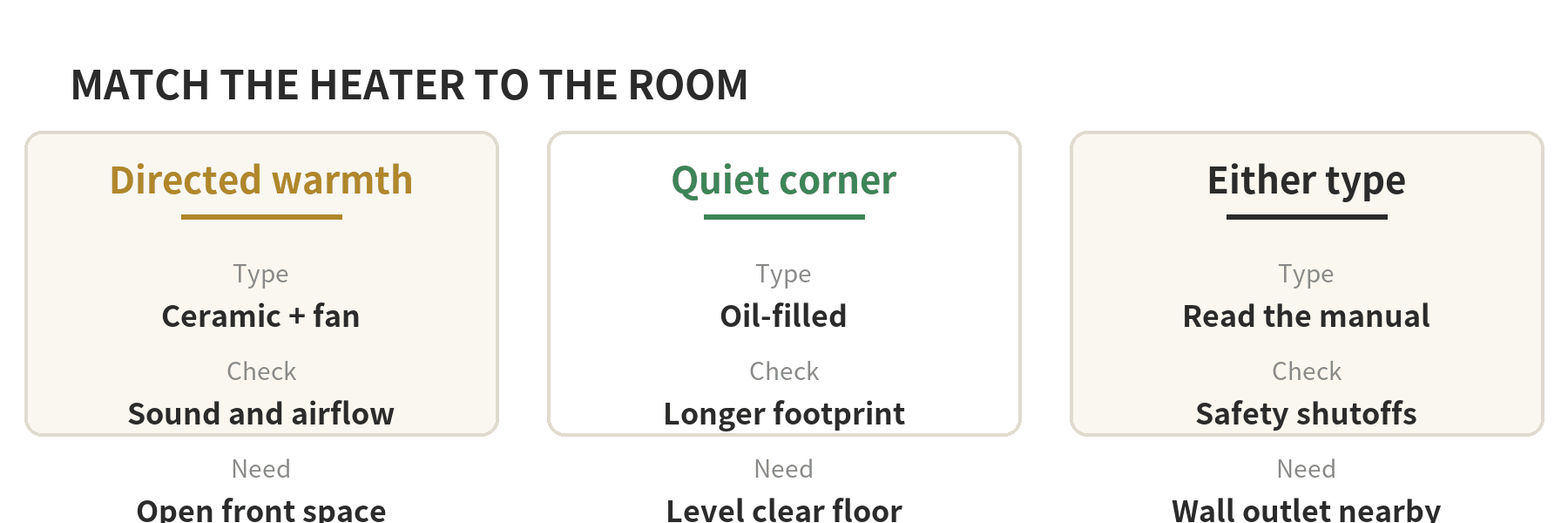
A ceramic heater uses an electric resistance element and a fan to move warmed air. That makes it a candidate for directed warmth near a desk or chair. The fan adds sound and moving air, and the grille needs an unobstructed area. Check the manual for the required clearances and whether the model is designed for the room where you intend to use it.
An oil-filled heater warms a sealed fluid inside radiator-like panels and transfers heat to the surrounding air. It has no fan-driven airflow, so it may suit a room where fan noise is unwelcome. Its larger body takes floor space, and the surface can become hot. Keep children, pets, fabric, and furniture away according to the product instructions.
Both types use electricity to produce heat. Do not assume one will cost less to run based on the heating element alone. Energy use depends on the unit’s input, how long it runs, the thermostat setting, and the home’s electric rate. Compare the electrical rating and use pattern rather than relying on a broad cost claim.
Think about when someone will be in the room and what else is running there. A heater used while you work needs a reachable control and a place where papers, bags, and chair movement stay clear of its openings and cord.
For a room used by several people, consider who may move the unit or walk past it. If its safe position depends on everyone remembering to step around a cord or keep belongings away, select a different spot before buying.
Compare the features that change daily use
| What to check | Ceramic, fan-assisted | Oil-filled radiator |
|---|---|---|
| Heat direction | Air moves from the heater toward an open area | Radiates from the body into the nearby room |
| Sound and airflow | Fan noise and moving air are part of operation | No fan-driven airflow on models without a fan |
| Floor footprint | Often a compact shape, but check base stability | Usually a longer radiator-shaped body |
| Controls to inspect | Thermostat, heat settings, timer, tip-over shutoff | Thermostat, heat settings, timer, tip-over shutoff |
| Best question for the label | Can the outlet and clearance suit this spot? | Can the larger body sit level with open space around it? |
Feature names do not guarantee identical performance across models. A thermostat can cycle the heater around its selected setting; a timer can schedule operation; an automatic shutoff can respond to a specified condition. Read the product manual to learn exactly what each control does and whether it restarts after power is interrupted.
Compare the same details on each exact model: rated electrical input, available heat settings, thermostat behavior, timer options, and shutoff features. Read the manual to find the conditions that activate each control and any limits on restarting after an interruption.
Make a short note of any feature you expect to use, then confirm it in the model’s instructions. Similar names on product pages do not tell you whether controls behave in the same way across different heaters.
Check the safety features before comparing extras
Look for a tip-over shutoff and overheat protection, then verify both in the manual. Check that the product bears a mark from a recognized testing laboratory, as the Electrical Safety Foundation International advises. Inspect the plug and cord for damage before use; skip a unit with a cracked plug, loose connection, or frayed cord.
Give safety features more weight than remote controls, app connectivity, or decorative styling. A remote does not make it safe to run a heater while you are asleep or away. If you need a heater in a bathroom, damp area, workshop, or child’s room, verify that the specific unit is approved for that location and consider whether another heat source is more appropriate.
Map a safe spot before bringing one home
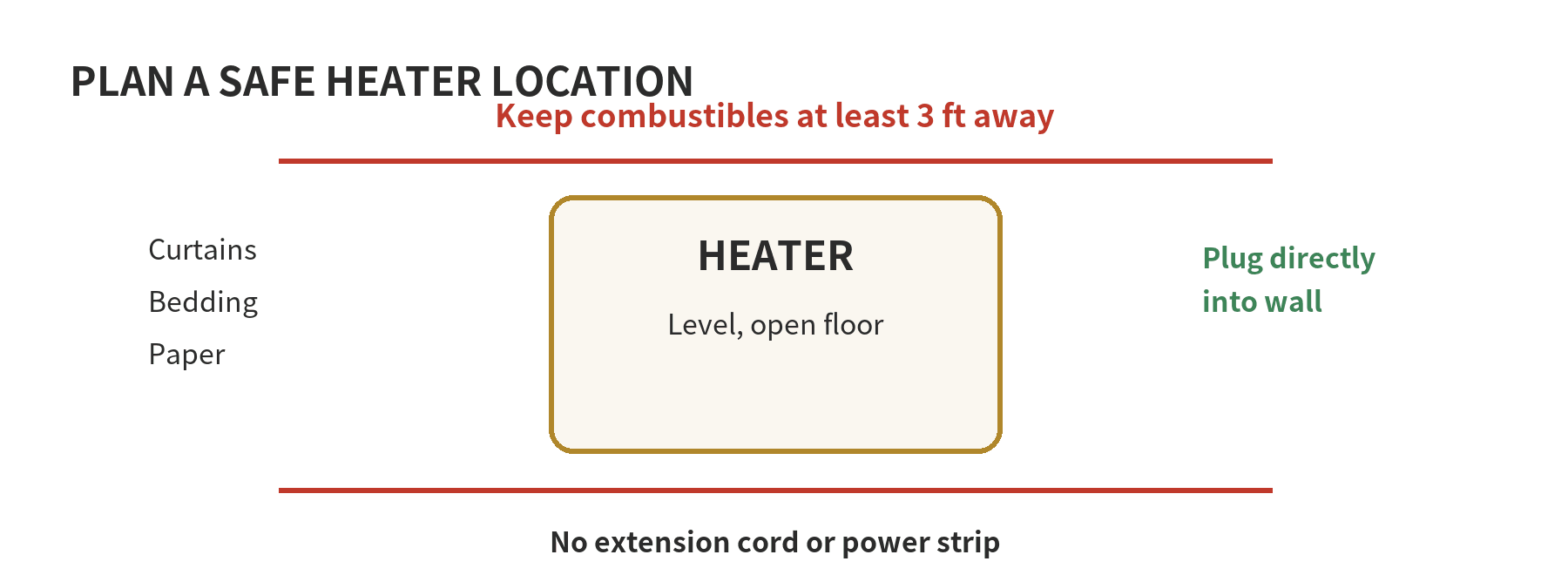
The U.S. Consumer Product Safety Commission and the National Fire Protection Association advise keeping portable heaters at least three feet from anything that can burn. That includes curtains, bedding, paper, clothing, rugs, and upholstered furniture. Measure the clear area around the heater, not just the gap in front of it.
Plug an electric space heater directly into a wall outlet. CPSC warns against extension cords and power strips because they can overload and cause a fire. ESFI also advises against plugging another electrical device into the same outlet. If the only usable outlet requires a cord, choose another location instead of improvising.
Set the unit on a firm, level floor away from doorways and walking paths. Do not put it on carpet, furniture, a shelf, or a table unless the manufacturer specifically permits that surface. Keep its intake and outlet openings unobstructed, and route the power cord where it will not be walked on or trapped under furniture.
Before checkout, compare the required clearances with the actual room rather than estimating from a product photo. Check the heater’s full footprint, the path to the outlet, and whether its cord can stay out of doorways and walking routes.
Think through setup and storage as well as operation. Confirm that the heater can be moved while cool, that there is a stable place to keep it between uses, and that storage will not leave it beneath clothing, bedding, or other combustible items.
Use a quick room-fit check
- For a home office: If you need warmth aimed toward a seated area and can keep the heater clear of the desk, a ceramic model may fit. Check fan noise and make sure papers cannot drift toward the unit.
- For a quiet reading corner: An oil-filled model avoids fan-driven airflow, but only if its body can sit level with the required open space around it. Confirm that the longer footprint does not narrow a walkway.
- For a shared family room: Favor a position that is visible and outside children’s play areas and pet routes. If traffic makes the required clearance unrealistic, do not use a portable heater there.
These examples help narrow the type; the manual and room layout decide whether a particular model is suitable. Never cover a heater, dry clothing on it, or leave it running while sleeping or when no one is watching it. CPSC and ESFI both emphasize attended use and clear space around the unit.
Questions to answer on the product page and manual
- What room size and use does the manufacturer specify?
- Does it have tip-over and overheat shutoffs, and how do they work?
- What clearances, floor surfaces, and outlet conditions does the manual require?
- Can the cord reach a wall outlet without an extension cord or crossing a path?
- Is the unit easy to move when cool, and where will it be stored between uses?
- Does the warranty cover the intended use, and how are replacement parts or service handled?
Compare the answers across the exact models under consideration. If a safety instruction conflicts with the location you had in mind, choose a different spot or a different heating approach.
Frequently asked questions
Is a ceramic heater better than an oil-filled heater?
Neither is universally better. Ceramic models move warm air with a fan, while oil-filled models provide radiator-style heat without fan-driven airflow. Let room layout, sound preference, clearance, and the manual determine the fit.
Can I leave a space heater on overnight?
No. CPSC advises never leaving portable heaters on while sleeping, and ESFI says to turn them off when leaving the room or going to sleep.
Can I plug a space heater into a power strip?
No. Plug an electric space heater directly into a wall outlet, following its manual. Do not use an extension cord or power strip.
How much will a space heater add to my electric bill?
There is no single bill impact: it depends on the heater’s electrical input, hours of use, thermostat cycling, and your utility rate. Use the product’s electrical rating, your expected hours of use, and the rate on your utility bill to estimate the added use.