If runoff is landing beside the foundation, use a downspout extension to carry the outlet to a safer discharge area; a splash block helps spread the flow where it exits.
The right choice depends on the route water can take across your yard, not on the fitting alone.
Keep the job focused on the final stretch below the downspout.
The gutter collects roof runoff and the downspout carries it down; an extension or block changes where that water leaves the house.
The University of Minnesota Extension and the EPA advise moving roof runoff away from the foundation.
Local drainage guidance can set a different distance for a particular site.
Choose by where the water needs to go
A downspout extension lengthens the outlet route.
It can be a useful fit when the water needs to pass a planting bed, paved edge, or short stretch of yard before reaching a stable area.
A splash block can spread flow and reduce the direct force on soil at the outlet, but it does not carry water as far as a longer extension.
| Part | What it changes | Check before choosing |
|---|---|---|
| Downspout extension | Moves the outlet farther from the wall. | Whether the route stays clear and drains toward a suitable area. |
| Splash block | Spreads water at the outlet and reduces direct impact on soil. | Whether its end points away from the house and toward a stable surface. |
| Both together | Carries water farther, then spreads it at the end. | Whether the combined route fits the space and local direction for runoff. |
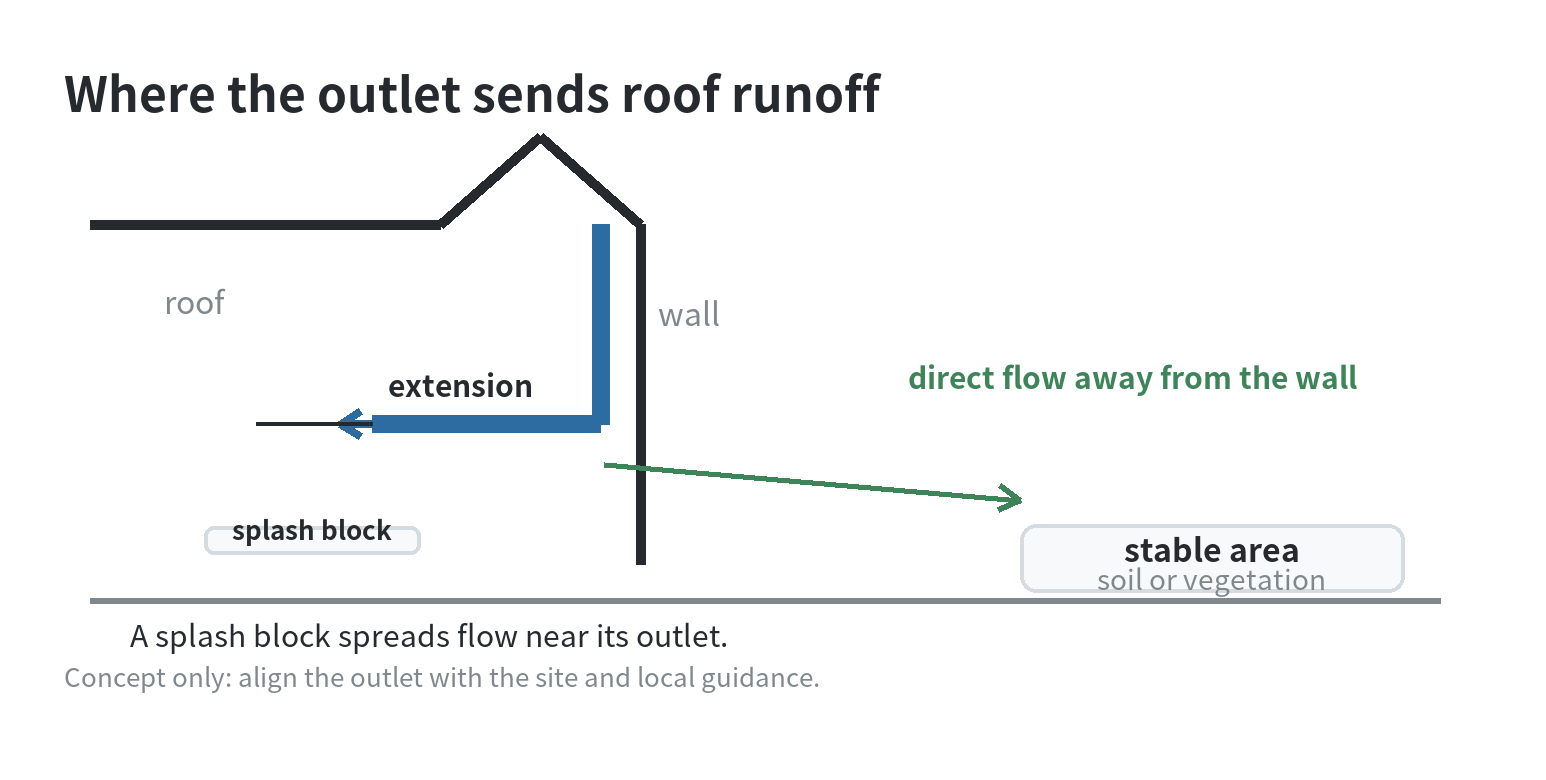
Use an extension when the discharge point itself needs to move.
Add a splash block when the outlet needs a surface that directs water outward and reduces soil washout.
The two can work together if the outlet still needs to travel farther after leaving the downspout.
Snohomish County’s drainage guidance describes splash blocks as a way to slow and spread outlet flow; it also notes that the block helps move runoff away from a foundation.
For more context on the equipment higher up the system, see this site’s guide to cleaning gutters and downspouts.
The extension discussed here starts at the downspout outlet, so a clog or damaged gutter is a separate issue to address first.
Do not treat one distance as a national rule
Guidance for discharge distance varies.
The University of Minnesota Extension says extensions should release water at least 4 feet beyond the wall.
An EPA-hosted Mid-America Regional Council guide advises discharging yard runoff at least 5 feet from foundations.
Snohomish County’s local drainage guidance says no water should be released within 10 feet of a foundation to protect a basement or crawlspace.
Those figures are recommendations for different guidance and settings, not one universal measurement.
Before choosing an extension length, check local stormwater instructions, the slope and soil on your property, and the destination of the flow.
A local rule or approved drainage plan takes priority for the property it covers.
Measure the route from the wall to the intended outlet, then check how water will continue from that point.
A longer piece is not automatically a better route if it sends runoff toward a walkway, a neighbor’s lot, or a low spot beside another structure.
The EPA’s downspout guidance says to consider local regulations and avoid directing water in a way that could cause property damage or unsafe conditions.
For example, imagine a downspout beside a narrow porch, with a paved path immediately beyond it and a planted area farther out.
A short block that stops at the path may leave runoff on the pavement.
An extension could carry the outlet past the path, with a block at the end to spread flow over a stable area.
The useful measurement is the route to that landing area, then the distance your local instructions require.
If a side yard cannot accommodate that route, do not assume water will safely soak in just because the surface is lawn.
A low area that holds water, bare soil on a slope, and a route that crosses onto another property each call for a different solution.
The EPA advises considering where the water will be directed; if the available route creates one of these problems, ask the local drainage office before changing the outlet.
Follow the ground instead of fighting it
Look at the ground from the wall to the planned outlet.
If it slopes toward the house, a surface fitting cannot reverse that grade.
The University of Minnesota Extension says level ground or a slope toward the foundation can direct water toward a basement.
It recommends shaping the grade away from the foundation.
Choose a route that continues away from the building and ends on a stable area.
The EPA describes redirecting downspouts toward a lawn or garden where water can soak into the ground.
Snohomish County advises avoiding outlets on hard, compacted surfaces when a safe vegetated route is available.
Do not send water across a public walk or driveway where it could create a slick surface or an obstruction.
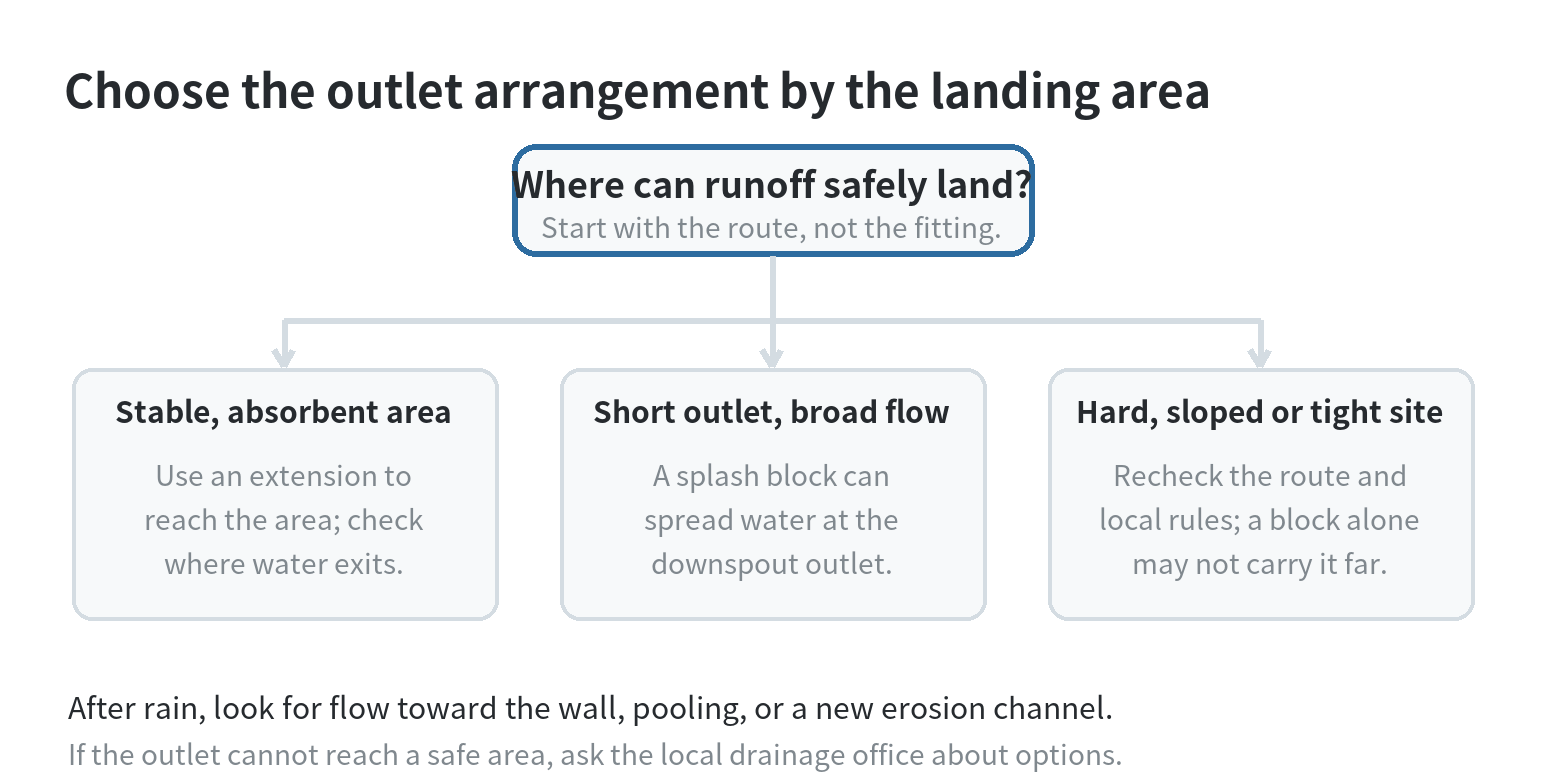
If the only available destination is a steep slope, a narrow side yard, or ground that stays saturated, pause before extending the outlet.
Snohomish County warns against directing outlets to steep slopes and recommends getting qualified guidance when there is no other option.
A splash block alone is not a substitute for a route that can safely carry the water away.
Check fit, movement, and the outlet path
Measure the downspout end before selecting a fitting.
Product shapes and connections vary, so compare the listed connection dimensions and installation directions with the downspout already on the house.
If parts do not seat securely or leave an obvious gap, use a compatible adapter instead of forcing the connection.
Follow the instructions for the specific parts in hand, since the connection method may differ across products.
Check how the extension sits while dry.
It should not block a door, gate, mower route, or walkway, and it should not rest where routine foot traffic can shift it.
If the piece moves when touched, check whether its connection or support needs adjustment.
For a fixed route, make sure the outlet remains accessible for inspection rather than burying or covering it without an approved design.
If gutter protection is also part of the system, this site’s article on installing gutter guards covers that separate upstream component.
The outlet still needs its own clear path after rainwater reaches the downspout.
Use the next rain as a route check
After rainfall, observe the outlet from a safe spot.
Look for water flowing back toward the wall, pooling at the end of the extension, washing a narrow channel into bare soil, or spilling onto a hard surface.
Snohomish County recommends inspecting drainage outlet protection after storm events for debris, pooling, and erosion.
If you see one of these signs, adjust where the water lands or ask the local drainage office what options fit the property.
Clear leaves or sediment that block the outlet, and check that the extension has not shifted.
A splash block can reduce the initial force and spread flow, but water volume and the yard’s slope still affect where it travels.
If the route cannot reach an appropriate area, a longer fitting by itself may not solve the drainage problem.
FAQ
Can I use a splash block without a downspout extension on a small lot?
Yes, if the block directs water to a suitable area and local guidance allows that discharge location.
Snohomish County describes splash blocks as outlet protection, but its distance guidance is local; check the rules for your property before relying on a short outlet.
Should the splash block touch the downspout?
Place it under the outlet so water lands on its directing surface.
Product shapes differ, so follow the fitting and block instructions that came with your parts for alignment.
What if the extension sends runoff toward a neighbor’s yard?
Choose another discharge route and check local drainage requirements.
The EPA advises against routes that could cause property damage or unsafe conditions.
The county notes that water released onto hard, compacted, or impermeable surfaces can contribute to downstream flooding, while fast-flowing water released to bare soils or steep slopes can cause erosion.