Match the spreader to the lawn’s shape.
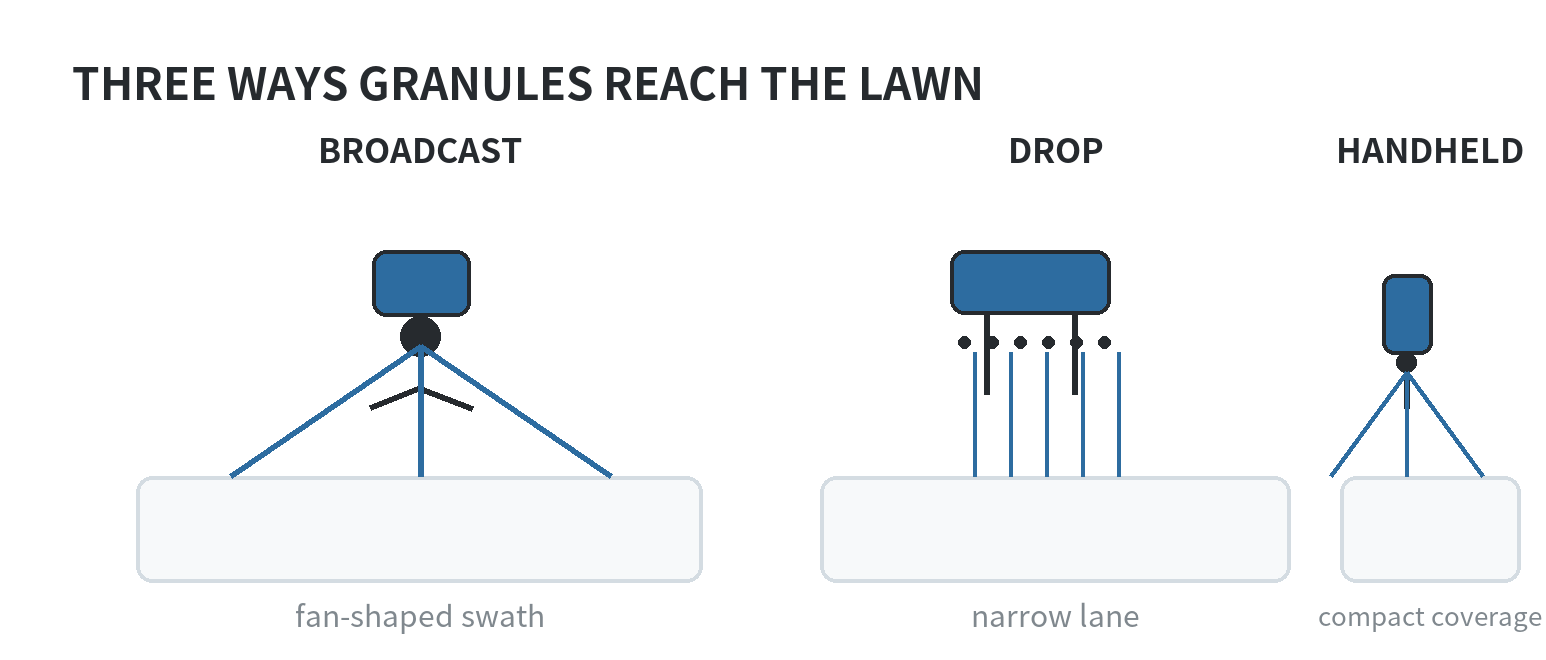
Broadcast models throw granules outward; drop models release them in a narrow strip; handheld models suit small or awkward patches.
For seed or fertilizer, follow the package and spreader manual for the rate and setting.
Start with the lawn’s shape
A wide, open lawn gives you room to use a broadcast spreader’s fan-shaped pattern.
The granules leave a rotating plate and land across a wider swath, so each trip covers more ground.
That pattern also reaches beyond the wheels, which calls for care along sidewalks, driveways, beds, drains, and property lines.
A drop spreader sends material through openings beneath its hopper, largely within the machine’s width.
That narrow path is easier to keep inside a defined boundary, but it takes careful lane placement.
If adjacent passes leave a gap, the gap remains untreated; if they overlap too much, the overlap receives extra material.
A handheld spreader is a portable option for small lawns, narrow strips, and touch-up areas.
Handheld designs include hand-crank and powered-spinner models.
Check the actual unit’s manual for how its gate opens, how it is held, and which materials it accepts.
What each pattern changes in practice
| Type | How material leaves | Good fit | Watch for |
|---|---|---|---|
| Broadcast (rotary) | A spinning plate throws material outward. | Open areas where broad passes are convenient. | Material can travel past the edge; account for wind and nearby surfaces. |
| Drop | Openings release material below the hopper. | Small, confined areas and clearly bounded edges. | Lane spacing matters; align passes without gaps or excess overlap. |
| Handheld | A compact gate or spinner releases material as you carry it. | Small patches, tight corners, and limited storage space. | Capacity and controls differ by model; a longer job means repeated refills. |
These are pattern differences, not a ranking.
For a rectangular front lawn with a planting bed on one side, a drop model may make the edge easier to manage.
For a broad, unobstructed backyard, a broadcast model may reduce the number of walking lanes.
A handheld unit can cover a small patch, but carrying its load across a large yard may be tiring and slow.
Before choosing, walk the route without material in the hopper.
Note gates, slopes, trees, and narrow turns.
Picture a side yard with a walkway on one edge and shrubs on the other.
A drop spreader keeps the pattern under the machine, but you must place each narrow lane carefully.
A broadcast pattern covers a wider area, yet needs room to turn before reaching shrubs or pavement.
A handheld model can be carried to a small bare patch, using its own listed settings.
If a broadcast pattern reaches a bed or pavement, consider a drop spreader or a model with a suitable deflector.
Broadcast spreaders need room at the edges
Penn State Extension describes rotary spreaders as casting granules outward and drop spreaders as releasing them below the hopper.
A broadcast spreader meters granules onto a spinning plate, which throws them past the frame.
Follow the maker’s suggested pass spacing; hopper width is not the spreading width.
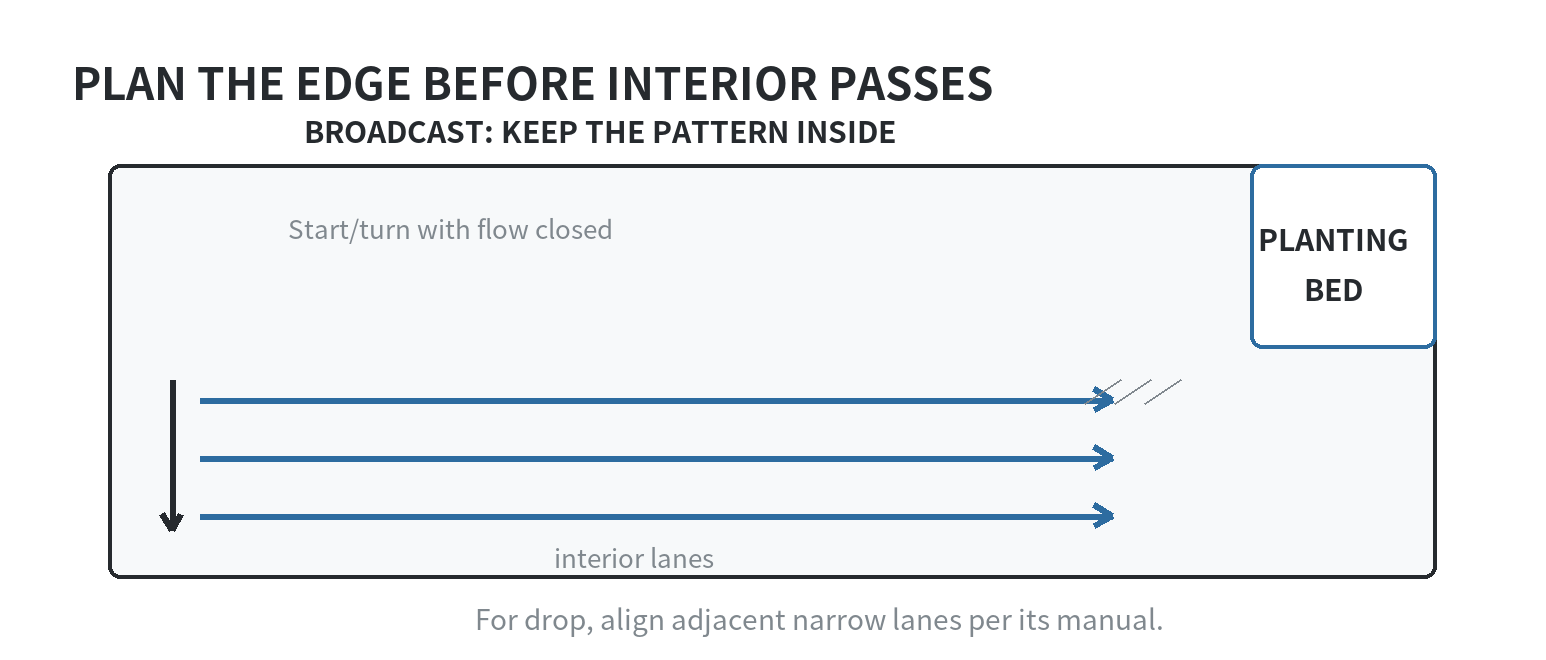
For a lawn beside a sidewalk, plan an edge pass before making long interior passes.
Check whether the model has a side deflector or edge-control feature, then follow its specific instructions.
If yours has no guard, leave room to turn and keep the spread pattern pointed into the lawn rather than over a hard surface.
Penn State Extension and Iowa State Extension both note that wind can alter spread patterns.
Pause if gusts make the edge of the pattern unpredictable.
Close the flow control before stopping or turning.
Close it before crossing pavement so material does not fall in one spot.
Drop spreaders trade width for a defined lane
A drop model is useful when the lawn has close borders or when you want the material to fall mainly under the hopper.
Its path is narrow, so outline the working area and decide how each lane will meet the next.
Follow the manual’s spacing for adjacent wheel tracks.
Material may fall between the wheels, not directly beneath them.
That precision depends on steady movement.
Open the gate after you begin walking and close it before you stop, following the model’s instructions.
Turning around with the gate open can leave a concentrated patch at the end of a lane.
If the maker recommends a test pass, use a safe, contained area and collect or sweep stray granules according to the product label.
Drop spreaders can take more passes over a large lawn because the swath is limited by the row of openings.
A drop spreader gives boundary control, not automatic accuracy.
A mis-set gate, uneven pace, or misaligned lane can change how much falls in a strip.
Handheld models suit short, contained jobs
Handheld spreaders are small enough to carry around a patch or along a narrow side yard.
The product may leave through a simple opening or a rotating mechanism, so do not transfer a setting from a walk-behind machine.
Settings are not interchangeable across spreader designs, even when the material is the same.
Check whether the unit is intended for seed, granular fertilizer, or both.
Check the approved material types in the unit manual.
Follow the package directions when granule size or moisture differs from the listed examples.
For a handheld unit, keep the hopper level as instructed and move at an even pace.
EarthWay’s hand-crank manuals pair crank movement with opening and closing the flow control.
Use the sequence for your model. Close the control before setting the spreader down.
Set the rate from the package, not the dial alone
A dial number applies to the spreader model and material named by its maker or package.
Material properties, pace, and equipment condition can change delivery.
The 3100 seeder/spreader manual calls its settings a guide.
Penn State Extension also recommends calibrating each spreader and granular product separately.
Start by reading the complete package directions, including the listed spreader type and model.
If the package does not name your spreader, check the manufacturer’s manual or support information for that exact model and material.
Do not guess a setting by matching a number from another spreader.
When the instructions call for calibration, follow their test-area and measurement method.
A calibration setup may use a measured area and the amount specified for it.
Weigh or collect the material released as the instructions direct.
Keep the test separate from nearby plants, drains, and surfaces where the label restricts application.
Seed and fertilizer can have different directions even when used in the same machine.
For seed, follow the seed label for the product and spreader.
For fertilizer, use the fertilizer package’s application directions and any local requirements that apply.
The spreader setting handles delivery; it is not a substitute for choosing an appropriate product or application amount.
A short setup routine prevents avoidable mess
- Read the directions. Check the package and manual for compatible material, rate, setting, and operating steps.
- Inspect it. Check the gate, openings, wheels, or spinner. Keep hands clear of moving parts.
- Mark your route. Note boundaries, turns, and obstacles. Decide where to open and close the flow.
- Choose a fill spot. Keep material off drains and pavement. Follow the package directions.
- Open while moving. Close the flow before turning or stopping. Keep a steady pace and use the manual’s lane spacing.
- Clean it after use. Store leftover material in its original package. Clean and dry the spreader as its manual directs.
When comparing spreaders in a store or on an e-commerce platform, check the type, compatible material, controls, and hopper capacity.
See whether the manual lists your package’s material or setting.
Capacity alone does not tell you whether its pattern and controls fit your lawn’s edges.
For related context, see the site’s overview of lawn tools and its article on fertilizer types and labels.
FAQ
Can one spreader handle grass seed and granular fertilizer?
A spreader can handle both when its manual lists grass seed and granular fertilizer as compatible.
Settings still depend on the exact spreader and material, so check both sets of directions.
Should I use the same setting after changing products?
No.
A setting that applies one material at its intended rate may not do so for another.
Find the setting for the exact product and spreader, then calibrate as directed.
What should I check if a spreader leaves stripes?
Check the gate, flow openings, pace, and lane spacing against the manual.
Also confirm that the setting matches the product and the specific spreader model.
Can I use a spreader on a sloped lawn?
Only if the manual permits it and you can keep stable footing and control of the material.
Do not use a wheeled spreader on a slope that you cannot safely walk or steer.