Use a biweekly pay calendar, grounded in the IRS’s 26-period payroll convention, to find the months when three deposits land, then give those deposits a job before they arrive. Keep ordinary monthly bills funded by the two-paycheck baseline; treat a third check as a planned deposit for a cash buffer, a known upcoming bill, debt, or a goal you have already named. That keeps rent and routine spending from depending on a third payday that will not appear every month.
Start with your take-home deposit, not gross salary. The IRS uses 26 biweekly pay periods in its annual withholding tables, while the Office of Personnel Management notes that a calendar year can contain 26 or 27 pay dates depending on the payroll cycle; the dates printed by your own employer determine your household calendar. (IRS Publication 15-T; OPM pay administration; checked September 30, 2026.)
Build the calendar from actual deposit dates
Open your employer’s payroll calendar or use the pay dates shown on recent pay statements. Copy each expected deposit date into a year view, moving a date only when the employer has announced a holiday adjustment. Do not assume the first Friday of a month is payday; a biweekly cycle covers fourteen days, keeping the same weekday as the calendar moves forward.
Mark each month with two or three expected deposits. The IRS uses 26 periods in its biweekly withholding tables, while OPM says an agency calendar year can include 26 or 27 biweekly pay dates depending on its payroll cycle. A payday near the start or end of a month can change which month receives the deposit, so the dates matter more than a generic list of “third paycheck months.” (IRS Publication 15-T; OPM pay administration; checked September 30, 2026.)
Next, write down the net amount that actually reaches your checking account. Use a recent ordinary paycheck as a starting point, then check the deposit amount again if benefits, withholding, or other payroll deductions change. The planning number is the money available to assign, not the larger gross amount on an offer letter.
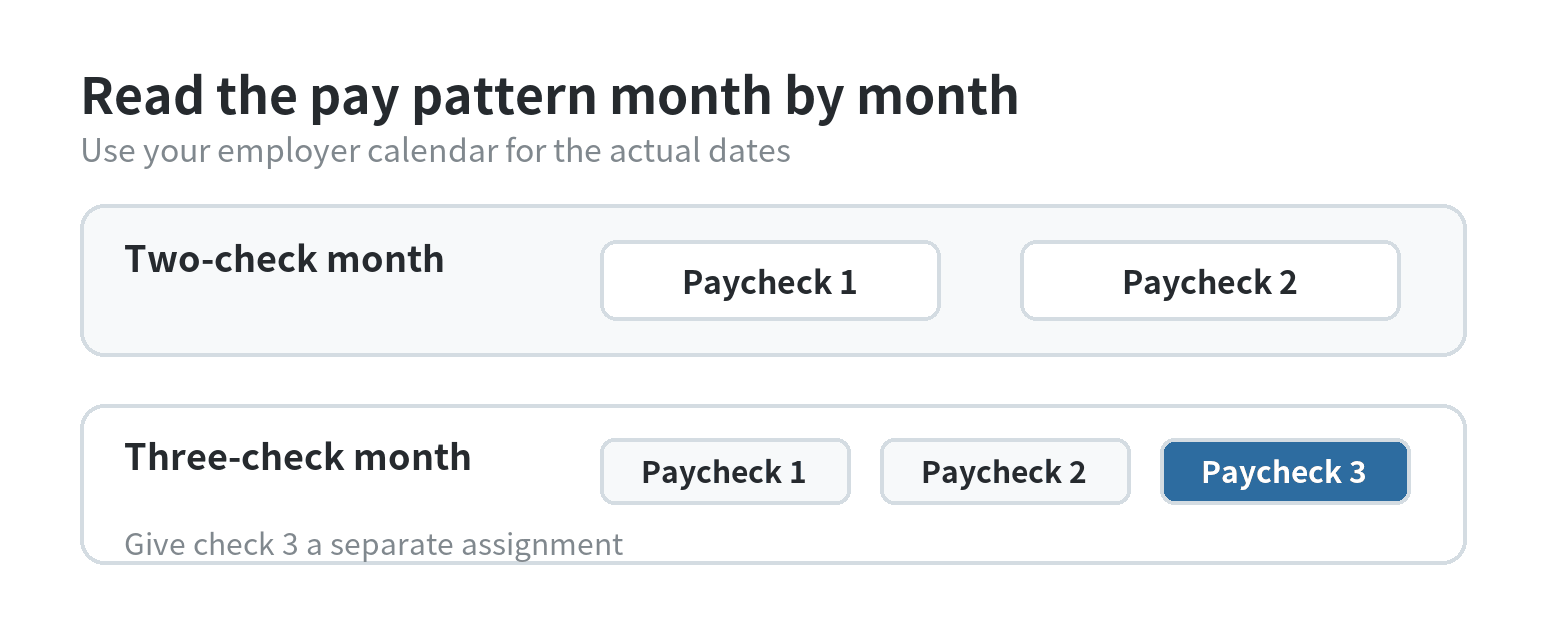
There is also an annualized way to set monthly income. The FDIC’s Money Smart worksheet converts biweekly income by multiplying it by 26 and dividing by 12 before entering it in a monthly budget. (FDIC Money Smart for Adults worksheet; checked September 30, 2026.) That approach spreads the year’s pay across the monthly plan. The two-check baseline below keeps regular spending tied to deposits that arrive in an ordinary month. Choose one approach for routine spending, and do not count the same third deposit once as monthly income and again as separate goal money.
Set a monthly baseline you can repeat
Suppose your take-home deposit is $1,800 every other Friday. For routine planning, use $3,600 as the month’s paycheck baseline: two deposits multiplied by $1,800. If recurring bills and planned everyday spending add up to $3,150, the example leaves $450 before irregular costs. These amounts are examples to replace with your own deposit and bills.
List costs that do not arrive neatly each month—car registration, school costs, annual subscriptions, seasonal utilities, or a medical bill you already know is coming. Add a monthly set-aside for each one to the baseline budget. If you leave these costs out, the ordinary month can look affordable on paper while a predictable bill later absorbs the third check.
For a concrete set-aside, imagine a $600 registration bill due once a year. FDIC Money Smart divides annual costs by 12; that gives you a $50 monthly line in the budget. When the bill arrives, the money is already assigned; the third paycheck can stay focused on its own list of priorities. Replace the sample amount with the bill on your own notice.
Decide which regular bills each of the first two deposits will cover. For example, assign the first deposit to rent and bills that leave early in the month, then use the second for later due dates and the remaining planned spending. The order depends on your actual calendar: a rent draft on the first may need money from the prior month, while another household may have its largest bill later. If one paycheck cannot cover a full bill, set aside a portion from each deposit and keep that amount reserved until the payment date.
A calendar budget also catches timing problems. Put each bill on the date the payment leaves your account, not only its due date, and place each paycheck on its deposit date. CFPB’s bill calendar asks users to record bill amounts and dates alongside income dates and amounts, then compare income with bills over the calendar. Its cash-flow worksheet also shows how to move a flexible expense to a date after income arrives. (CFPB Your Money, Your Goals toolkit; CFPB cash-flow adjustment worksheet; checked September 30, 2026.)
Give the third deposit a priority before payday
In the example, a month with three $1,800 deposits brings in $5,400. Keep the $3,600 baseline tied to regular costs; write a separate plan for the $1,800 third deposit. If this is the first three-paycheck month in your calendar, you can divide that amount across more than one purpose rather than letting the full deposit disappear into unplanned spending.
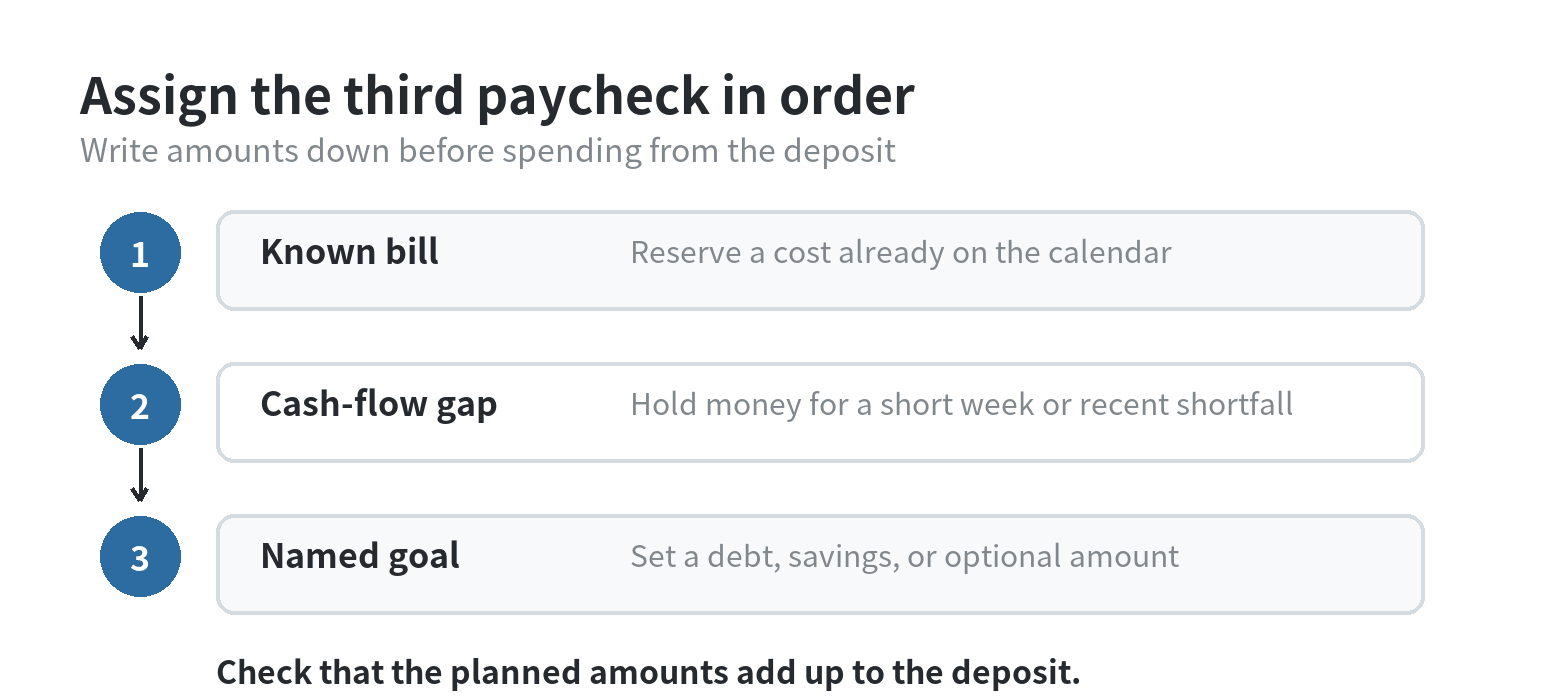
A useful order is to cover an upcoming bill that is already on the calendar, rebuild cash used for a recent shortfall, direct a set amount to a debt payment, and then assign any remaining amount to a savings goal or discretionary spending. This is a budgeting sequence, not a required formula. Change the order to match your actual due dates and commitments.
For example, a household could reserve $600 for a car registration and insurance bill due later in the year, hold $500 in checking to smooth next month’s bill timing, and divide the remaining $700 between a planned debt payment and a family activity. The exact split is yours; the point is to name the jobs and confirm their totals equal the deposit.
Keep the plan steady when the calendar shifts
Do not lower a monthly bill budget just because a third check is coming, and do not raise routine spending permanently after one larger month. If the extra deposit is needed for rent, groceries, or utilities, assign it there. A budget should reflect the bills you have, not an idealized rule that every third check must go into savings.
Check the calendar before you label the deposit “extra.” If a three-check month begins with a rent payment due before the first paycheck, the checking balance still has to carry that bill. Write down the opening amount you can use, the date each deposit arrives, and the dates money leaves. That view helps you tell the difference between a month with more income overall and a week when cash is actually available. CFPB’s bill-calendar process is built around those income and payment dates.
If your pay dates move around a holiday, use the employer’s announced date and adjust the calendar. If a deposit arrives later than expected, prioritize bills by due date and the consequences of missing them, then contact a biller if you need to ask whether a due date can move. CFPB’s bill-calendar guidance suggests comparing bill and income timing and asking about a different due date when a week’s bills exceed income. (CFPB bill calendar guidance; checked September 30, 2026.)
A third-check plan also needs a reset when your pay changes. Update the net deposit amount, repeat the calendar across the next twelve months, and review the plan after any change to recurring bills. If you track categories with a budgeting tool, the existing monthly budget and app setup overview can help you decide where to record those assignments. For a cash reserve goal, see the site’s emergency-fund budgeting overview.
FAQ
Is biweekly pay the same as getting paid twice a month?
No. BLS describes a biweekly pay period as fourteen days, while semimonthly payroll has two pay periods in a month. The IRS lists 26 biweekly periods and 24 semimonthly periods in its 2026 withholding tables. (BLS pay-period definitions; IRS Publication 15-T; checked September 30, 2026.)
What if one paycheck is smaller than the others?
Use the actual net deposit for that date, then revise the month’s assignments before moving money to optional categories. If the difference comes from a payroll deduction or benefit change, check the pay statement so the next calendar uses the right amount.
Can I use a third paycheck for a bill due next month?
Yes. Put the bill and its payment date on the calendar, reserve the amount from the third deposit, and leave that money assigned until the bill is paid. CFPB’s cash-flow worksheet uses income and expense dates to show how money can be lined up with later payments. (CFPB cash-flow adjustment worksheet; checked September 30, 2026.)
How should I handle a paycheck that moves because of a holiday?
Use the revised date your employer provides, then compare it with bills due around that week. Keep the deposit attached to its actual arrival date rather than assuming the usual payday still applies.
Should I average all biweekly pay across the year?
You can use an annualized monthly amount if that is how you prefer to budget. FDIC Money Smart’s worksheet says to multiply biweekly income by 26 and divide by 12; a two-check baseline instead keeps routine spending tied to two deposits and assigns three-check deposits separately. (FDIC Money Smart for Adults worksheet; checked September 30, 2026.)
Last updated: 2026-09