Budget for a professional work wardrobe by pricing the specific gaps between what you already own and what your job asks you to wear.
Start with a written dress-code check, count usable pieces, then set a monthly clothing amount that fits after bills and savings.
You do not need a closet full of new outfits; you need a plan for the next useful purchase and its upkeep.
A price target copied from a broad apparel average can include costs unrelated to your role.
The Bureau of Labor Statistics tracks household spending in the broad “apparel and services” category, not the price of a wardrobe for a particular job.
Use your own quotes for the items on your list instead of treating that category as your spending limit.
Write down what your workplace actually expects
Before setting a dollar amount, list the situations your clothes need to cover.
Include office days, client meetings, travel, outdoor work, or a uniform requirement.
Check the written dress code or ask your manager about unclear items.
Separate required pieces from preferences such as color or a more formal look.
Then note practical constraints: your commute schedule, whether you can change at work, the local weather, and whether you can wash clothes at home.
A job with a uniform, protective gear, or a strict client-facing standard may need a different plan from a casual office.
List work shoes and outerwear only if your job or commute makes them necessary.
Make three columns: “required,” “useful,” and “later.” A required item fills a real gap or replaces something no longer wearable.
Useful items make combinations easier, while later items are style upgrades.
This keeps a sale or a convenient shopping trip from turning a vague need into a larger project.
Rank the list by the next work event and the gaps each item fills.
Note whether an item works with clothes you own or needs a full outfit around it.
This ranking helps when the total exceeds the amount available this month.
Audit the closet before you set the cap
Pull together the clothes you would genuinely wear to work.
Try on pieces, check fasteners and hems, and note stains, repairs, fit issues, and cleaning instructions.
Count outfits by whether they suit a work situation, not by the number of hangers.
A jacket that does not fit or trousers that need costly alterations are not ready-to-wear options for your plan.
Build combinations from what is usable.
For example, you may own two work-appropriate pairs of trousers and three tops that coordinate with them.
Your next gap may be a layer or a replacement rather than another full outfit.
Your role, schedule, laundry routine, and dress code determine what is enough.
Write the gap beside each item: replace, repair, alter, borrow for a one-time event, or leave alone.
Repair and alteration are choices to price, not automatic savings; ask for a quote and compare it with the cost of a suitable replacement.
If an item is only needed for a rare event, compare borrowing or renting with buying, including cleaning and return costs.
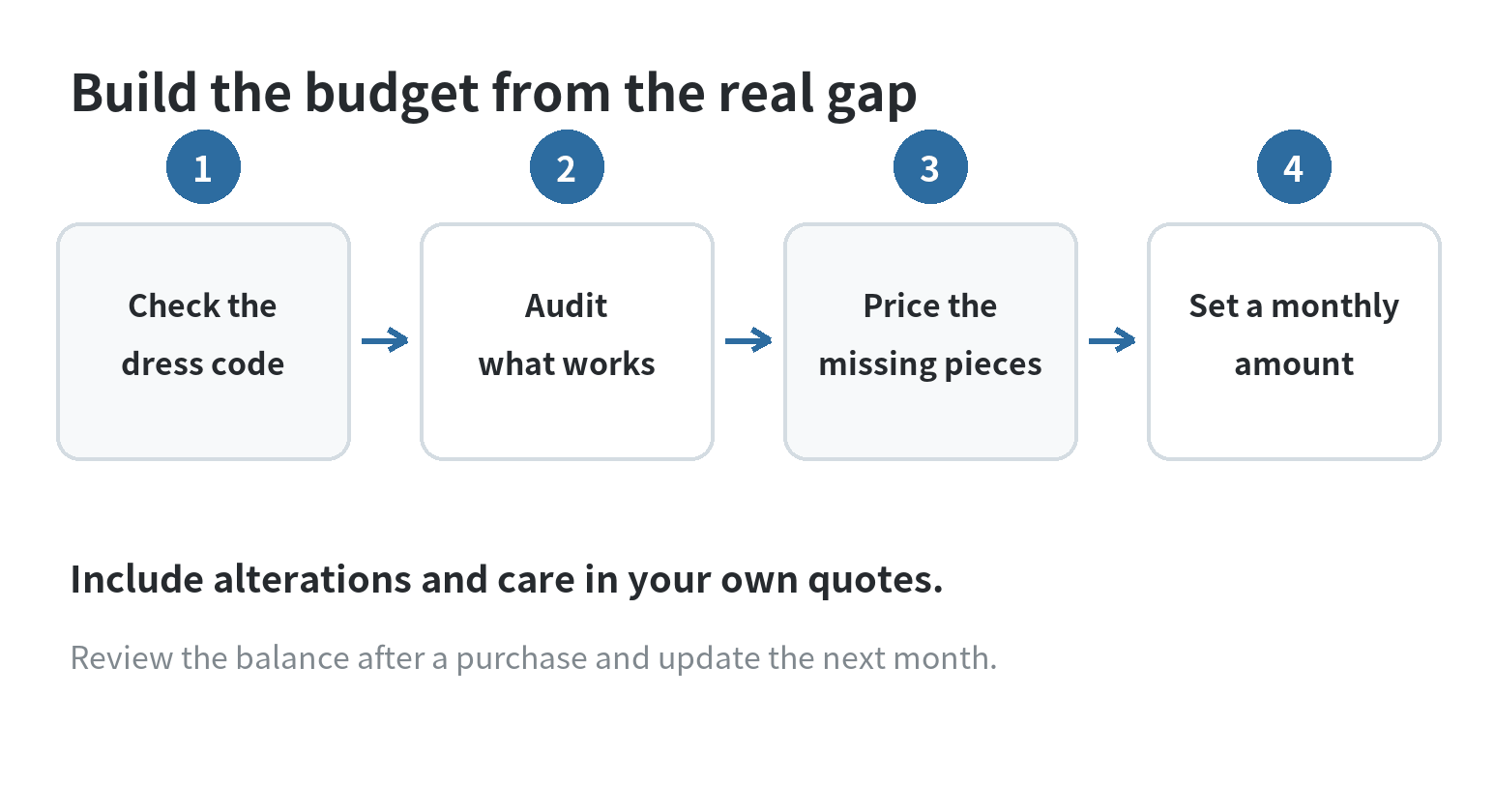
Set a monthly amount from your own cash flow
Use take-home pay and current expenses, not a percentage copied from someone else.
The Consumer Financial Protection Bureau’s monthly budget worksheet lists income and expenses, then subtracts spending to see what remains (checked September 30, 2026).
Review bank and card statements for clothing, shoes, alterations, dry cleaning, and laundry supplies.
The CFPB’s spending tracker advises recording purchases before setting a budget.
Include a full month when clothing purchases are irregular.
After essentials, debt payments, and planned savings, choose an amount you can set aside without borrowing or missing a bill.
If work clothes are an occasional expense, keep the amount in a separate line of your monthly budget until a needed purchase comes up.
A sinking fund turns a larger replacement into several planned contributions; it does not make the purchase cheaper, but it helps you see the cash required before buying.
Fictional budget example: set aside $80 a month for work clothes.
Suppose your own quotes for an outfit, alterations, and care add up to $320.
Four monthly contributions would cover that quoted total if your other spending stays on plan.
If you need the items sooner, reduce the list to the highest-priority gap.
Move money from a flexible category only after checking upcoming bills.
When money is tight, tell required costs apart from upgrades.
Handle a uniform or dress-code gap first, then replace pieces that cannot do their job.
Delay duplicate colors, trend pieces, and “just in case” purchases.
If your employer has a uniform policy or reimbursement process, ask the employer directly what it covers before counting on that money.
Compare the full cost, not just the tag
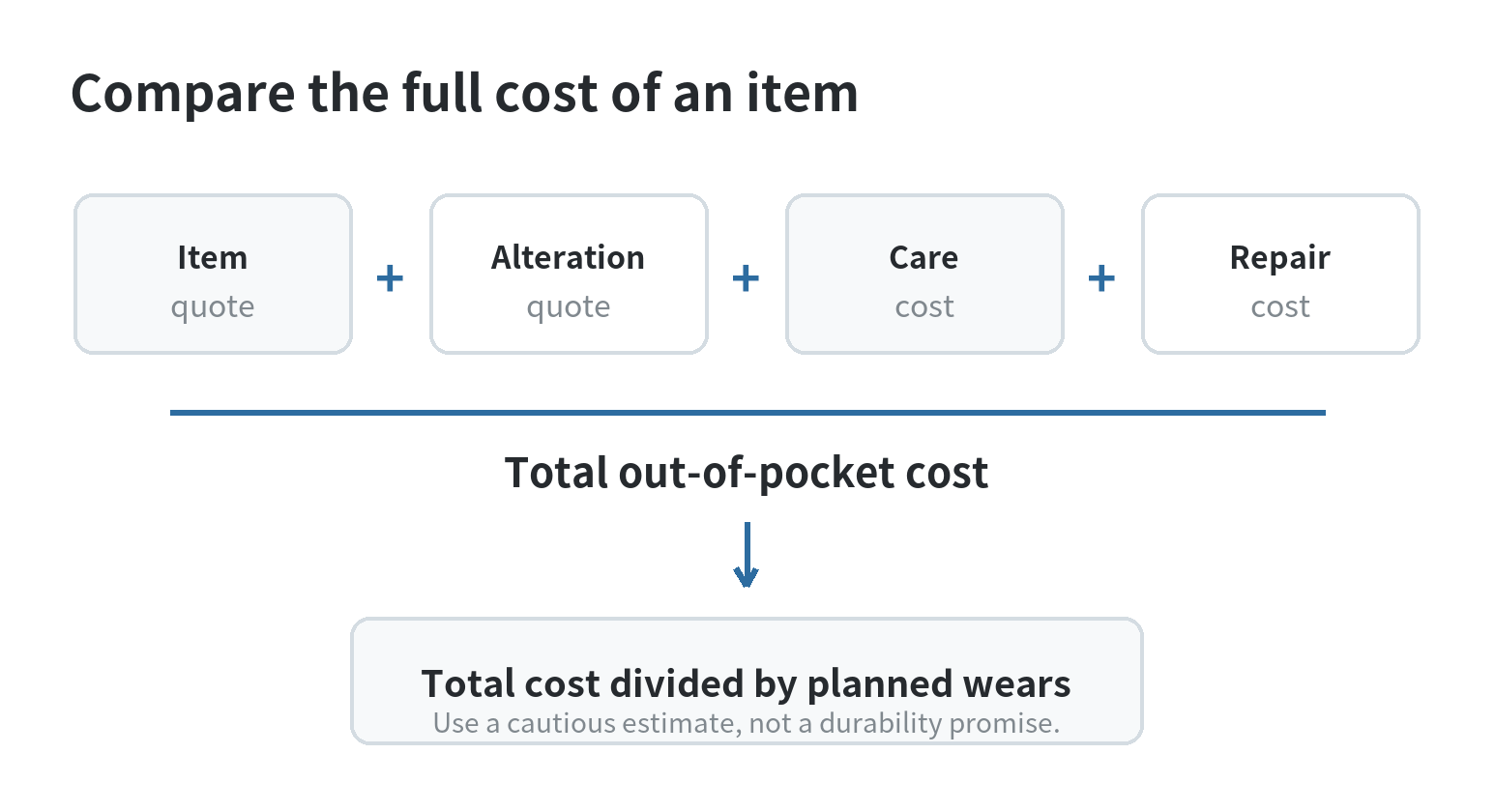
For each candidate item, record the quoted price, tax, shipping if applicable, alterations, and care cost.
Ask whether the fit works with clothes you own and whether the garment can be cared for with your available laundry setup.
A lower tag price can be offset by alterations or repeated specialty cleaning; a higher price does not by itself prove better value.
Use cost per planned wear as a comparison tool, not a promise about durability.
Divide your total out-of-pocket cost by the number of workdays you realistically expect to wear that item before it needs replacement.
Estimate conservatively and compare only similar options.
This helps reveal when an item is expensive because it serves one narrow event, but it cannot predict how long the garment will last.
Use a cautious wear count.
Think about the workdays when you will actually choose the item, not every day on the calendar.
If a shirt suits one presentation only, compare it with a piece that completes several outfits you already own.
This comparison helps you decide what belongs on the list.
Check the care label before committing.
The Federal Trade Commission’s Care Labeling Rule requires manufacturers and importers of covered textile apparel to provide regular care instructions.
Directions cover washing or dry cleaning as applicable, along with related warnings.
The FTC rule was checked September 30, 2026.
Add likely cleaning and repair costs to your own calculation.
Follow the garment’s care instructions.
Do not assume every fabric or finish can use the same routine.
Give the budget a review point
After a purchase, update the remaining clothing balance and keep the receipt or quote with your notes.
At the end of the month, compare planned and actual spending.
If an alteration, uniform requirement, or commute-related need changed the total, adjust the next month’s plan instead of hiding the difference in another category.
Revisit the list when your job, dress code, climate, work schedule, or body fit changes.
Otherwise, keep the same replacement priorities and direct unused clothing money toward the next gap or leave it in the clothing fund.
For a simple tracking setup, see how to set up a budget on your smartphone or how to build a budget tracker.
The next step is to pick one work situation, identify one genuine gap, and get the full quote for filling it.
That gives you a number tied to your needs and local options, plus a clear reason to wait when an item does not fit the plan.
FAQ
Should I make work clothes a monthly or yearly budget category?
A monthly set-aside is useful when clothing purchases arrive irregularly.
Choose the amount from your own cash flow and keep the balance for planned replacements, rather than treating every month as a reason to shop.
How should I budget for an interview outfit I may wear once?
Start by checking whether clothes you own can meet the interview setting.
If not, price borrowing, renting, alterations, and buying; include any cleaning or return costs before comparing the options.
What if my employer requires a uniform or specific dress code?
Ask your employer which items are required and whether a uniform or reimbursement policy applies.
Put confirmed out-of-pocket costs in your work-clothing line and keep optional upgrades separate.
What should I ask a tailor before paying for an alteration?
Ask what the quoted work includes, when it will be ready, and whether another fitting is included.
Compare that full quote with a replacement that already fits, including any care costs for either option.
Last updated: 2026-09