Build your gas and transportation budget from the trips you actually make, then keep fuel, public transit, parking, tolls, and ride-hailing in separate lines. That gives you a usable monthly number without relying on a national average that may not match the prices or routes where you live.
Start with the trips your month already contains
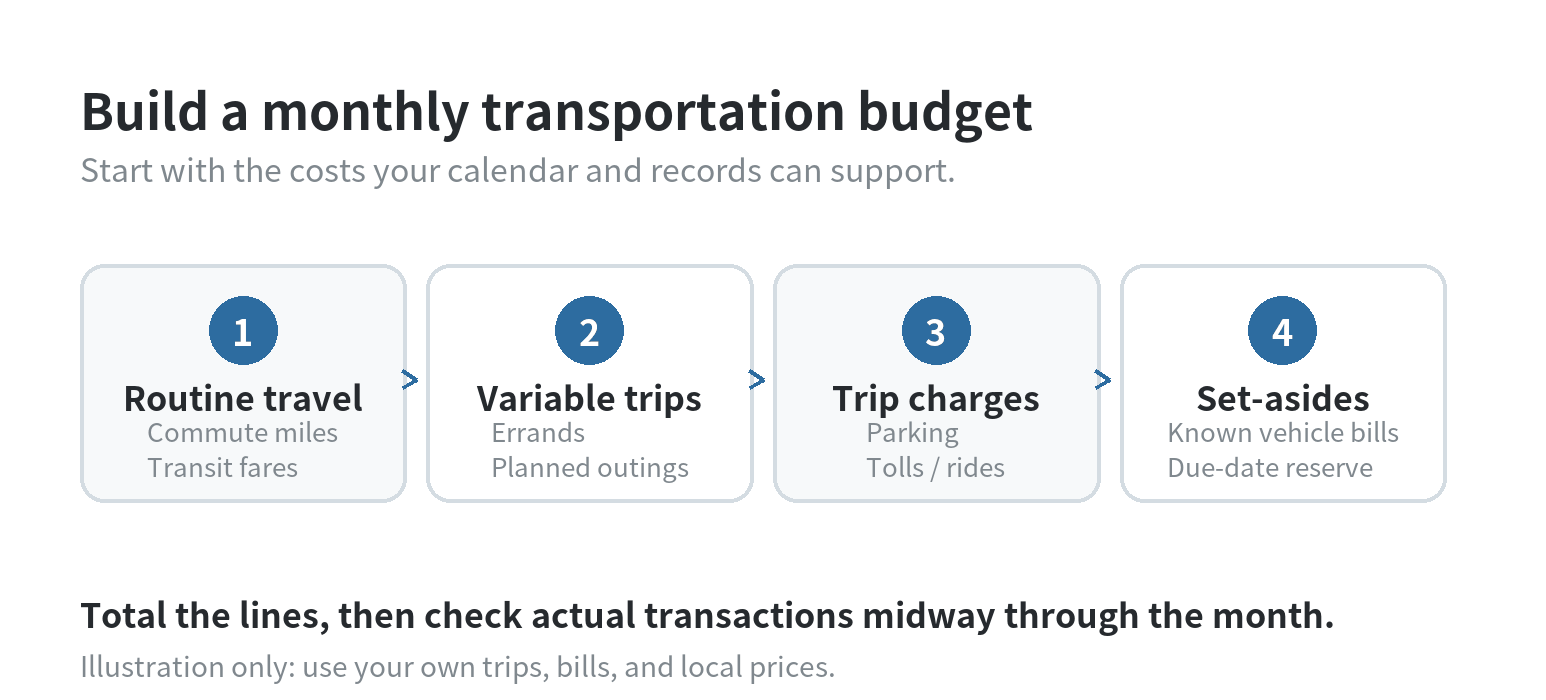
Open your calendar and list the travel you expect: work or school commutes, regular appointments, errands, and any scheduled trips. Mark which trips require your car and which use a bus, train, taxi, or ride-hailing service. The aim is to map the month before setting a dollar cap.
For driving, use recent odometer readings or trip records to estimate how many miles you drive in a month. Separate routine miles from occasional travel, such as a longer visit or a seasonal commute. If your schedule changes from week to week, use the calendar for the upcoming month and leave room for the known variation instead of treating every month as identical.
For public transportation, start with the fare products you already use and the trips they cover. Check the current fare with the transit agency serving your route. For rides, parking, and tolls, use your own account history, receipts, statements, or posted rates for the places you expect to visit. A citywide average can miss a route-specific fare, a workplace parking charge, or a toll road you use only on certain days.
Turn miles into a fuel line
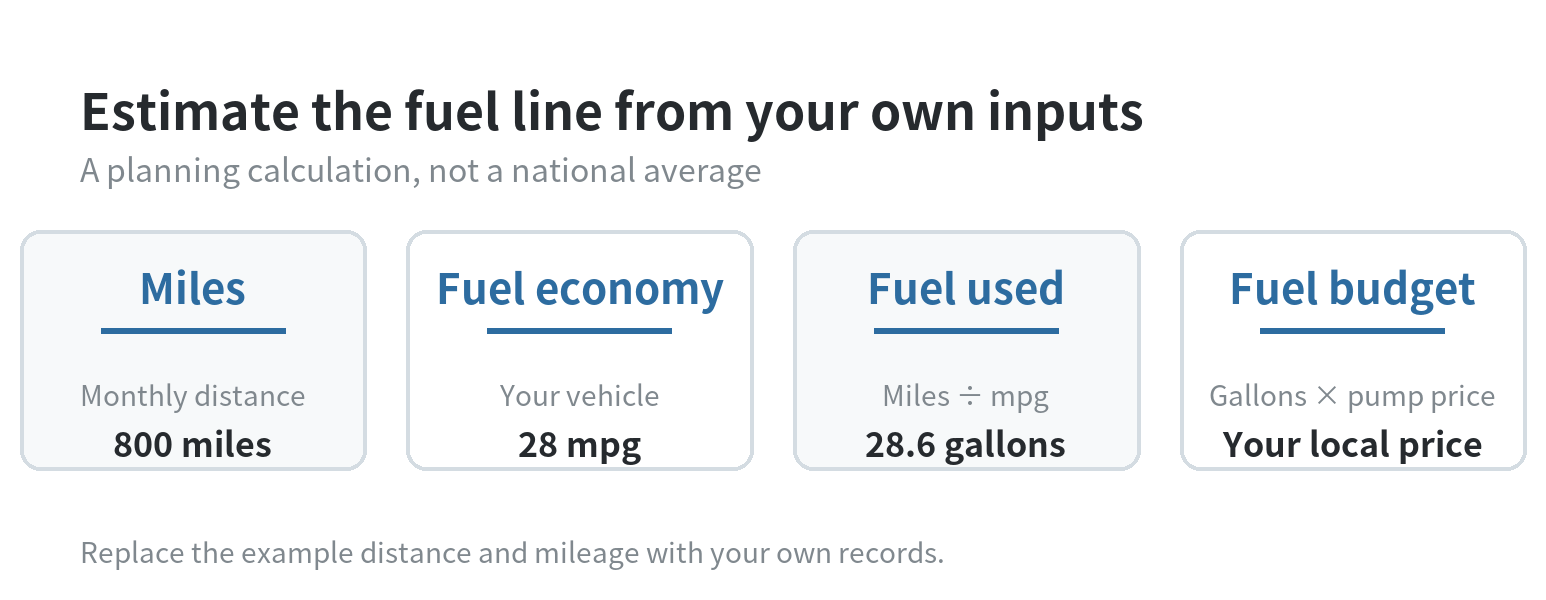
Estimate gallons first, then multiply by the pump price you expect to pay: monthly miles ÷ your vehicle’s miles per gallon × dollars per gallon. The U.S. Department of Energy’s Alternative Fuels Data Center uses distance divided by fuel economy to estimate gallons, then multiplies gallons by price to estimate fuel cost. Its Vehicle Cost Calculator accepts a driver’s mileage, fuel economy, and fuel price as inputs.
For a made-up example, 800 miles at 28 miles per gallon uses about 28.6 gallons. Multiply those gallons by your local price per gallon to get a fuel amount you can replace with your own numbers.
Use the odometer and receipts to check how closely your estimate fits. If you do not know your actual fuel economy, divide miles driven between fill-ups by the gallons purchased over the same period. The U.S. Department of Energy’s Vehicle Cost Calculator also lets a user enter custom city and highway fuel-economy values and fuel prices.
For a current benchmark, the Energy Information Administration publishes retail gasoline prices by week for the United States, regions, and selected states. EIA says prices vary across regions, with local supply and demand, fuel specifications, and taxes among the factors. Use a nearby state or regional price as a planning reference, then substitute the price you see locally. The EIA page was checked on October 1, 2026.
Give recurring and occasional costs different jobs
Keep a monthly transportation plan in a small set of lines. The table is a worksheet, not a recommended spending level.
| Budget line | What to enter | Where to get your number |
|---|---|---|
| Gas | Expected gallons multiplied by local dollars per gallon | Miles, fuel economy, pump price, receipts |
| Transit | Pass or fares for the trips on your calendar | Transit agency fare and your trip count |
| Parking and tolls | Expected visits or crossings | Receipts, statements, facility or road rates |
| Taxi or ride-hailing | Trips you plan to take | Past receipts and current trip estimates |
| Vehicle upkeep | Known service, registration, or repair costs | Invoices, renewal notices, maintenance records |
Separate recurring bills from costs that arrive unevenly. A transit pass may be predictable while a tire replacement or annual registration is not. If you have a known vehicle bill, divide it by the number of months before it is due and reserve that amount in a vehicle-cost line. For example, a planned $360 expense due in six months works out to $60 per month. The arithmetic helps distribute a known cost; it does not predict what a repair will cost. If you share transportation bills with another person, agree on which charges count as shared before splitting them; our shared household expense budget covers that decision.
Vehicle insurance, loan payments, and registration do not rise and fall with the miles driven, so keep them visible in your broader transportation total even if you track fuel separately. This prevents a low gas estimate from making car travel look cheaper than the amount leaving your checking account.
Build the line around your pay schedule
Set aside the planned monthly amount when income arrives. For each deposit, reserve what is due before the next deposit and leave any remaining amount in the transportation category. Put bill due dates and deposit dates on the same calendar, then assign each cost to the deposit that arrives before it is due. If a deposit date shifts, reassign the planned cost using the date you actually receive the money.
Suppose your take-home pay is $3,600 in a sample month. You could list rent, utilities, food, minimum debt payments, savings, and transportation before deciding whether another trip fits. Within transportation, separate fuel from fares and parking so one category does not silently absorb money reserved for another. The sample income is only an illustration; replace it with your deposited pay.
For a short month or an irregular paycheck, prioritize costs tied to a fixed obligation or a trip you cannot easily move. Then decide whether optional trips can be combined or shifted. Avoid counting an unconfirmed reimbursement or employer benefit as cash available for fares; enter money only when its amount and timing are clear to you.
Use a midmonth check to catch a mismatch
Choose one date in the middle of the month to compare what you planned with what you have spent. Review card and bank transactions, fuel receipts, transit reloads, parking charges, toll statements, and ride receipts. Assign each transaction to one line. A charge that appears under both “gas” and “commute” makes the total look larger than it is; a toll omitted from both makes it look smaller. If you keep spending records on your phone, our budget tracker setup shows a simple way to record transactions.
If fuel is running ahead, ask what changed: more miles, a higher local pump price, a longer route, or an estimate based on old driving habits. EIA updates its gasoline series weekly, so a change in the price reference can be checked against its current release. If the price assumption still fits, revise the expected mileage or move available money from a flexible category before making another trip commitment.
If a bus pass or parking bill is higher than the estimate, use the actual charge in next month’s plan. For costs that happen only a few times a year, keep a note of the date and amount so the next plan accounts for them. You do not need to rebuild the full budget after one unusual trip; record the reason and adjust the category that caused the gap.
When the month closes, keep the useful number
At month-end, compare the plan with what cleared your account. Carry forward the categories that matched, and change only the assumptions that were off. If travel changed because of a temporary event, label it as temporary rather than baking it into every future month. If the same trip pattern repeats, update the routine mileage or fare estimate.
A budget is easier to use when it reflects the full trip cost: fuel or fare, plus the charges attached to that trip. Keep the calculation simple enough to repeat, and let your own calendar, records, and local prices set the next month’s starting point. If money remains in a category, decide whether to carry it forward for a planned high-travel month or return it to the general budget. If the line runs short, note the cause before changing next month’s amount; a single unusual trip may not represent your routine.
FAQ
How should I budget fuel if my household uses two different cars?
Estimate each car’s fuel separately, then add the amounts for the household total. Use the miles, fuel economy, and local pump price that apply to each vehicle.
How do I budget when I alternate between driving and public transit?
Keep a line for each travel mode and assign expected trips from your calendar to one of them. That shows what changing the commute pattern does to fuel and fare spending without mixing the two amounts.
How should I budget for a road trip that crosses into another month?
Put expected fuel, fares, tolls, and parking in the month when you expect to pay them. Keep prepaid costs with their actual charge date and reserve later trip costs in the month you will use them.
What is the simplest way to split gas costs for a carpool?
Agree on a repeatable contribution before the rides begin, then budget only the amount you expect to pay. Record reimbursements or shared contributions once so the same fuel expense is not counted twice.
Last updated: October 2026.
Last updated: 2026-10