A water-hammer arrestor can address the sharp bang that follows a fast-closing valve. It helps only if the sound is a pressure shock.
Identify which fixture triggers the sound, then check its arrestor instructions and local plumbing rules.
A loose support or worn valve needs a different fix.
What makes a pipe bang when the valve closes
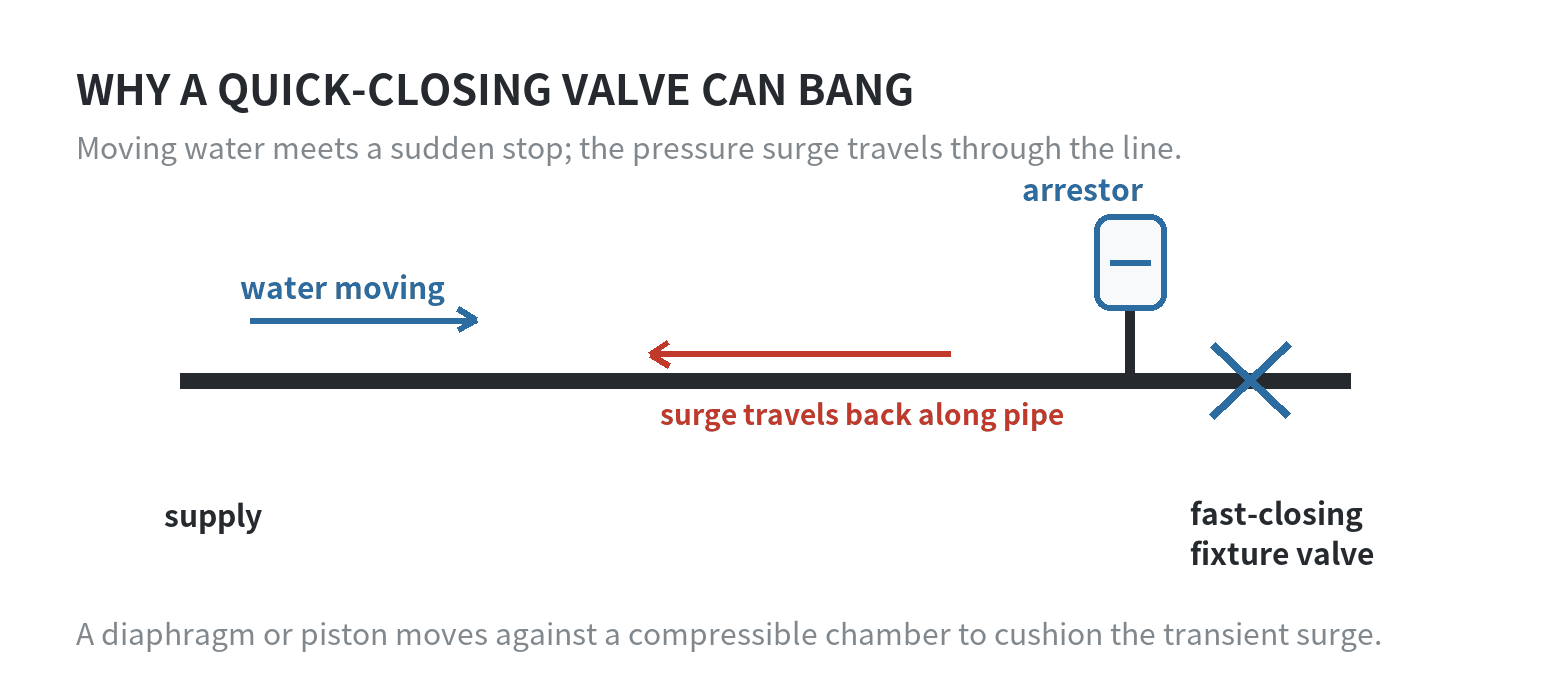
When moving water stops suddenly, its momentum creates a pressure rise at the closing point.
The U.S. Environmental Protection Agency’s Quieting in the Home says a pressure wave reflects through the piping.
Repeated reflections create hammer-like sounds.
A fast-closing faucet, washer valve, dishwasher valve, or ice-maker valve can trigger the sound.
An arrestor adds a compressible cushion beside the affected supply line. A diaphragm or piston moves against an air or gas chamber.
That movement gives the surge room to dissipate. Watts’ Series 05 instructions say arrestors control shocks from fast-acting valves.
ASSE International’s product standards identify ASSE 1010 as the performance standard for water-hammer arresters.
Use the sound and timing to find the source
Note which appliance or fixture was running and whether the bang happens as its water shuts off.
If the sound follows one washer or dishwasher cycle, trace its hot and cold supply lines. The arrestor belongs on the line serving that valve.
A bang alone does not confirm water hammer. The EPA guide also identifies loose pipe hangers as a cause.
A surging line can move in a loose hanger and strike the building. The same guide links chattering with worn valve stems, faucet washers, and seals.
If the noise occurs during flow, changes with faucet position, or comes from a pipe striking the structure, an arrestor may not address it.
The EPA guide also describes sudden starting of water flow as a possible source of hammering. Note whether the bang comes at startup or shutoff.
If loose supports are suspected, ask the plumber to inspect the pipe supports. An arrestor will not secure a pipe that strikes framing.
Listen from a safe, accessible spot and write down the trigger. Do not open a wall or ceiling just to locate a pipe.
If a line is hidden, the noise affects multiple rooms, or a fitting is leaking, ask a plumber to trace the system before choosing a part.
An ice maker can also have a quick-closing inlet valve. Watts’ Series 05 instructions list ice makers among the shock sources to consider.
If the noise happens during a refrigerator’s water fill, note whether it ends with the cycle.
This helps distinguish valve noise from a steady hum.
Record which fixture was on, whether the sound came at shutoff or during flow, and which room or wall seemed to carry it.
Sound travels along framing and piping, so the loudest spot is not necessarily the source. Share the pattern rather than guessing where the pipe runs.
Place the arrestor by the culprit valve
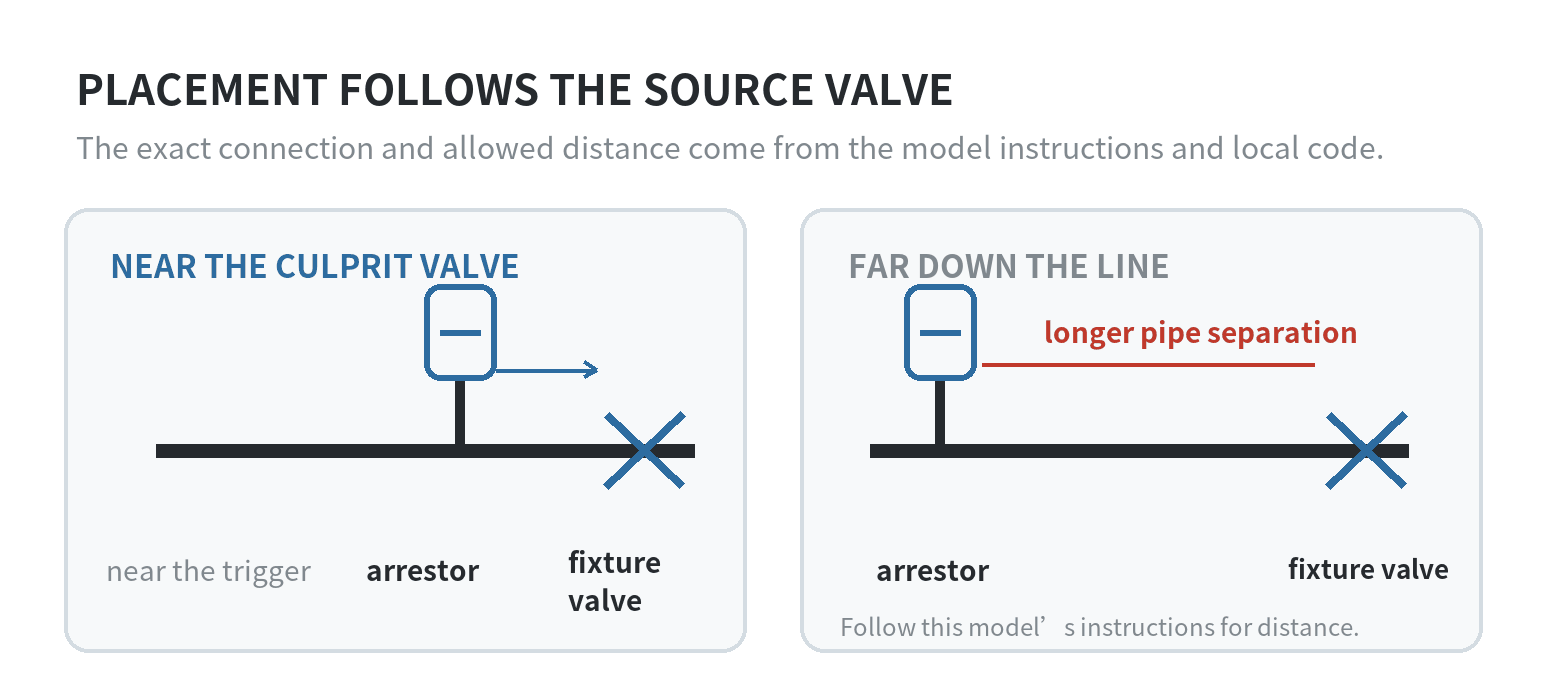
Start with the arrestor maker’s instructions, not a distance copied from another model.
Watts’ Series 05 instructions say to place the unit close to the shock source. They also direct installers to consult local plumbing codes.
That is why identifying the culprit valve comes before choosing a place on the main line.
Sioux Chief’s 660-GT specification sets a maximum distance of 6 feet from the culprit valve or faucet for that product series.
That distance applies to the listed product. It is not a universal placement limit.
For a washer, check whether the instructions call for an arrestor on both hot and cold inlets.
Sioux Chief’s 660-GT sheet says to install arrestors on both hot and cold supply lines where applicable.
Other models have different connections and installation details. Match the model to the pipe material, connection, and available space.
A threaded hose connection, compression tee, and soldered connection are not interchangeable just because they serve a similar purpose.
A residential point-of-use arrestor differs from a device sized for a shared branch or commercial plumbing group.
Sioux Chief’s sizing guide treats residential units as point-of-use applications. Its commercial guidance uses branch-line fixture units.
If multiple fixtures or a concealed branch are involved, a plumber can identify the right placement and size.
Check the code and the work before opening a line
New York City’s Plumbing Code §604.9 calls for an arrestor where quick-closing valves are used.
It also requires installation under the manufacturer’s instructions and conformity to ASSE 1010.
The code is a model document. Local jurisdictions can adopt editions or amendments.
New York City’s Plumbing Code §604.9 requires an arrestor at quick-closing valves, installation under the manufacturer’s instructions, and conformity to ASSE 1010.
Those rules apply within the city.
Check the rules where the home is located before treating one code as universal.
Work that cuts, solders, or changes concealed water piping has more variables than an accessible threaded connection.
Pipe material, shutoff condition, water isolation, leak testing, permits, and licensing can all affect the job.
Watts directs installers to consult local code before installation.
California’s Contractors State License Board includes water piping in C-36 plumbing work.
The California classification also covers maintenance or replacement of plumbing-system items. Licensing categories and requirements differ by state.
For altered or hidden piping, ask a licensed plumbing professional to assess the job and check local requirements.
Watts and EPA WaterSense distinguish a pressure-reducing valve that manages home pressure from an arrestor’s local surge cushion.
What to have ready before you ask about a part
Record the fixture that triggers the noise, whether it occurs at shutoff or during flow, and whether it affects one line or multiple rooms.
Take a clear photo of the accessible shutoff and supply connection, including any printed pipe or fitting markings.
Those details help a plumber or parts counter identify whether the connection is threaded, compression, or another type.
Do not choose a unit by the outside diameter of a pipe alone. Connection type, pipe material, hot or cold line, and valve location matter.
The manufacturer’s sizing instructions matter too. New York City’s code requires arrestors to conform to ASSE 1010.
Check that the product listing and exact application match local requirements.
Ask a licensed plumber before taking apart a concealed line or one that is hard to isolate.
Before comparing a package or specification sheet, check the stated application, connection type, and fixture guidance.
A washer hose adapter may fit a washer shutoff but not a rigid supply line at a sink. Similar-looking bodies do not establish compatibility.
Record the model number and look for its exact instructions. Confirm the listed application, connection, and any stated operating limits.
An ASSE 1010 reference connects the product to the arrestor standard named in the plumbing code. It does not replace checking local code or fit.
For more on pipe material and fitting compatibility, see our pipe and fitting overview.
Use that as background only; the arrestor’s own instructions govern its connections.
FAQ
Can I install a water-hammer arrestor sideways?
It depends on the model. Sioux Chief’s HydraRester instructions allow any angle for those listed models.
Watts says its Series 05 unit functions in any orientation, while showing preferred positions for shock absorption.
Check the exact unit’s instructions and local access rules.
Does a sealed water-hammer arrestor need routine maintenance?
ASSE 1010 describes covered arrestors as providing continuous protection without maintenance.
Follow the exact model’s instructions and local plumbing requirements for inspection and access.
Can a water-hammer arrestor go behind a finished wall?
Only if that model and local access rules allow it. Sioux Chief says its HydraRester models do not require an access panel.
The same instructions say to confirm local access requirements. Do not assume another model has the same approval.