If you are choosing between vinyl and fiber cement siding, compare the full installation and upkeep plan, not just the panel appearance. Vinyl is lighter and needs room to move as temperatures change; fiber cement is a cement-based board that calls for silica-dust controls when cut. Your wall condition, preferred finish, crew, and local code will determine which trade-off matters to you.
Start with the wall, not the sample
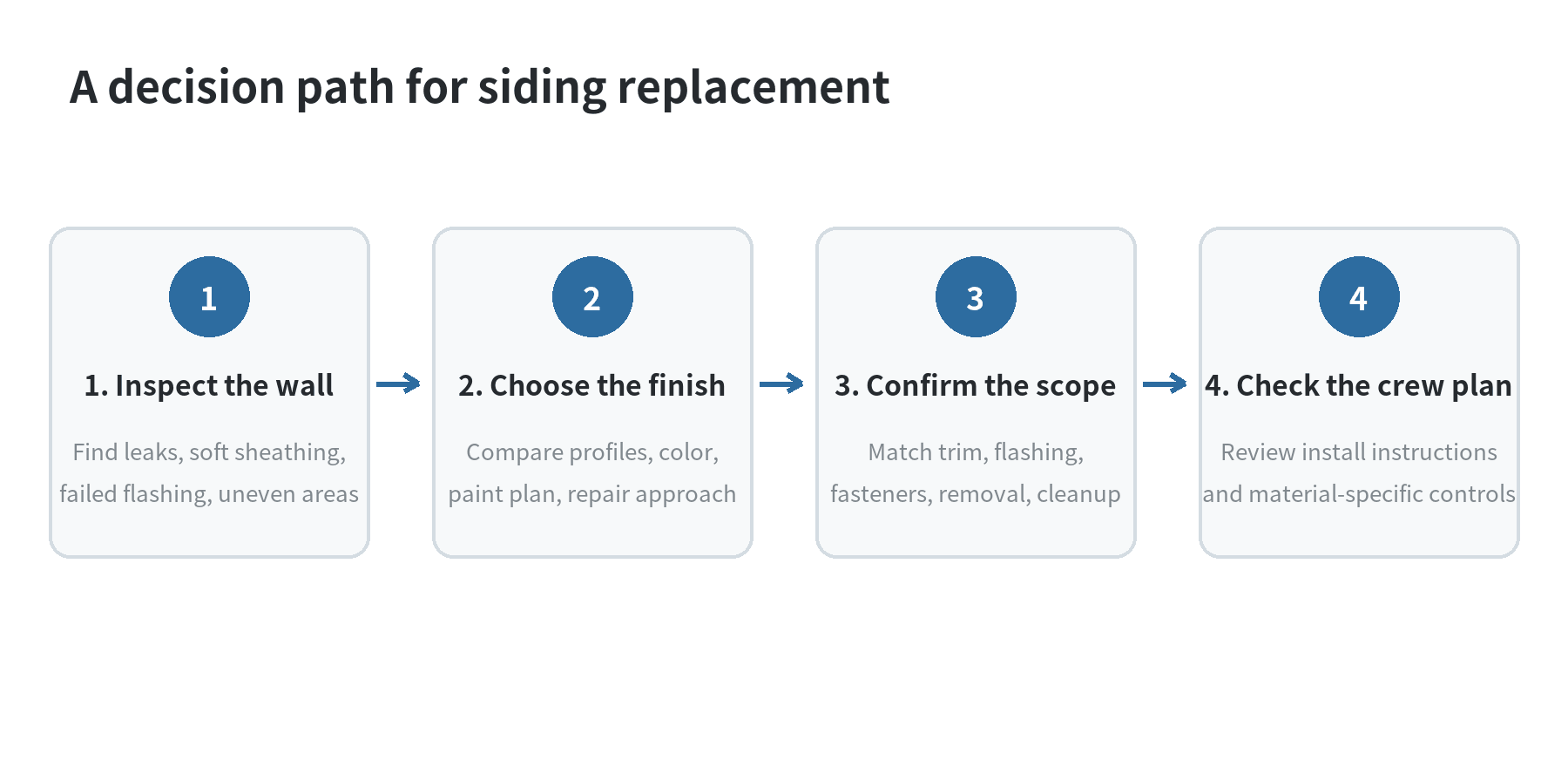
Siding is the outer cladding in a wall assembly. It does not replace the layers that manage water behind it. Before comparing colors, ask what the existing cladding is hiding: damaged sheathing, missing flashing, moisture at windows, or uneven framing can change the scope whichever material you choose.
Ask each installer to describe the same work in writing: removal and disposal, inspection of the sheathing, water-resistive barrier, flashing at windows and doors, trim, corner details, and cleanup. The U.S. Department of Energy’s Building America guidance treats flashing and drainage as parts of the wall’s water-management system. A new face layer cannot correct a leak path that remains behind it.
During the walk-through, photograph each wall and mark visible stains, soft trim, cracked caulk, and prior patches on a simple elevation sketch. Ask the estimator to separate confirmed work from concealed-condition allowances. That gives you a record to compare against the crew’s findings after removal, when sheathing and old flashing are visible.
Ask how the water-resistive barrier will connect to each opening instead of accepting a general promise to install new wrap. The Department of Energy’s Water Managed Walls guidance describes flashing as part of a drainage path that directs water outward. A written detail should identify the order of the barrier and flashing at windows, doors, and penetrations, along with how the bottom edge drains.
Also check local permit requirements, fire rules, and any homeowners’ association design limits before settling on a profile or color. A sample board shows color and texture; it does not show how a window opening will be flashed or how the product will be fastened.
Compare the materials in the places you will notice
| Decision point | Vinyl siding | Fiber cement siding |
|---|---|---|
| What it is | Rigid PVC cladding panels. | Boards or panels made from cement, sand, and reinforcing fibers; exact formulations vary. |
| Movement and fastening | Panels expand and contract with temperature; installation must allow free movement. | Follow the selected product’s fastening, clearance, and joint instructions; boards are not installed like vinyl panels. |
| Finish choices | Color and texture are part of the panel finish. | May arrive primed for field painting or with a factory-applied finish, depending on product. |
| Cutting work | Cutting methods vary by panel and detail. | Cutting can create respirable silica dust; tools and dust controls matter. |
| Planning question | Can the installer preserve movement at ends, corners, and openings? | Who will cut the boards, where, and with what dust collection and cleanup method? |
Each product line has its own specifications. Thickness, finish, accessory system, climate rating, warranty exclusions, and installation details differ by manufacturer. Use the selected product documents to confirm which options and instructions apply to that line.
Compare the same wall area and the same list of accessories on every proposal. Record whether tear-off, haul-away, sheathing repairs, housewrap, flashing, trim, and painting are included or priced separately. If one estimate includes replacement of damaged wood and another assumes the surface is ready, their totals describe different jobs even when both name the same siding material.
Have each installer identify the exact panel or board profile and show the matching installation instructions. The Vinyl Siding Institute’s manual describes movement requirements for vinyl fastening, while fiber-cement instructions set their own fastening and clearance details. Ask the crew to explain how its written scope follows those product-specific details at corners, openings, and board ends.
Look closely at movement, water, and finish
The Vinyl Siding Institute’s installation manual says vinyl panels move as temperature changes. Its manual gives clearances for particular installation conditions and tells installers to leave panels free to move side to side. That makes fastening technique and end clearances part of the material choice: a panel pinned tightly in place can buckle or distort. The exact dimensions belong to the selected product’s current instructions.
For either material, ask how water gets back out of the wall assembly. Request details for window head flashing, door trim, roof-wall intersections, penetrations such as hose bibs, and the bottom edge. Those transitions are more useful to review than a broad claim that a cladding is “waterproof.” Cladding, flashing, and the drainage plane have separate jobs.
Finish affects the future work. A field-painted fiber cement product requires a coating plan and later repainting decisions; a prefinished option has its own care and repair instructions. Vinyl color is integral to the panel, but color availability and surface appearance vary by line. Get the maintenance sheet and warranty for the exact product, and ask what happens if a panel or board is damaged.
If appearance is decisive, view samples outside in shade and direct sun, then compare them with the home’s roof, masonry, and trim. Look at full-size profile samples when possible: a small chip cannot show shadow lines, lap depth, or how corner and window trim will look together.
Plan the fiber cement cutting step before work starts
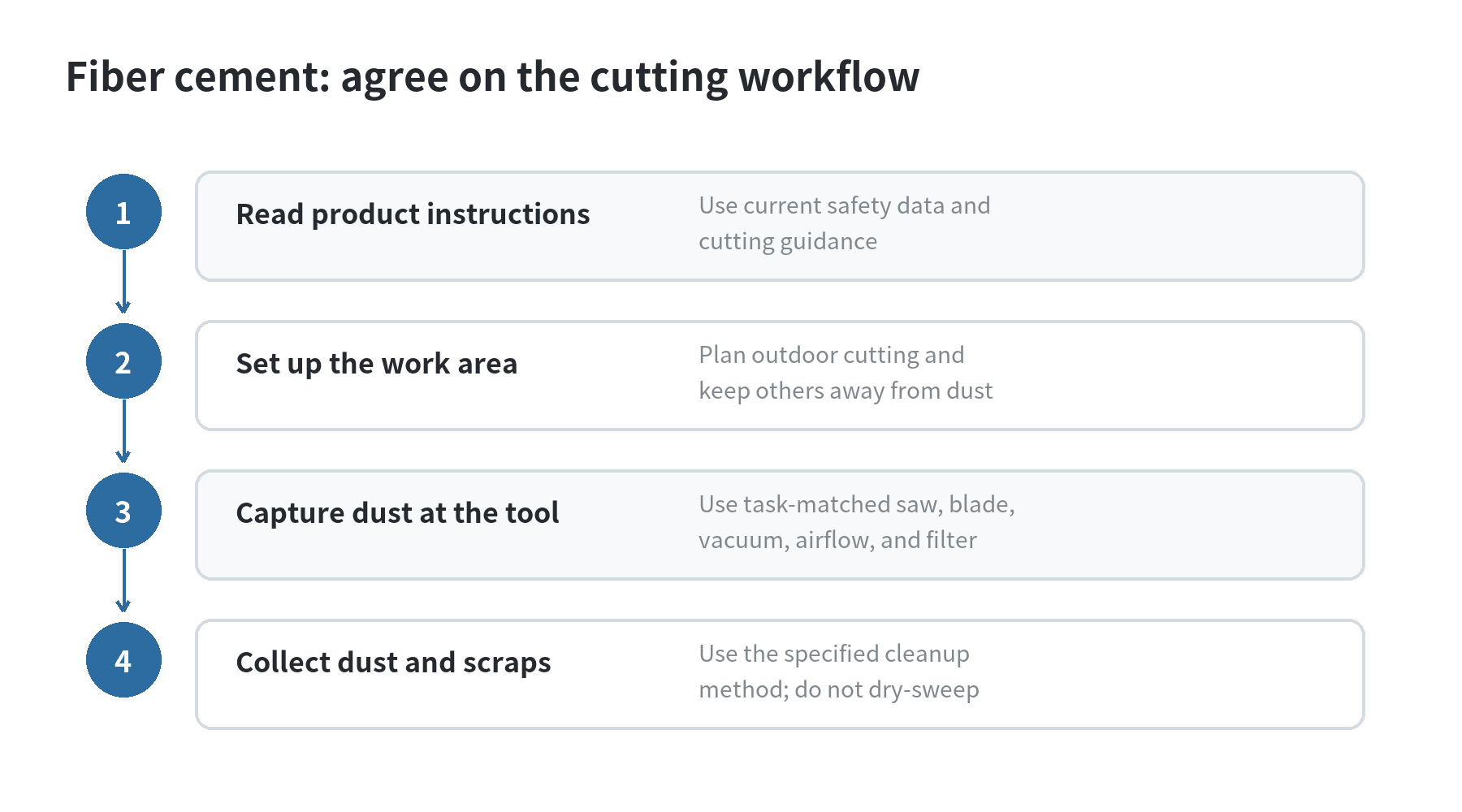
OSHA says cutting fiber-cement board with a handheld circular saw can generate airborne respirable crystalline silica. Its fact sheet describes an outdoor vacuum dust-collection setup for the saw task it covers, including a partially enclosed blade, suitable airflow, and an exhaust filter rated at least 99 percent efficient. A vacuum attachment alone is not a complete plan if the tool, filter, or work method does not match the task.
Ask the contractor to name the cutting method, where the station will sit, how dust will be captured, how nearby people will be kept away, and how dust and scraps will be cleaned up. Follow the current product manual as well as applicable OSHA requirements. OSHA’s construction silica FAQ says employers must follow manufacturer instructions related to dust control. For a homeowner doing the work, the product’s safety data sheet and cutting guide are the starting documents; do not dry-sweep accumulated dust.
These controls concern work that cuts or otherwise disturbs the board. James Hardie’s Silica Safety Resources page says there is no dust concern from its fiber cement once it is installed on the home, while OSHA’s fact sheet focuses on dust generated during cutting. Keep the distinction clear when discussing the job with the crew.
Build a comparable project scope
Ask each bidder to answer the same questions so you can compare the work rather than a headline material name:
- What existing layers will be removed, and what conditions trigger added sheathing or flashing work?
- Which exact siding line, profile, finish, trim, and fasteners are included?
- How will windows, doors, roof edges, corners, and wall penetrations be flashed and finished?
- For fiber cement, what cutting controls and dust cleanup are included?
- Which maintenance instructions and written warranty apply to the selected product?
A scope that leaves flashing, trim, disposal, or surface preparation vague is hard to compare with a complete scope. If the home already has a moisture problem, resolve its source and document the repair before covering the wall. For paint planning around exterior work, see our exterior paint and stain guide; for cleaning equipment, our pressure-washer guide explains the decisions involved in choosing a washer.
The useful next step is to gather the product installation and care documents, then ask two installers to quote the same wall assembly and details. That lets you compare the finish you want with the construction work each option requires.
Think through who will use the exterior and how close the work is to patios, doors, and neighboring property. A cutting station placed beside an open window or a busy walkway can affect how the work area is organized. Ask for the proposed location before the start date, then confirm how the crew will keep residents and visitors clear while boards are cut and debris is collected.
Make the completion check part of the quote discussion. Walk the exterior with the installer and review visible joints, corner trim, window and door transitions, the lower edge, and the cleanup area. Keep the product care sheet and warranty with the final scope, and note who to contact if a loose panel, damaged board, or finish issue appears later. Before signing, put the selected finish, included work, excluded repairs, dust-control method, and cleanup responsibility in the same written proposal.
FAQ
Can vinyl siding be installed over existing siding?
It depends on the wall condition and the selected product’s instructions. Ask the installer to check whether the old layer is flat and sound, whether openings and trim can be flashed correctly, and whether local code permits the proposed assembly.
Does fiber cement siding arrive ready to paint?
Some products are primed for field painting and others have factory-applied finishes. Check the product label and installation guide for the finish included, paint compatibility, edge treatment, and care instructions.
What should a contractor explain about silica dust?
Ask what tool and dust collection method the crew will use, where cutting will happen, how access to that work area will be controlled, and how debris will be collected. OSHA’s fact sheet and the selected product’s safety instructions describe controls for the specific task and product.