If you are replacing a smoke alarm, first match its power and connection type to the alarm already in your home, then choose the sensing option.
Ionization and photoelectric sensors respond differently to fire conditions; a dual-sensor model combines them, while interconnected alarms make every linked unit sound when one detects smoke.
The U.S.
Fire Administration (USFA) recommends both sensor types or a dual-sensor alarm, and recommends interconnection.
What the sensor labels mean
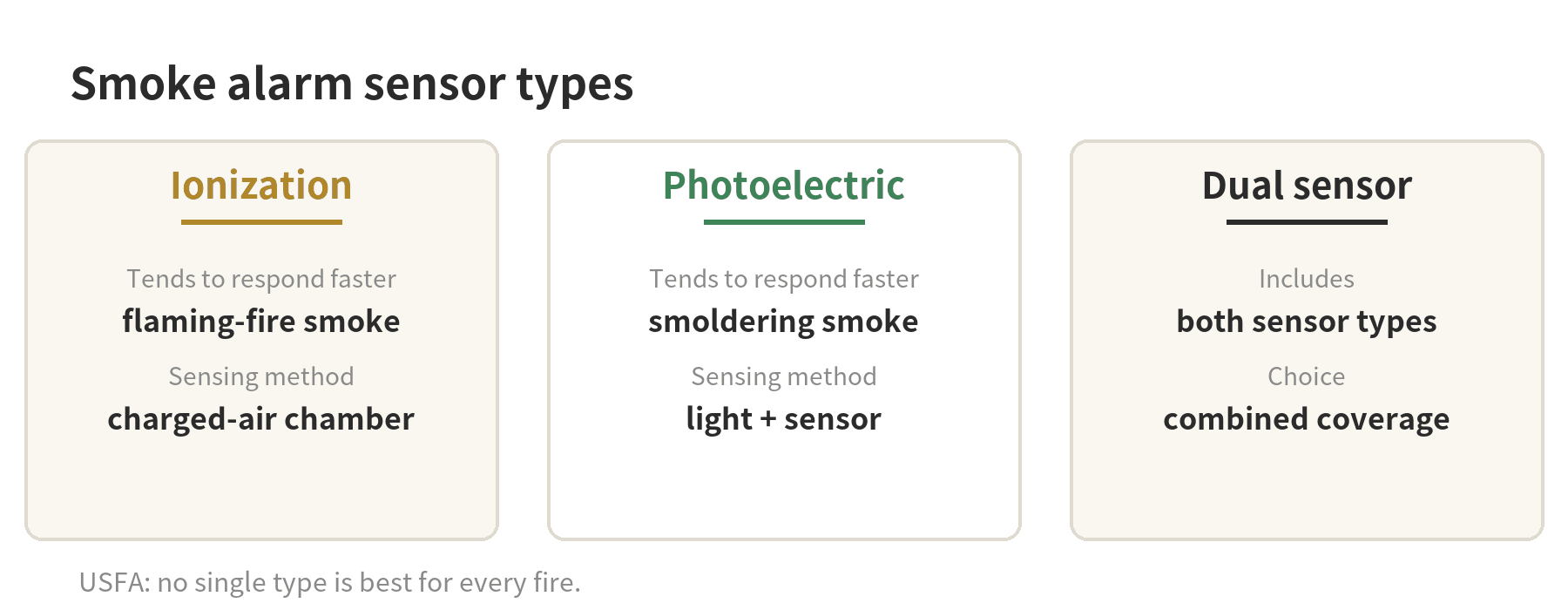
An ionization alarm detects changes in electrically charged air inside its sensing chamber.
A photoelectric alarm uses light and a sensor to detect smoke particles.
In the USFA’s summary of fire research, ionization alarms tend to respond faster to flaming-fire smoke, while photoelectric alarms tend to respond faster to smoke from smoldering fires.
Both can detect either kind of fire, and test results vary by fire conditions.
That difference is why the USFA does not call one type universally better.
It recommends having both types in the home, or choosing dual-sensor alarms that contain both.
If a single replacement is all you can install today, a working, correctly placed alarm is the immediate priority; you can use the recommendation to plan the rest of the home’s coverage.
Choose the replacement by working backward
Before looking at packages, remove the old alarm only if it is safe to do so and read its label and manual.
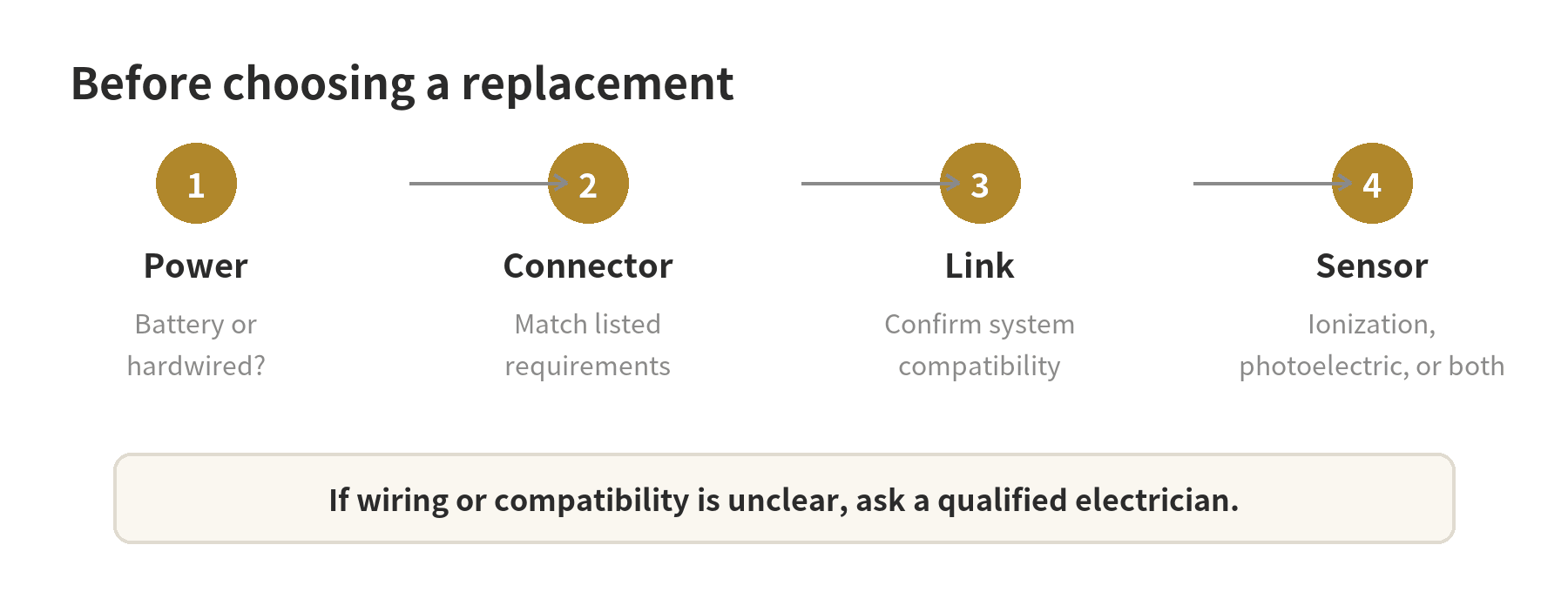
Record whether it is battery powered or hardwired, whether it has a backup battery, how it attaches, and whether it is connected to other alarms.
Take a clear photo of the label and connector.
Those details help you compare the replacement’s listed specifications without relying on the front-of-box name.
- Battery powered: Check the battery type, whether the battery is replaceable or sealed, and the alarm’s replacement instructions.
- Hardwired: Match the home’s electrical setup and connector requirements. A plug that looks similar does not establish compatibility.
- Interconnected: Confirm the new unit is compatible with the existing alarms and system, using the manufacturer’s compatibility information.
- Combination unit: Read the label to distinguish a smoke-only alarm from a combination smoke and carbon monoxide alarm.
USFA says hardwired alarms should be installed only by qualified electricians.
If the wiring, connector, or circuit is unclear, keep the old alarm in place until a qualified electrician identifies the correct replacement and installation method.
Do not cut, splice, or adapt house wiring based on appearance.
For a simple one-for-one replacement, note the old alarm’s model before removing it and compare the manual for the replacement with the existing system.
Keep the old model information until the new unit passes its test and any system test described by the manufacturer.
For a renovation or a move into an older home, make an inventory room by room.
Mark which alarms are battery powered, which connect to house wiring, and which sound together.
This turns a vague “replace the alarms” task into a clear list of compatible units and any wiring questions to resolve.
Interconnected alarms: check the whole system
With interconnected alarms, one unit sounding causes the linked alarms to sound too.
The connection may use house wiring or a wireless link.
Replacing only one alarm can leave the system inconsistent if the replacement cannot communicate with the others, so identify the make and model of the installed units and check the replacement maker’s compatibility list or instructions.
Do not assume that two alarms will link because they share a wireless label or use the same power source.
If you cannot confirm compatibility from manufacturer documentation, ask the manufacturer or a qualified electrician before replacing one unit.
For a home without an interconnected setup, consider the feature as part of planning the home’s overall smoke alarm coverage; local requirements can vary.
Check placement and local requirements
The CPSC recommends smoke alarms on every level of a home, inside each bedroom, and outside sleeping areas.
USFA gives the same basic placement guidance and says alarms should be on the ceiling or high on a wall; follow the manufacturer’s placement instructions.
These are home-safety recommendations, not a substitute for local code requirements.
Alarm rules can differ by city, county, and state, including what type is permitted or required.
Before choosing a model for a remodel, rental property, or a home with older wiring, ask the local fire marshal or building department what applies.
Check the alarm’s certification mark and installation instructions, too.
CPSC identifies NFPA 72 and UL 217 among the model codes and standards related to smoke alarm performance and safety.
A multi-unit package can simplify matching, but confirm that every included alarm has the sensing, power, and communication features you need.
A package label alone does not show whether a unit will pair with an older alarm already on the ceiling.
If you rent, ask the property manager who is responsible for the alarm system and whether a building-wide model or wiring standard is already in use.
Keep the request specific: share a photo of the alarm label and ask which replacement is approved for that location.
Local rules and lease responsibilities differ.
After installation, test and date it
Follow the new alarm’s manual for installation, testing, cleaning, and battery care.
USFA and CPSC recommend testing alarms monthly.
USFA says alarms should be replaced 10 years from the manufacture date, and CPSC advises following manufacturer instructions for replacement.
Read the date on the unit itself; the date you install it is not necessarily its manufacture date.
Write the installation date and model in a household maintenance note, but keep the manufacturer’s date and end-of-life instructions as the replacement reference.
A chirp may mean a low battery or another condition described in the manual.
Do not silence a warning by leaving the alarm without power; use the instructions to identify the cause and restore a working alarm.
When the new alarm is installed, use its test button and follow any additional pairing or system test in the manual.
If other interconnected alarms are supposed to respond, verify that behavior using the maker’s test procedure.
A beep from only the replacement may not establish that the other units are linked.
Keep the user guide or a photo of its maintenance page with your household records.
If the unit has a hush feature, learn how the manual says to use it before a nuisance alarm occurs.
Never remove a battery or disconnect power as a routine way to stop nuisance alarms.
A smoke alarm detects smoke from fire.
A carbon monoxide alarm detects carbon monoxide, a different hazard, so one device does not automatically replace the other; check the home’s separate CO alarm coverage.
FAQ
Can I replace a hardwired alarm with a battery-only model?
Check local requirements and the home’s alarm system before making that change.
A hardwired unit may be part of a required or interconnected setup, and USFA says a qualified electrician should install hardwired alarms.
What if the old alarm’s model number is unreadable?
Photograph the wiring, connector, mounting plate, and any visible labels, then ask a qualified electrician or the original manufacturer to identify the system.
Do not infer electrical compatibility from the shape of a plug.
Does a sealed 10-year battery mean I keep the alarm for 10 years?
Use the alarm’s manufacture date and its own replacement instructions.
USFA says alarms need replacement 10 years from manufacture, while its maintenance guidance also tells readers to follow the manufacturer’s instructions for sealed long-life battery alarms.
Do smoke alarms and carbon monoxide alarms do the same job?
No.
Smoke alarms respond to smoke from a fire; carbon monoxide alarms address carbon monoxide.
Check that the home has the appropriate coverage for each hazard.