Choose a tankless water heater by matching its output to the hot-water fixtures you may run at the same time, then compare that output at your local winter inlet-water temperature. Gas and electric models can both serve a home, but their fuel supply, electrical demand, venting, and rated flow differ. A box label or household-size estimate alone cannot tell you whether a unit will keep up.
Start with the busiest hour in your home
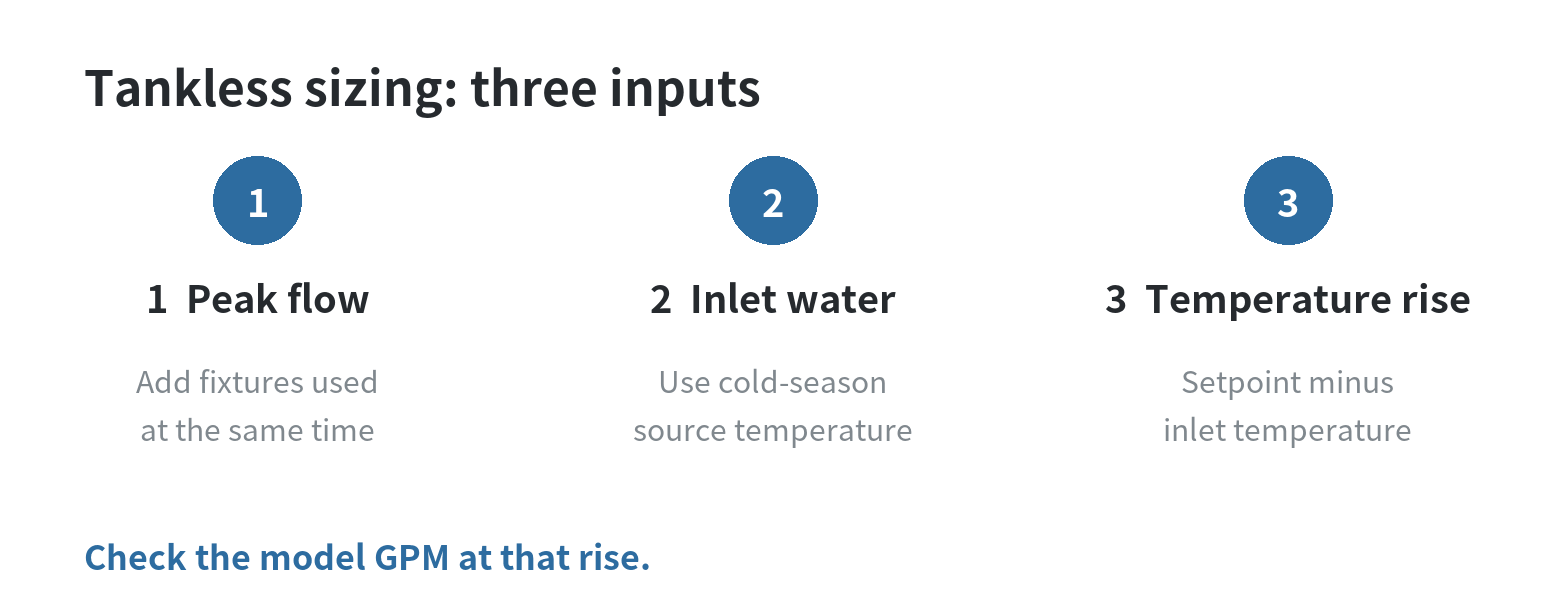
List the fixtures that might overlap: for example, two showers before work, or a shower while the dishwasher fills. Add their hot-water flow rates to estimate peak demand in gallons per minute (GPM). Use the fixture specifications or measure actual flow; a showerhead setting and a high-flow shower can produce different totals.
As a planning example, if two showers each draw 2 GPM and a sink draws 0.5 GPM at the same time, the combined demand is 4.5 GPM. Those numbers describe that example, not a standard home. If the family staggers showers, its practical peak may be lower; if laundry overlaps, add that draw too.
Rinnai’s sizing guidance, checked October 21, 2026, also begins with required GPM, then local groundwater temperature and the temperature rise. The Department of Energy’s Building Science Education page says to size for the maximum flow needed at one time and the required rise. Occupancy helps describe routines, but the overlap of fixtures is the useful design question.
Flow and temperature rise work together
Temperature rise is the difference between incoming groundwater and the hot-water setpoint. If winter inlet water reaches 50°F and you want 120°F output, the heater must raise it by 70°F. Rinnai gives the same calculation using a 60°F inlet and 120°F setpoint for a 60°F rise. Check local or installer data for winter inlet conditions rather than relying on a national average.
A unit’s maximum GPM changes with the required rise: as the incoming water gets colder or the chosen outlet temperature gets higher, the heater has more temperature to add for each gallon. Read the manufacturer’s performance chart at the required rise and confirm the rated GPM meets your simultaneous-use estimate. A headline maximum flow number without its temperature-rise condition is incomplete.
For the example above, a model rated for 4.5 GPM only at a mild rise may not satisfy the same demand when winter water is colder. Compare the chart row for your location’s design inlet temperature, not a warmer test condition. If the chart does not show the demand you calculated, ask the manufacturer or installer to identify a configuration that does.
Gas versus electric: compare the home’s services
| Check | Gas tankless | Electric tankless |
|---|---|---|
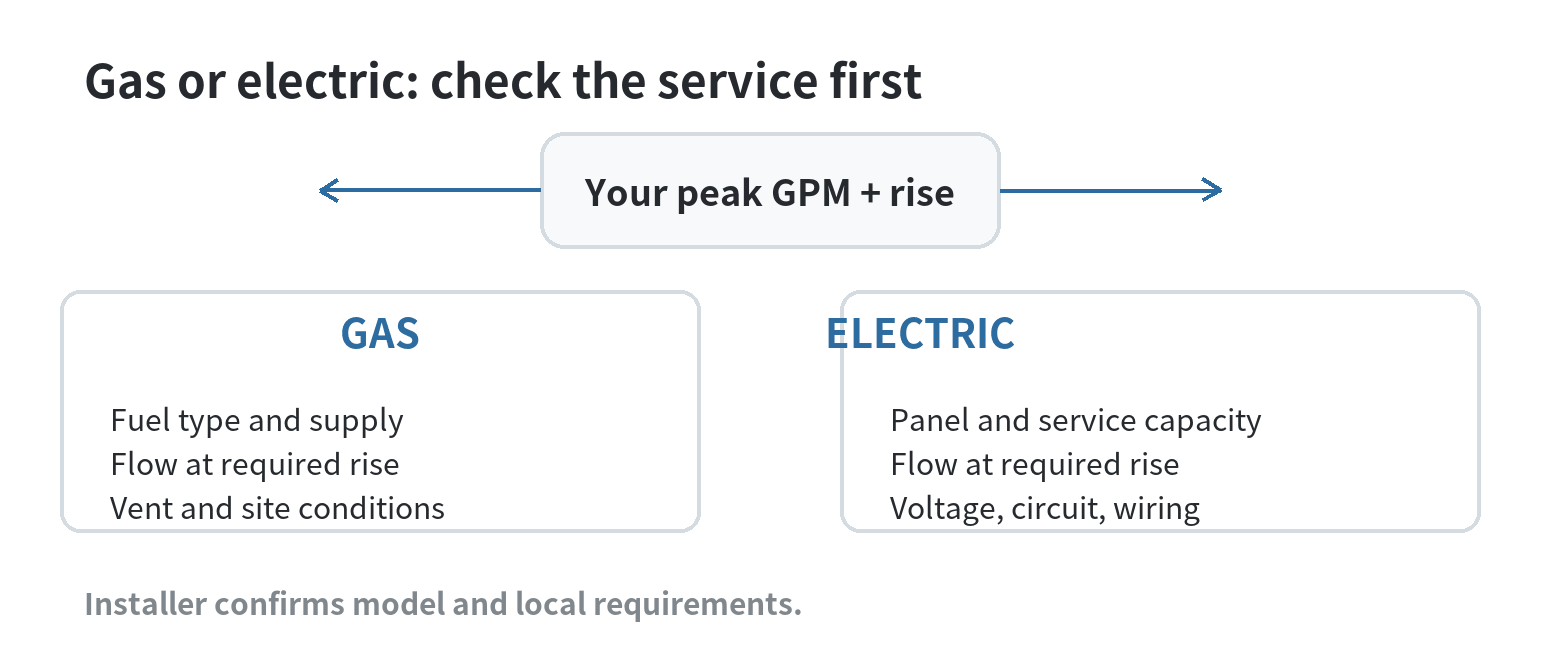
| Energy supply | Natural gas or propane connection; confirm the model’s fuel type. | Electrical service and circuits must support the unit’s rated load. |
| Heat delivery | Burner heats water as it flows; review flow at the needed rise. | Heating elements heat water as it flows; review flow at the needed rise. |
| Installation constraints | Fuel capacity, vent route, combustion air, and condensate needs depend on model and site. | Available panel capacity, voltage, breaker and wiring requirements depend on model. |
| Best first question | Can the existing gas supply and venting support the selected unit? | Can the electrical service support the selected unit without unplanned upgrades? |
The Department of Energy describes gas-fired tankless heaters as using a burner, fan, and heat exchanger; its guidance notes that sizing still depends on peak flow and temperature rise. For electric models, check the manufacturer’s electrical requirements against the home’s panel and service. Stiebel Eltron’s sizing page specifically lists available amperage, panel capacity, and dedicated-circuit requirements as items for evaluation.
Do not assume that an existing tank heater’s hookups are sufficient for a tankless replacement. A gas model may need a different fuel or vent arrangement; an electric whole-house model may require electrical work. The exact changes depend on the selected unit and the home. Ask a qualified installer to assess the gas line or electrical service, venting, clearances, drainage, and local permit requirements before choosing a model.
Use the product page as a specification sheet
Compare candidate models in a short worksheet: fuel type, indoor or outdoor placement, GPM at your required temperature rise, minimum activation flow if listed, electrical rating, venting method, and included or separately required components. The manufacturer’s current specification sheet and installation manual should answer model-specific questions; retailer category filters can help narrow options but cannot replace those documents.
For a point-of-use setup, size the unit around the fixture or room it serves. For a whole-house setup, add the fixtures that can overlap across bathrooms, kitchen, and laundry. A small heater intended for one sink does not become a whole-house model because it is tankless. Conversely, buying excess capacity does not solve a service limitation if the gas or electrical supply cannot support it.
Also confirm whether the model is designed for natural gas or propane; do not treat the fuels as interchangeable unless the manufacturer lists the unit or an approved conversion for that fuel. Check the model’s installation manual for intake and exhaust requirements, especially for an outdoor or cold-weather location. DOE’s gas-fired guidance explains that vent placement and cold-climate conditions affect the installation layout.
Read the rating chart against two household scenarios
Write down a normal busy window and an occasional peak window. Your weekday morning might include one shower and a bathroom sink; a weekend could add a second shower and laundry. The second case matters if you expect the heater to support that overlap. Do not average the two into a single smaller number: the unit has to meet the demand you want available at once.
When comparing specification sheets, keep the inlet temperature and target setpoint consistent across models. A chart that lists several GPM values may be showing output at different rises, so compare the row or curve tied to your calculated rise. If the chart lists a range, ask which rated point applies to the exact model number and fuel version. Rinnai’s FAQ explains that higher required rises reduce the flow a tankless unit can produce; its sizing sequence asks readers to identify flow, groundwater temperature, and minimum temperature rise.
Use the chart to rule out mismatches before considering cabinet size or controls. Then verify the service details from the installation manual: gas type and supply for a gas unit, or electrical load and circuit information for an electric unit. Keep the model number with the documents you bring to an installer. That way the conversation can address a specific rating and connection requirement instead of a broad label such as “whole-house.”
If the home’s routines change by season or family schedule, list the overlap that matters rather than counting residents. Two bathrooms may be used back-to-back without overlapping, while two showers can run together even in a small household. The sizing question is the water demand at the same moment, paired with the coldest inlet condition used for planning.
Questions to settle before selecting a size
- Which fixtures can run together during the household’s busiest hour?
- What is the cold-season incoming water temperature used for the sizing calculation?
- Does the manufacturer’s chart show the calculated GPM at that temperature rise?
- Can the home support the chosen fuel, venting, panel load, and model location?
- Which installation, permit, and inspection requirements apply locally?
Bring the fixture list and winter inlet estimate to the installer, then ask them to show the selected model’s output at that rise and confirm utility capacity. Local code and permit requirements vary, so confirm them with the building department or the licensed professional handling the installation. The DOE and manufacturer pages cited for this guide were checked October 21, 2026.
FAQ
Can one tankless heater run two showers at once?
It can if its rated flow at the required temperature rise meets the combined demand. Add the two shower flows, then compare that total with the model’s performance chart for local winter inlet water.
Is electric tankless a plug-in replacement for a gas tank?
No assumption is safe from the product name alone. Confirm the unit’s voltage, amperage, circuits, and panel capacity with the manufacturer’s specification and a qualified installer.
Does a larger household always need a larger unit?
Not by household count alone. The key sizing inputs are simultaneous fixture flow and temperature rise; a household’s schedule changes which fixtures overlap.
What should I ask about installation rules?
Ask which permits, clearances, venting, gas or electrical work, and inspection steps apply to the exact model and address. The local building department or licensed installer can identify applicable requirements.
Last updated: 2026-10