Size a portable generator by adding the running watts of the appliances you expect to use at the same time, then account for the largest motor startup surge. Running watts keep equipment going; starting watts cover the brief extra demand when a motor begins. The generator must handle both the ongoing load and the highest startup event, so a single “total watts” number on a product label is not enough to compare against your whole list.
What the two watt numbers describe
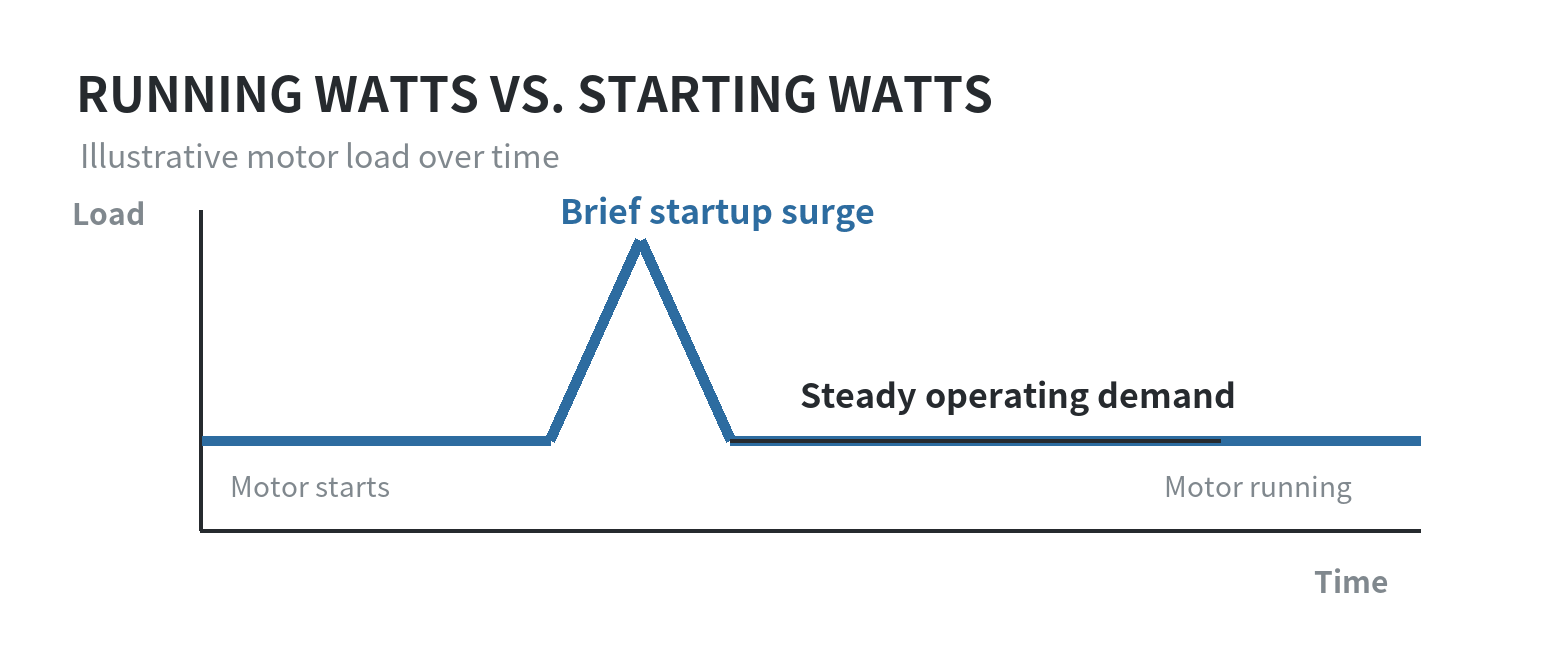
Running watts, also called rated watts, describe the power an appliance draws while operating normally. Starting watts, sometimes called surge watts, describe the short burst needed to start equipment with a motor. Refrigerators, air conditioners, pumps, and some power tools can have a startup figure above their running figure, as shown in Generac’s sizing explanation and Champion’s wattage chart (checked October 21, 2026). Generac describes motor startup as a short surge; exact values depend on the appliance, so use its nameplate or manual rather than a generic estimate.
Generator labels may use “rated,” “running,” “surge,” or “starting” in different combinations. Read the manual’s definitions before doing arithmetic. Some worksheets list the appliance’s total starting watts; others call the extra amount above running watts “additional starting watts.” Mixing those conventions can make you count the same demand twice. The Champion owner’s manual treats surge watts as the extra burst and adds the highest starting wattage to the combined running load (Champion’s capacity instructions, checked October 21, 2026).
Build a load list around one real outage routine
Start with what you need to operate together, not every appliance in the house. Write down the refrigerator, lights, router, sump pump, or other equipment that matters during an outage. Add only the items you expect to run at the same time. A portable generator plan is easier to size when it reflects a specific routine, such as keeping food cold and a few lights on, rather than an undefined goal like powering everything. For a wider outage checklist, see the site’s power outage supplies guide; for a broader look at backup-power approaches, see backup power options.
For each item, record its running watts and its starting watts from the product label, owner’s manual, or the appliance maker’s specifications. If the label gives volts and amps but not watts, multiply volts by amps for that stated operating condition; Champion’s manual gives the formula as volts × amps = watts. Treat wattage as specific to the exact appliance; two items with the same general description can have different power requirements.
Keep a note of where each number came from. A refrigerator’s label may show electrical input, while a manual may provide a separate startup figure. If a value is missing, ask the manufacturer or a qualified service professional for the correct figure for that exact appliance. The manufacturer sizing guidance says to check the nameplate or manufacturer specifications for major appliances. Do not fill the gap with an online average when the result could affect whether the generator can start the load.
Calculate the continuous load and the startup peak
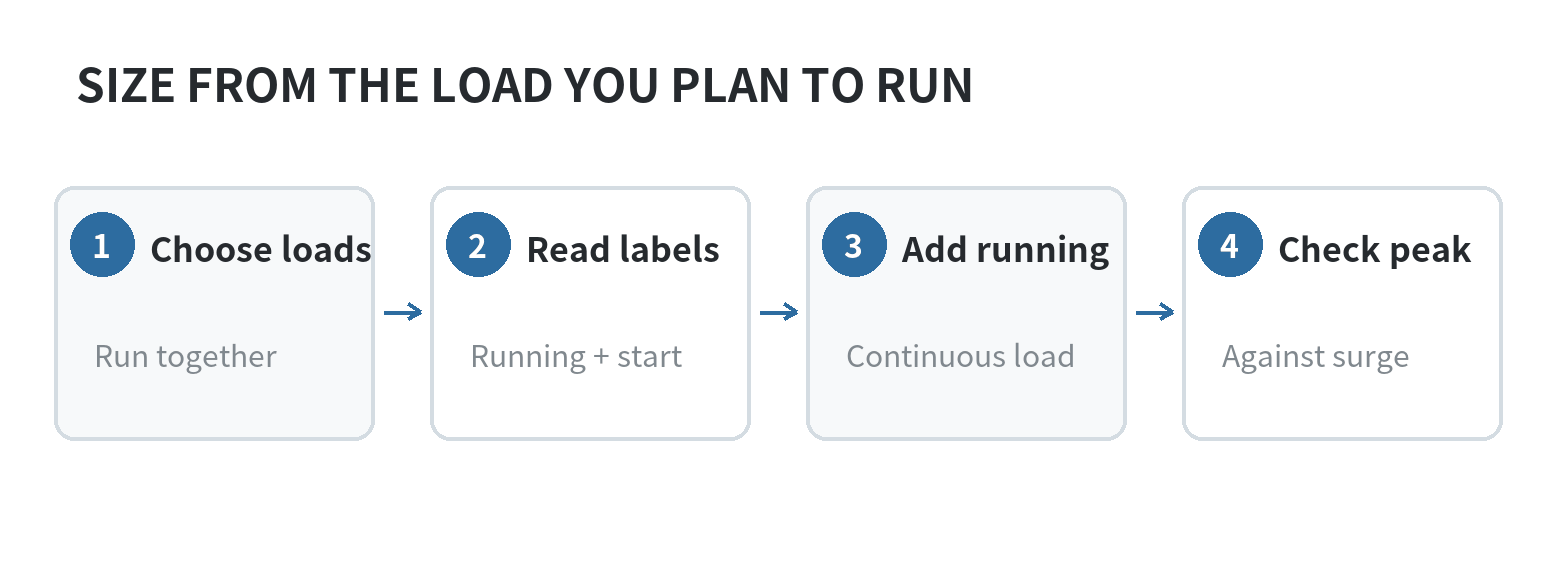
First add the running watts for all selected appliances. Then account for the biggest startup demand that could occur while those items are already running. If only one motor starts at a time, the planning calculation is the running-watt total plus the largest additional startup surge. The Champion manual describes this approach and advises selecting the devices used together before adding the highest starting wattage.
For a made-up worksheet, suppose a refrigerator is listed at 700 running watts with an additional 1,000-watt startup surge, while lights and a router together use 150 watts. The continuous total is 850 watts. If the refrigerator starts while the lights and router are on, the example peak is 1,850 watts: 850 plus the refrigerator’s 1,000-watt extra surge; the calculation follows the manufacturer’s running-load-plus-startup method. These example figures illustrate the arithmetic only; replace them with the values for your own equipment.
If two motors may start before the first startup surge has passed, do not assume the largest single surge is enough. Check the appliance instructions for start timing or ask the manufacturer how to account for overlapping starts. The Champion manual’s staged load sequence assumes you can control when each device starts.
| Worksheet line | Example | What it answers |
|---|---|---|
| Running load | 700 + 150 = 850 W | What stays on together? |
| Largest extra startup surge | 1,000 W | Which motor needs the biggest brief boost? |
| Planning peak | 850 + 1,000 = 1,850 W | Can the generator cover the load and that start? |
If the appliance chart instead gives total starting watts rather than an extra surge, follow that chart’s method. For example, when a listed starting figure already includes the appliance’s running demand, do not add that appliance’s running watts a second time on top of its total starting figure. Generator and appliance manuals control the calculation because the labels can use different terms.
Compare the result with the generator’s ratings
Check both the generator’s continuous or rated output and its starting or surge output. The rated output must cover the equipment that will stay on. The surge rating must cover the startup peak for the way you plan to use the equipment. A high surge figure cannot make up for an insufficient running rating once the motor has started.
Compare like with like: watts to watts, and use the generator ratings that match the setup described in its manual. Confirm voltage and receptacle requirements too; a watt total alone does not establish that a generator has the right outlet or circuit arrangement for an appliance. The manufacturer manual’s capacity section and equipment labels are the reference for the exact unit and loads.
Consider what happens when two motors start close together. If the refrigerator and pump can restart at the same moment after an interruption, compare the combined event against the generator’s surge capability or plan a sequence that avoids simultaneous startup, if the equipment instructions permit it. Champion’s manual recommends adding loads in steps and says not to exceed the specified capacity. Staggering starts helps only when the resulting continuous and surge loads remain within the equipment ratings; it does not increase generator capacity.
Keep generator placement and connections in the plan
Portable generator sizing does not change where it can be operated. The CDC says to keep a generator outdoors at least 20 feet from doors, windows, or vents; the Consumer Product Safety Commission also says to point the exhaust away from the home (CDC generator safety guidance and CPSC carbon monoxide guidance, checked October 21, 2026). CPSC says never to run a portable generator inside a home or garage, even with doors and windows open. The agency recommends CO alarms on every level and outside sleeping areas (CPSC carbon monoxide guidance, checked October 21, 2026).
For appliances connected by extension cord, use cords rated for outdoor use and sized for the load, as the CPSC safety alert advises. Do not plug a generator into a wall outlet to energize house wiring. The CPSC identifies that practice as backfeeding and warns of electrocution risk to utility workers and neighbors, as well as bypassed household circuit protection. OSHA also says a generator must not be attached directly to a building electrical system without a properly installed transfer switch (OSHA portable generator safety fact sheet, checked October 21, 2026). Keep the sizing worksheet with the manual so anyone operating the generator can see which loads are included and what startup sequence the plan assumes (CPSC portable generator safety alert, checked October 21, 2026).
If your list includes central air conditioning, a well pump, or house wiring, the worksheet is a starting point for a qualified electrician or generator professional. Those loads can involve motor surge, voltage, and connection details that a simple sum does not resolve. A useful next step is to record each appliance’s exact model and nameplate values, then ask the professional to check the planned simultaneous loads and connection method.
FAQ
Can I add all starting watts together?
Only for loads that may start together. If you plan to start one motor at a time, compare the running total plus the largest applicable startup surge, using the definitions in the equipment manual.
Does a generator’s peak watt rating mean it can run that load all day?
No. Peak or surge output is for startup demand. Use the rated or running output to check the load that remains on after startup.
What if an appliance label shows amps instead of watts?
Use the stated voltage and amperage for that operating condition to calculate watts, or obtain the wattage from the appliance maker. Champion’s owner’s manual gives volts multiplied by amps as the conversion formula.
Can I connect a portable generator directly to a home outlet?
No. Do not use a cord to feed power into a wall outlet. The CPSC warns that feeding house wiring this way, called backfeeding, can create an electrocution hazard.
Last updated: October 2026.
Last updated: 2026-10