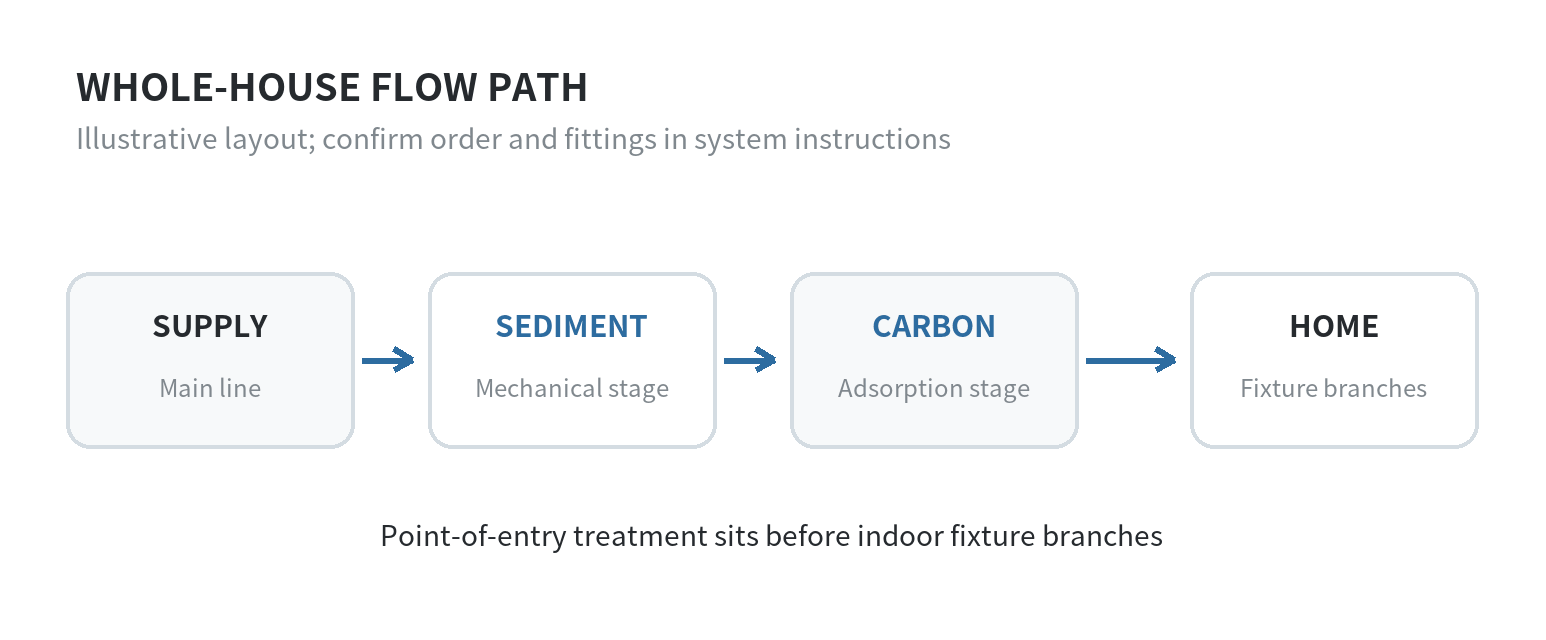
A whole-house filter is a point-of-entry device, installed on the supply serving indoor fixtures, so its cartridge choice and rated flow affect the plumbing that serves the home. Start with the job you need the system to do, then compare sediment and carbon stages, the system’s rated gallons per minute (GPM), and its exact certification listing. A cartridge label alone cannot answer all three questions. NSF’s standards overview identifies whole-house systems as point-of-entry treatment.
Decide what the system needs to handle
Write down the reason you are considering a filter before looking at housings or cartridge sizes. Visible grit, a specific substance named in a water report, and a preference about taste are different problems. A sediment cartridge is a mechanical media: particles are held in the filter’s pores, and collected debris can clog those pores and slow water movement. NSF describes that distinction in its filter maintenance guidance.
Activated carbon uses adsorption: material can adhere to the carbon’s surface or pores, as described in NSF’s water-treatment standards overview. EPA’s certification guide explains that specific claims belong with the certification mark, so two carbon cartridges may not share the same listed claim, operating conditions, or service life.
If the concern comes from a private well, a utility notice, or a test result, keep that information beside the product documentation. A filter type is not a substitute for identifying what is in the source water. The next step depends on the named issue and the unit’s documented claim, so do not infer a treatment purpose from words such as “carbon,” “whole house,” or “multi-stage.”
Read sediment and carbon as different stages
| Stage | What the media does | What to check on the listing |
|---|---|---|
| Sediment | Mechanical filtration holds particles in pores; collected debris can restrict flow. | Particle claim, cartridge dimensions, replacement part, and system flow rating. |
| Carbon | Adsorption lets selected material adhere to the carbon media. | Exact model, named certification claim, rated flow, and stated service cycle. |
Use the table to separate media roles from certification details. A “micron” number describes a particle-size rating, but the label alone does not tell you the complete test method, whether the rating is nominal or absolute, or what the assembled system is certified to do. The EPA filtration facts sheet distinguishes nominal and absolute ratings; use the performance sheet and the certifier’s directory for model details.
A sediment-first, carbon-second layout appears in an EPA whole-house system description, but that is one documented installation rather than a universal design. Treat the order as a question for the system instructions or a qualified installer. The housings, bypass arrangement, pipe size, shutoff access, and cartridge direction must match the selected equipment and the home’s plumbing.
Size flow around simultaneous use
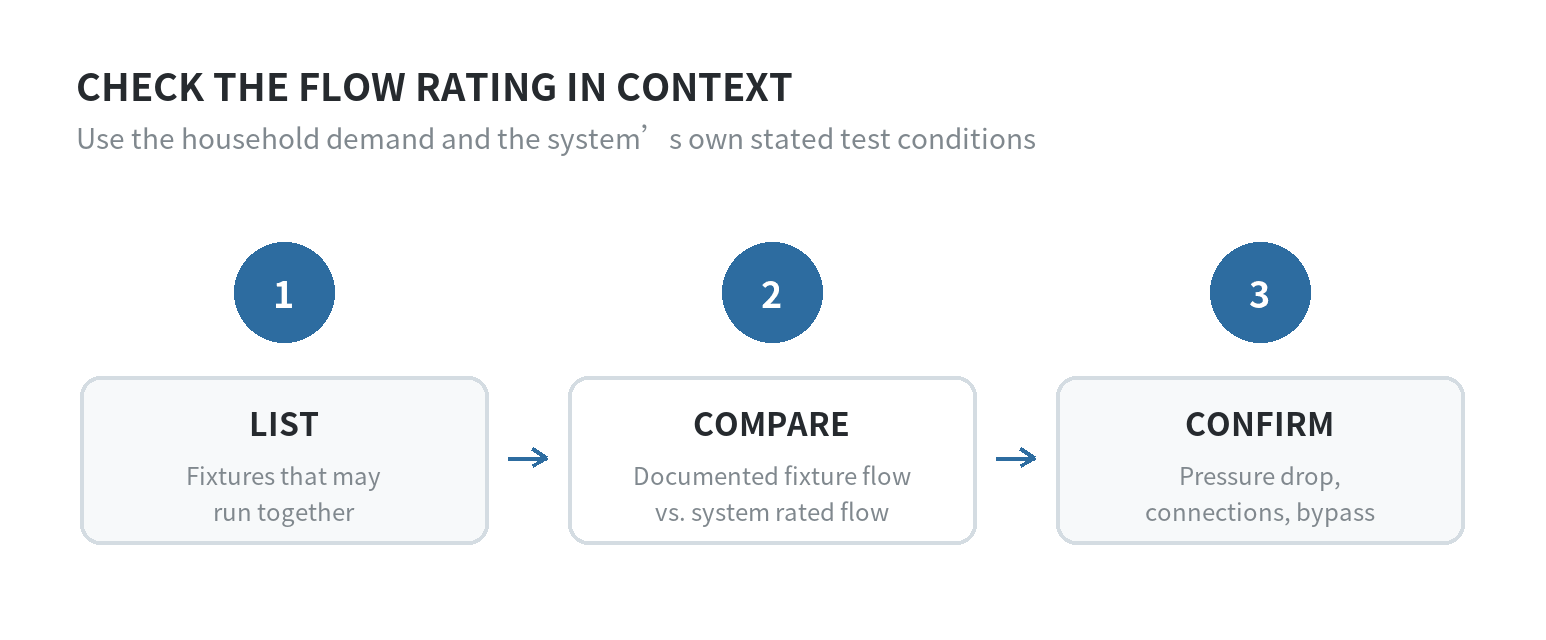
GPM means gallons per minute; NSF’s product directory uses that unit in its flow-rate field. For a whole-house unit, compare its rated flow with the fixtures that may run at the same time, not just with a single faucet. Make a short list of the busy moments that matter in your home, such as a shower running while a washer fills or an outdoor tap is open. Record fixture flows from their labels or manuals, then ask the system maker or installer how the rating applies to that combined demand.
NSF’s product directory displays flow-rate and service-cycle fields for listed treatment units where those ratings apply. A directory entry is tied to a named product and configuration; it is not a universal GPM target for every house. Compare the complete system, not a loose cartridge’s advertised maximum. If a listing gives a flow for a particular test arrangement, confirm that the system you are considering uses the same cartridge and housing configuration.
Do not read “high flow” as a complete sizing answer. Check the inlet and outlet connection size, the maximum operating pressure, the temperature range, and any stated pressure drop at the rated flow. Ask whether a gauge or bypass is included, what the bypass does, and whether using it sends unfiltered water to the fixtures. Compare these installation and operating details alongside the flow figure.
If pressure is already weak, write down which fixtures show it, when it happens, and whether it is limited to hot or cold water. Share those observations with a licensed plumber before adding equipment. That gives the installer a useful starting point for checking the supply and sizing the proposed unit.
Check the certification on the exact model
Look up the complete model name in NSF’s drinking-water treatment directory and compare its entry with the packaging and performance sheet. NSF lets you search by manufacturer, model, standard, product type, and claim. Its standards overview describes NSF/ANSI 42 as covering aesthetic-effect claims and NSF/ANSI 53 as covering specified health-effect claims; the standard number is not a ranking. EPA’s guide likewise says certification marks are paired with claims specified on the performance data sheet.
Read the claim text, not only the logo or standard number. The NSF directory may list multiple claims for a system, and those claims can differ by model. Confirm whether the listing is for a complete point-of-entry system or only a cartridge or component, and whether the claim applies to the cartridge currently supplied. A component listing and a complete-system listing are not interchangeable.
For this check, use the NSF certified drinking-water treatment directory and the EPA guide to certification marks and performance claims. If the exact model or claim does not appear, ask the manufacturer or certifier to identify the current listing before relying on the label.
Plan the replacement and service access
Before choosing a housing, locate the shutoff valve and make sure there is room to remove the sump or cartridge without moving a water heater, storage shelf, or drain line. Check the replacement part number, whether a wrench or pressure-relief step is specified, and where rinse water will go. Keep the instructions with the replacement cartridge so the next service does not depend on memory.
NSF says service cycles vary by product and may be expressed as a gallon capacity or an estimated number of months; it advises following the manufacturer’s replacement recommendation. Record the installed date and the stated capacity or interval on a simple reminder. If the system has a pressure gauge, compare its reading with the maker’s maintenance instructions. NSF also explains that flow can slow when mechanical-filter pores clog, while a carbon stage’s remaining adsorption capacity may not be visible by appearance alone.
Confirm whether each replacement is a certified cartridge for that system. NSF cautions that cartridges that look similar may not fit the housing closely enough, and water may bypass the media. A compatible part is therefore defined by the housing and listing, not just by a matching outside diameter or a familiar color. Check the replacement documentation before stocking spare cartridges.
Keep the decision tied to the actual water line
A sensible comparison has four pieces: the reason for filtration, the exact sediment or carbon stage, the flow rating under its stated conditions, and the claim listed for the complete model. Put those details in one note and compare candidates against the same household demand and plumbing facts. If the goal remains unclear, pause the product comparison and clarify the water issue with the utility, a qualified lab, or a plumbing professional.
For related plumbing terms, see our faucet flow-rate guide and guide to tracing low water pressure. Those topics help separate fixture flow from a whole-house equipment rating.
FAQ
Does a whole-house filter need electricity?
Check the complete system’s installation instructions for its power requirements. A cartridge housing alone does not identify every component included in a whole-house setup.
Will a whole-house filter include an outdoor faucet?
It depends on where the outdoor branch connects to the plumbing. Ask the installer to trace whether that line sits downstream of the filter; point-of-entry treatment is installed on the incoming supply, while the home’s branch layout controls which outlets receive it.
When should I compare a point-of-use filter instead?
Compare point-of-use equipment when the task is limited to one faucet or drinking-water outlet. EPA defines point-of-use filters by their location where water is used, while NSF identifies whole-house systems as point-of-entry treatment.
Last updated: October 2026.
Last updated: 2026-10