Match a replacement tank water heater to the busiest hour in your home, then confirm that its fuel, venting, dimensions, and service clearances fit the existing space. Household size gives you a starting point, but the tank’s gallon capacity alone does not tell you how much hot water it can deliver when showers, laundry, and dishes overlap.
Start with the hour when hot water runs out
Write down what is likely to draw hot water during the same hour: showers, a bath, shaving, dishwashing, or a clothes washer. Note which activities overlap and which can wait. You are building a peak-use picture, not estimating the household’s total daily water use.
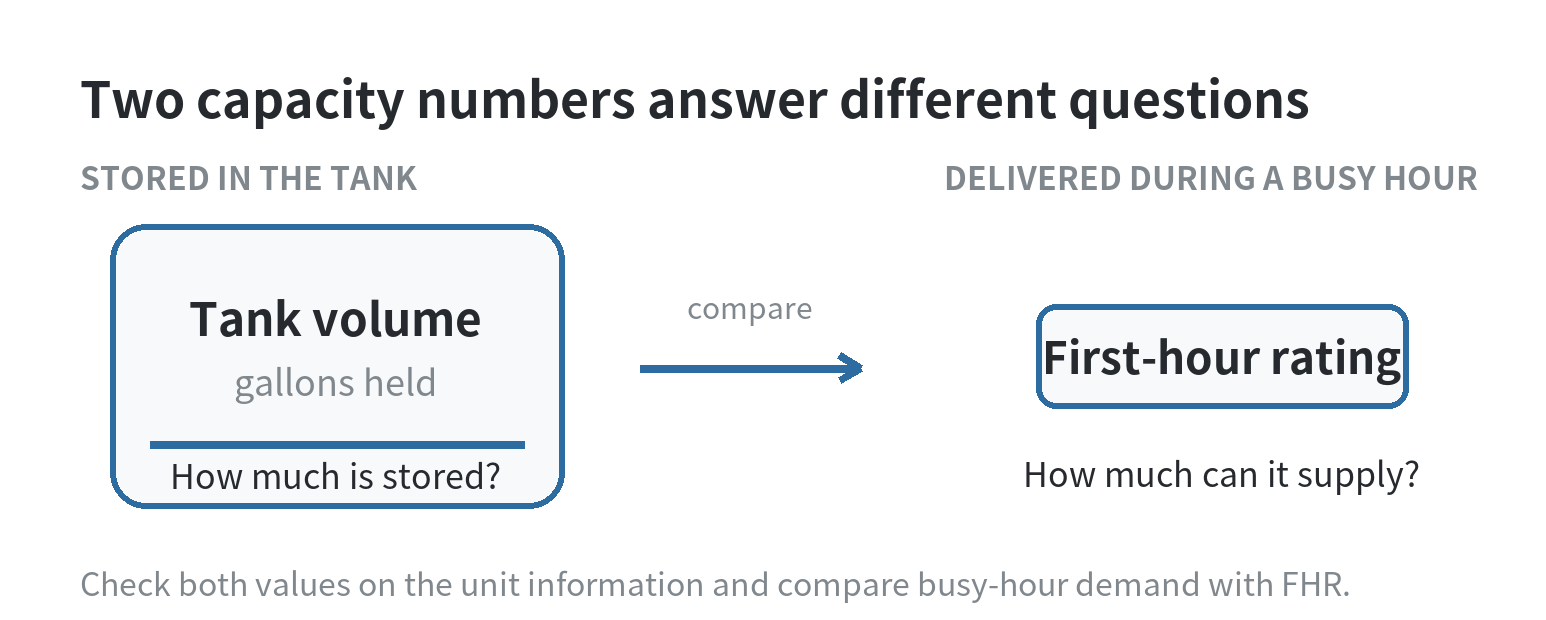
The U.S. Department of Energy’s consumer guidance treats storage water heaters as units that heat and hold water. ENERGY STAR explains that a storage model’s first-hour rating (FHR) estimates how much hot water it can supply in an hour starting with a fully heated tank. Check the existing unit’s nameplate or EnergyGuide label for its capacity and FHR, then compare the FHR with the new unit’s rating.
Use the old unit as evidence, not as an automatic template. If it supplied enough hot water during your busiest hour, a similar capacity may work, but ENERGY STAR notes that FHR can provide better delivery without moving to a larger tank. If the old heater regularly ran short, describe the exact pattern to the installer: for example, two back-to-back showers followed by a load of laundry. That detail is more useful than saying only “a family of four.” (Sources checked October 21, 2026.)
Translate household size into actual use
People in the home matter because they shape the draw pattern, but schedules and habits matter too. A household of two with simultaneous morning showers may have a sharper peak than a larger household whose hot-water use is spread across the day. A bath, long showers, or several appliances running close together can also change the peak.
Make a short list with three columns: activity, approximate time, and whether it can be moved. Use your own routines rather than a generic gallons-per-person rule. If the morning shower sequence is fixed, count it as one busy-hour demand. If laundry can run after work, do not treat it as simultaneous unless it actually overlaps.
For a concrete example, imagine a home where two showers happen before school and a dishwasher starts just afterward. If the showers can be staggered, record the longest likely overlap; if they cannot, record both in the peak-hour estimate. The example is a planning exercise, not a model rating. Ask the installer to translate that use pattern into a suitable FHR under local plumbing requirements.
Check the fuel and vent before comparing models
Record what powers the current heater: natural gas, propane, electricity, or another fuel. Also photograph the rating plate, electrical connection, water connections, gas line if present, and vent path. These details identify the starting installation. They do not prove that a different fuel type can use the same connections or location.
A fuel change can involve more than choosing a tank with a similar gallon label. The replacement may need different electrical service, gas piping, venting, combustion-air arrangements, condensate drainage, or controls. For a heat-pump water heater, ENERGY STAR’s design guidance calls out room air volume, airflow, noise, cooler exhaust air, condensate drainage, and electrical requirements. A closet that held a conventional tank may need a different layout for a heat-pump model.
Ask the installer to identify which existing connections can remain and which would need changes. Confirm the applicable permit and inspection requirements with your local building department; rules vary by jurisdiction. ENERGY STAR’s replacement guidance also recommends checking that an installer understands local residential codes and can obtain a permit when one is required. (Sources checked October 21, 2026.)
Measure the route and the service space
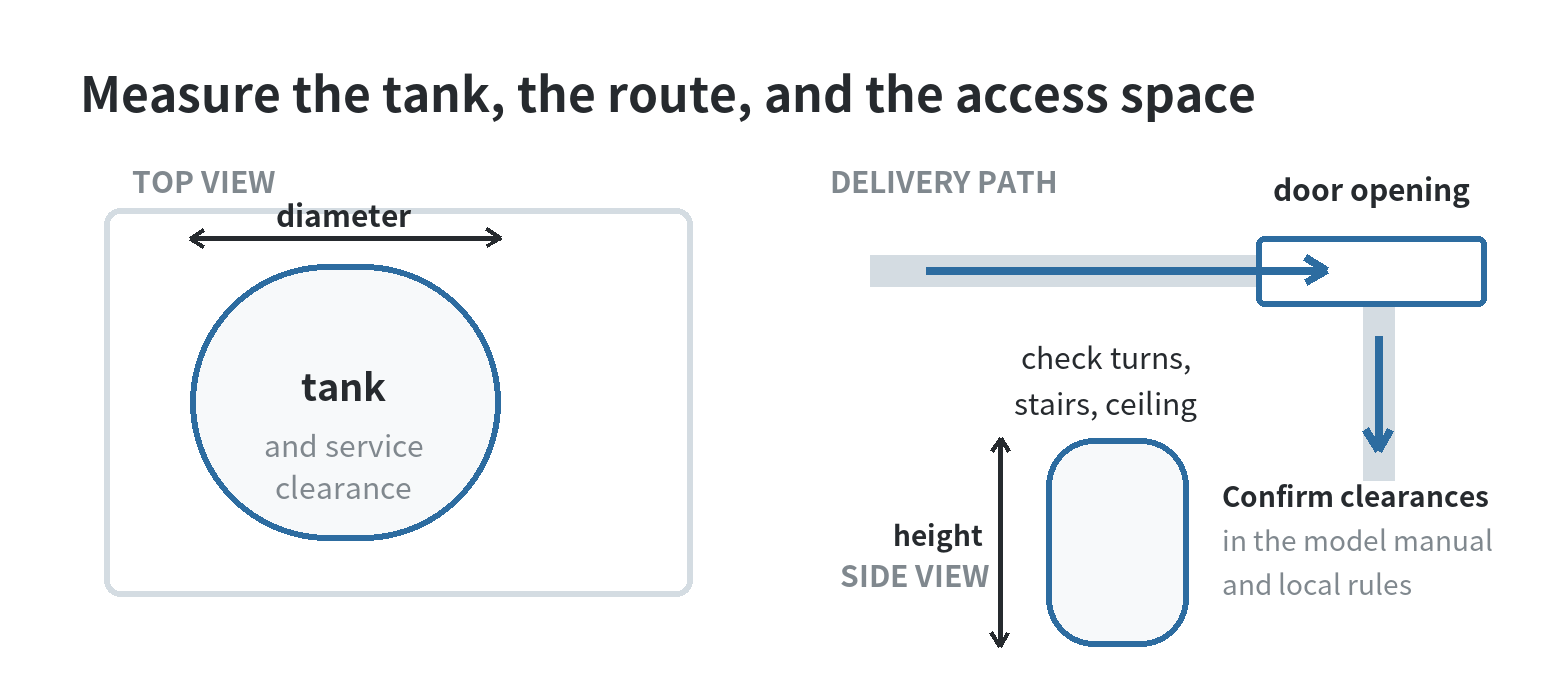
Measure the existing heater’s height and diameter, then measure the installation area and the path from the entrance to that area. Include door openings, turns, stairs, ceiling height, and any platform or drain pan. The new tank may have a different shape even when the gallon capacity is similar, so compare the product’s published dimensions rather than relying on the old tank’s footprint.
Leave room for the installer to connect and service the equipment. Check the manufacturer’s installation manual for required clearances, access, vent route, and airflow. A tank that can be carried into a closet may still be unsuitable if the required service space or airflow is missing. Measure the route before model selection so a tight turn or low ceiling is discovered early.
For a basement installation, include the stairwell landing and the turn at the bottom, not just the stair width. For an upstairs closet, measure the hallway turn and doorway with the door open. Write down any low pipes or shelves that restrict the vertical space. The replacement’s delivery route and its final service space are separate checks: a clear route does not prove the installed unit will have enough access.
For heat-pump models, ENERGY STAR says the room or properly vented area needs enough free air space and room for installation and service; the manufacturer’s guide gives model-specific requirements. Its guidance describes heat-pump units as producing cooler exhaust air and condensate that must drain away. Include a drain path and consider whether the cooler air would be uncomfortable near a bedroom or living area.
Compare the right details on the label
Once capacity and fit are clear, compare candidates by reading their labels and installation documents. Use the EnergyGuide label for estimated energy information, the nameplate for the unit’s identification and input details, and the manufacturer’s manual for installation conditions. ENERGY STAR explains that FHR and tank volume describe different parts of hot-water delivery; the federal ENERGY STAR criteria page defines FHR using a standardized test method.
| Check | What to compare | Why it matters |
|---|---|---|
| Capacity | Tank gallons and FHR | Stored volume and busy-hour delivery are different measures. |
| Fuel and connections | Fuel type, electrical needs, gas and water connections | A fuel change can require changes beyond the tank itself. |
| Venting and airflow | Vent type, room air, exhaust path | Requirements depend on the heater design and installation manual. |
| Physical fit | Height, diameter, route, service clearance | The tank must reach the location and remain accessible. |
| Drainage and code | Condensate or discharge needs, permits, local requirements | Installation conditions are model- and jurisdiction-specific. |
If a label is missing or unreadable, ask a qualified installer to identify the heater and assess the connections on site. Do not infer the fuel or vent type from tank color, shape, or age. A photo of the rating plate and the surrounding installation can make that conversation more precise.
Bring a useful replacement brief
Before requesting a model match, prepare one page with the current heater’s label details, the busiest-hour activity list, fuel type, vent configuration, measurements, and photos of the route and installation space. Include a note about any shortage: when it happens, which fixtures are running, and whether changing the schedule is realistic.
Ask the installer to explain the proposed tank’s FHR, why it matches the recorded peak, whether the existing fuel and vent can be reused, and what clearance or drainage work the selected model needs. Have them state any permit or inspection steps for your address. You can then compare proposals on the same facts rather than choosing by household headcount or tank gallons alone.
For broader setup questions, see the site’s water-heater installation planning overview. If you are reconsidering a storage tank for a tankless system, the separate tankless format overview covers that different equipment choice.
A replacement is a good fit only when the delivery rating, fuel setup, physical dimensions, and service conditions work together. If any one item is uncertain, resolve it from the unit label, manufacturer manual, or local code office before settling on a model.
FAQ
Should I choose a larger tank if my current heater runs out of hot water?
First compare the current and replacement FHR, not only tank gallons. ENERGY STAR describes FHR as busy-hour hot-water delivery, so show the installer when uses overlap and ask whether a higher FHR or different schedule addresses the shortage.
Can I replace a gas tank with an electric heat-pump model in the same closet?
Not without checking the space and connections. ENERGY STAR’s heat-pump guidance covers air volume, airflow, service access, drainage, cooler exhaust air, and electrical needs; compare the exact model manual with the closet and local requirements.
What should I do if the old water heater label is gone?
Ask an installer to identify the unit and inspect its connections. Share photos, the measured space, and your busy-hour use pattern so the replacement can be assessed from the site instead of a guessed capacity.
Does a replacement tank have to use the same vent?
Check the selected heater’s installation manual and local code. Venting depends on the heater design, so the existing route alone does not establish that a new model can use it.
Last updated: 2026-10