Choose a window well cover by the well’s actual opening, the window’s swing, and the load rating printed for that exact cover. If the window is an emergency escape opening, the cover must also release from inside as required by the locally adopted building code. A cover that fits the rim but blocks the sash, exit path, or release mechanism is the wrong size.
Measure the well at the rim, not the window
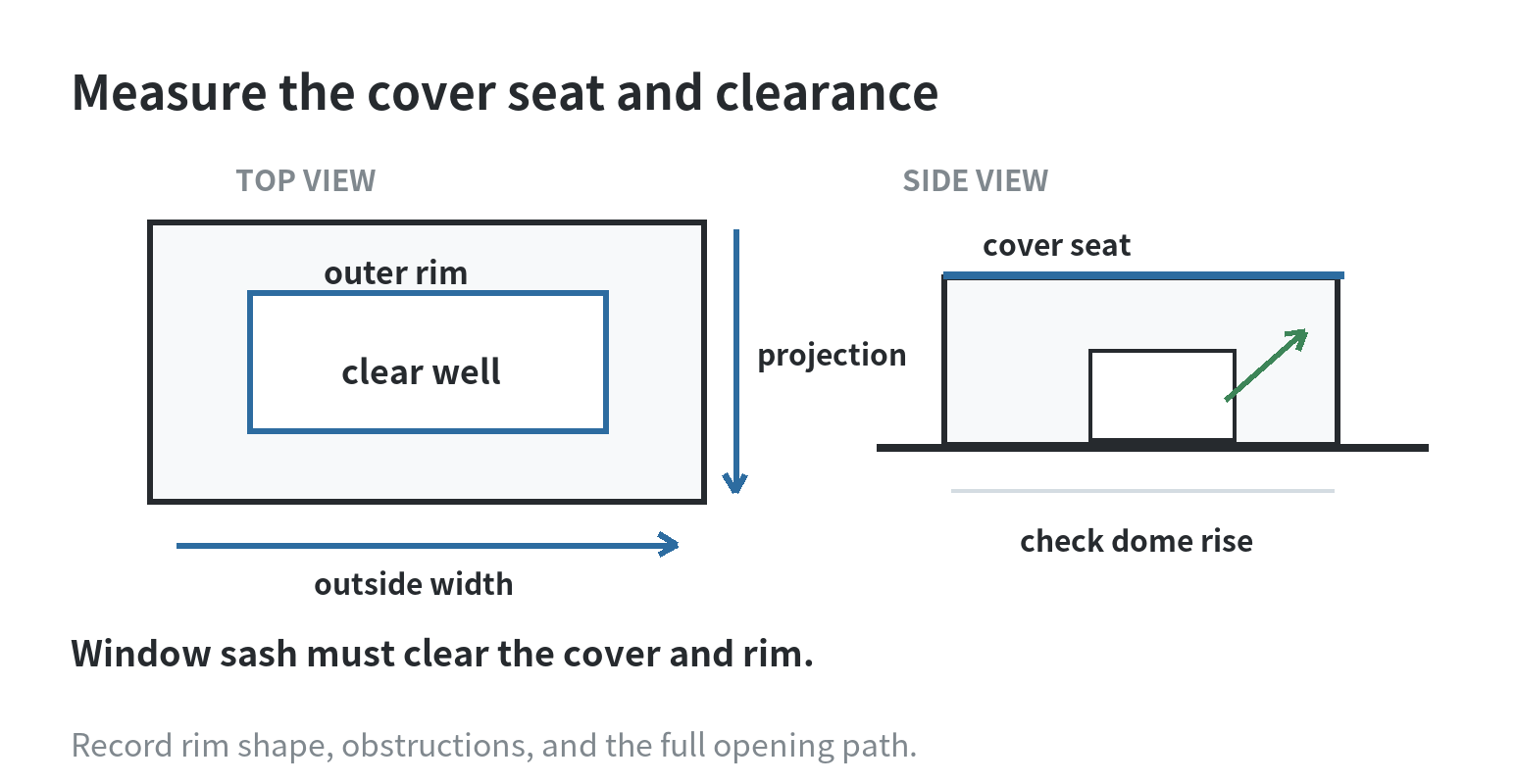
Measure the well’s outside width and projection at the top edge where the cover will sit. Record the rim shape, height, and any lip or flange. Then measure the clear opening inside the well and the window sash’s path as it opens. A product’s stated well-size label can refer to a particular rim style; it does not establish that every well with a roughly similar opening will accept it.
Sketch the well from above and note the wall, siding, trim, and any corner that protrudes. For a domed cover, also check the rise above the rim and the space available below a deck, railing, or window trim. For a flat cover, check whether it needs a supported center or a specific rim profile. Take the measurements in the same units used by the product drawing, and compare each dimension with the manufacturer’s fit diagram rather than matching only one width.
Make the escape opening work with the cover in place
First confirm with the local building department whether the basement window must meet emergency escape and rescue opening requirements. Rules are adopted and amended by state and local jurisdictions, so a model code is a starting reference rather than a substitute for the code that applies to your address. Ask the local building department which residential code edition and amendments govern the opening and cover.
The 2021 International Residential Code, Section R310.4.4, addresses covers and similar devices over emergency escape and rescue openings; the adopted local text may differ, so have the building department confirm the applicable section before selecting a cover. Its Section R310 also addresses the well’s dimensions, full window operation, and ladders for deep wells.
Test the whole sequence on paper and, if the cover is already installed, from inside: Can the sash reach its required open position? Can a person reach the cover release without climbing around an obstruction? Does the cover lift, hinge, or disengage in the direction allowed by the instructions? A latch that is easy to open from outside may still be unsuitable if the inside release needs a key, tool, or awkward reach.
For casement windows, pay close attention to projection and hinge clearance. The BILCO cover product page warns that a dome cover used with a casement window requires the well to sit higher than the top of the window so the cover does not interfere with operation. Treat such notes as model-specific installation requirements, not a universal dimension for every well.
Read a load rating as a limit for one cover
Find the load rating in the manufacturer’s listing or installation document for the exact cover model and size. Check whether the number is a live load, a concentrated load, or another stated test condition. Those terms describe different loading setups; one rating cannot be assumed to apply to every cover made by the same company.
For example, BILCO lists a minimum 200-pound live-load design for its egress window well covers, and its FAQ describes an optional dome cover as separately rated to support up to 300 pounds before it would invert. Neither figure is permission to stand, store equipment, or work on a cover. Other manufacturers publish their own test data for their own models under their own test conditions; do not assume a number from one brand’s testing applies to a different brand or model.
If the packaging or listing gives no rating, ask the manufacturer for the technical sheet tied to the model number. Do not infer capacity from thickness, material, a similar looking cover, or an online answer about another model. Keep the label and instructions with your home records so a future replacement can be matched to the right rating.
Use the product listing as a fit document
When comparing listings on an e-commerce platform, look for a model number, dimensioned drawing, supported well type, material, included clips or hinges, installation instructions, and the stated load test. If a listing gives only a generic size label, use the manufacturer’s drawing to identify which rim dimensions it means. A clear cover lets light reach the window from above, while an open grille-style cover leaves more of the opening unobstructed; confirm that whichever style you choose still meets the opening’s code requirements.
Confirm whether the cover is sold as a standalone part or is designed for a particular well system. The BILCO installation instructions for one modular well describe specific mounting spacing and fasteners so its optional cover will fit. That instruction illustrates why a product family’s accessories may rely on exact installation geometry. Do not transfer those dimensions to another manufacturer’s well.
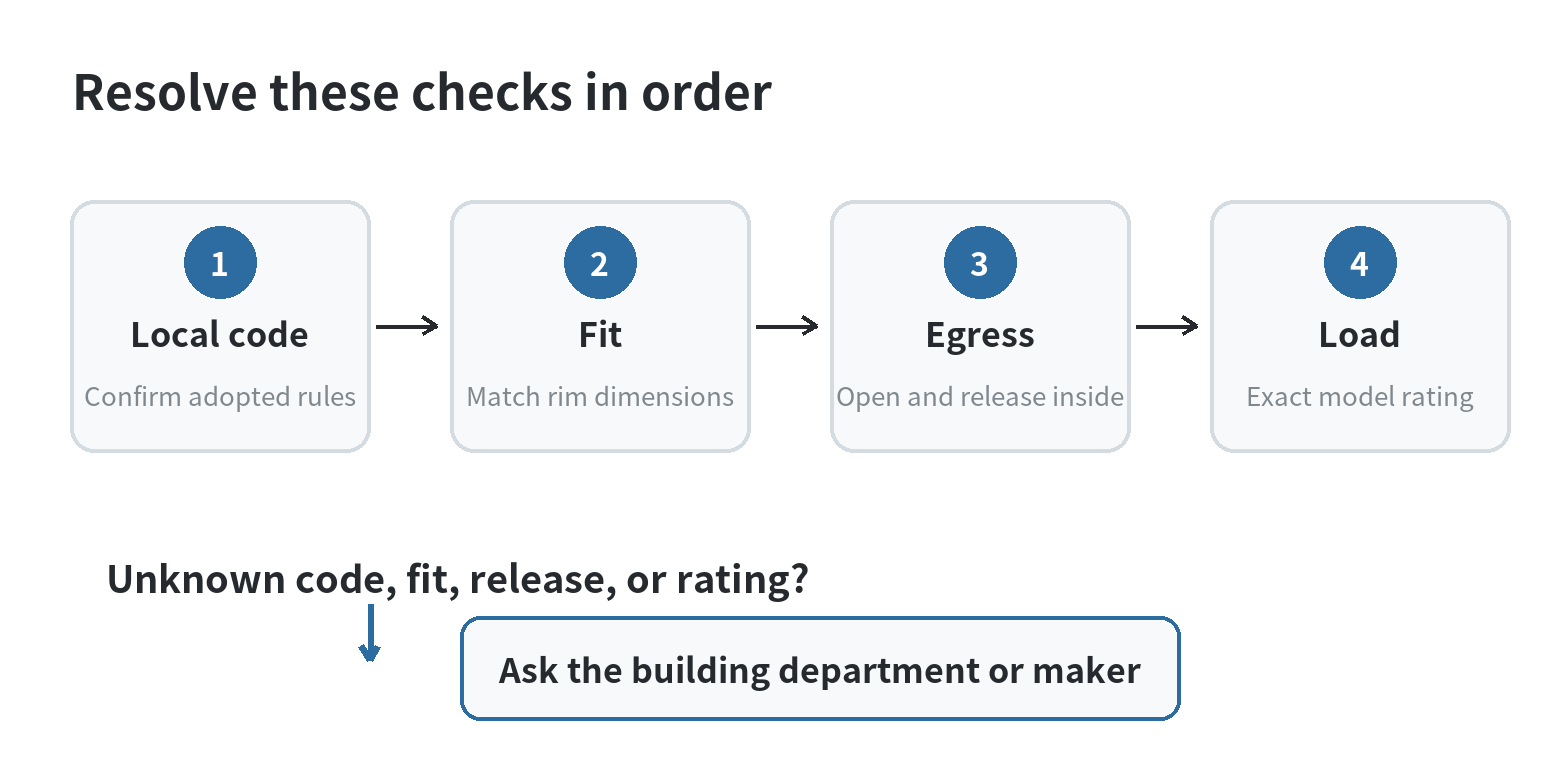
Before installation, resolve these four checks
- Fit: The cover drawing matches the well’s outer rim, projection, and profile.
- Operation: The window opens fully and the cover does not collide with the sash, trim, or structure above.
- Egress: The local authority confirms the applicable opening rules, and an occupant can release the cover from inside as required.
- Load: The rating belongs to the exact model and describes the load condition you need to understand.
Resolve an unknown item with the building department or manufacturer before installing. For an existing egress cover, have everyone who may use the room learn the inside release and keep that path clear.
Take measurements at several points if the well is not square or the rim has shifted. Record the smallest clear width and projection, plus the largest outside dimensions that the cover must span. A tape measure reading across the window glass is not a substitute: the cover rests on the well rim, while the sash occupies a separate path inside it. Photograph the rim with a ruler in view and label the photo with the location of each measurement.
Check the product drawing for whether its listed width is an inside dimension, outside dimension, or nominal fit range. Also note the edge that bears on the rim and whether clips, brackets, or a hinge take up space. If the well has an irregular cap, stone veneer, or projecting siding, include that obstruction in your measurement notes. A seller’s broad “universal” description does not explain how an unusual rim is supported.
FAQ
Can I cut a window well cover to fit around siding?
Only if that exact manufacturer’s instructions allow it. BILCO’s FAQ discusses modifying or incorrectly installing a StakWEL window well cover; check the instructions for your own model before altering anything.
Does a heavy-duty rating mean the cover is safe to stand on?
No. A rating reports a specified load condition, not general permission to use the cover as a platform. Follow the exact product label and instructions for your model, and do not assume a rating from one manufacturer’s testing applies to a different brand or model.
What if the well opening is an unusual shape?
Send the manufacturer a sketch with rim width, projection, profile, and the window’s opening direction. Ask for a drawing that confirms fit and clearance for that configuration before choosing a cover.