Choose landscape fabric when you need a temporary weed barrier or a separator under a gravel path; skip it under a permanent planting bed if you expect to keep adding compost, dividing plants, or changing the layout. “Woven” and “nonwoven” describe how a fabric is made, but the label alone does not tell you how it will handle water, roots, or years of yard work.
Utah State University Extension describes fabric as a barrier for weeds emerging from below the sheet. Oregon State University Extension explains that weeds can still sprout in mulch above it, grow through openings, or push through the material. The useful question is less “Which fabric is best?” and more “Will this spot stay simple enough for a buried sheet to make sense?”
What woven and nonwoven tell you
University of Illinois Extension describes woven landscape fabric as plastic strips and other landscape textiles as spun fibers, including spun polyester. Woven and spun fabrics are both used as weed barriers, but construction is only one part of how a product performs.
Water passage, fabric weight, openings, and intended use can differ by product. University of Illinois Extension notes that water and air can pass through landscape fabric for a time, before fine sediment clogs it. Utah State University Extension also cautions that fabric can interfere with air and water movement around landscape plants. Read the product’s stated use and permeability rather than assuming every woven fabric drains well or every nonwoven fabric blocks water.
The construction can affect weed penetration, too. UC IPM explains that thin, lightweight, or open-mesh geotextiles let more weeds through than more closely woven or nonwoven spunbonded fabrics.
| Question | Woven fabric | Spun or nonwoven fabric |
|---|---|---|
| What does the name describe? | Plastic strips interlaced into a sheet | Fibers bonded or spun into a sheet |
| What should you confirm? | Water passage, intended surface, and installation notes | Water passage, intended surface, and installation notes |
| What does the name not promise? | A fixed service life or weed-free bed | A fixed service life or weed-free bed |
If a package gives no clear use for your planned surface, do not infer one from the texture. A sheet intended for a path or construction layer may not be a good fit beneath plants that need regular soil care.
Read the package for the job you have
Before comparing two rolls, check the same details on each label. Start with the intended use: a seasonal garden cover, an unplanted path, or a planted bed are different jobs. Next, check whether water is meant to pass through the sheet if rainfall or irrigation needs to reach soil below it. Finally, read how the maker expects seams, planting openings, and the cover layer to be handled.
Those details answer more than color or hand feel. A tight-looking sheet is not automatically the right choice for a planting bed, and a porous feel does not show how the material will behave after soil particles collect in it. The University of Illinois Extension description notes that sediment can clog fabric over time, while UC IPM explains that weed penetration differs by fabric construction. Use those limits to narrow the choice, then follow the product directions for its stated application.
For a seasonal vegetable bed, the fabric may work as a temporary surface cover with openings for crops. University of Illinois Extension describes using it much like black plastic in a vegetable garden, without putting a mulch layer over the top. That is a different setup from burying weed cloth under decorative mulch around permanent shrubs.
Where a barrier earns its place
A fabric layer can make sense under a gravel walkway where the goal is to keep the soil and stone separate. Utah State University Extension identifies unplanted walkways as a better setting for fabric than beds with landscape plants. UC IPM also describes fabric under rock mulch as a layer that keeps rocks from sinking into soil. The material sits under a stable hardscape, so you are less likely to dig through it every season.
It can also be used as a temporary cover in a seasonal vegetable bed or over a garden walkway. University of Illinois Extension describes those as practical short-term uses. If the area will become a planting bed later, a temporary cover is easier to plan around than a buried permanent layer that may need cutting and removal.
For a path project, see the site’s gravel path material overview. If the fabric is being considered beneath a raised bed, the raised-bed construction article covers the structure; choose any ground layer based on the bed’s drainage and soil needs.
When to leave it out
Skip fabric in a bed where you plan to add compost, work the soil, or move plants. The sheet creates a boundary between the surface and the soil below, and it can make amendments and plant changes harder. Utah State University Extension notes that fabric may restrict air and water infiltration and the return of organic matter from decomposing mulch.
It is also a poor match for spreading perennials or plants that need frequent division. Fabric can get in the way when you remove or relocate them. A plain organic mulch gives you a surface you can refresh or rake aside without cutting through a buried sheet.
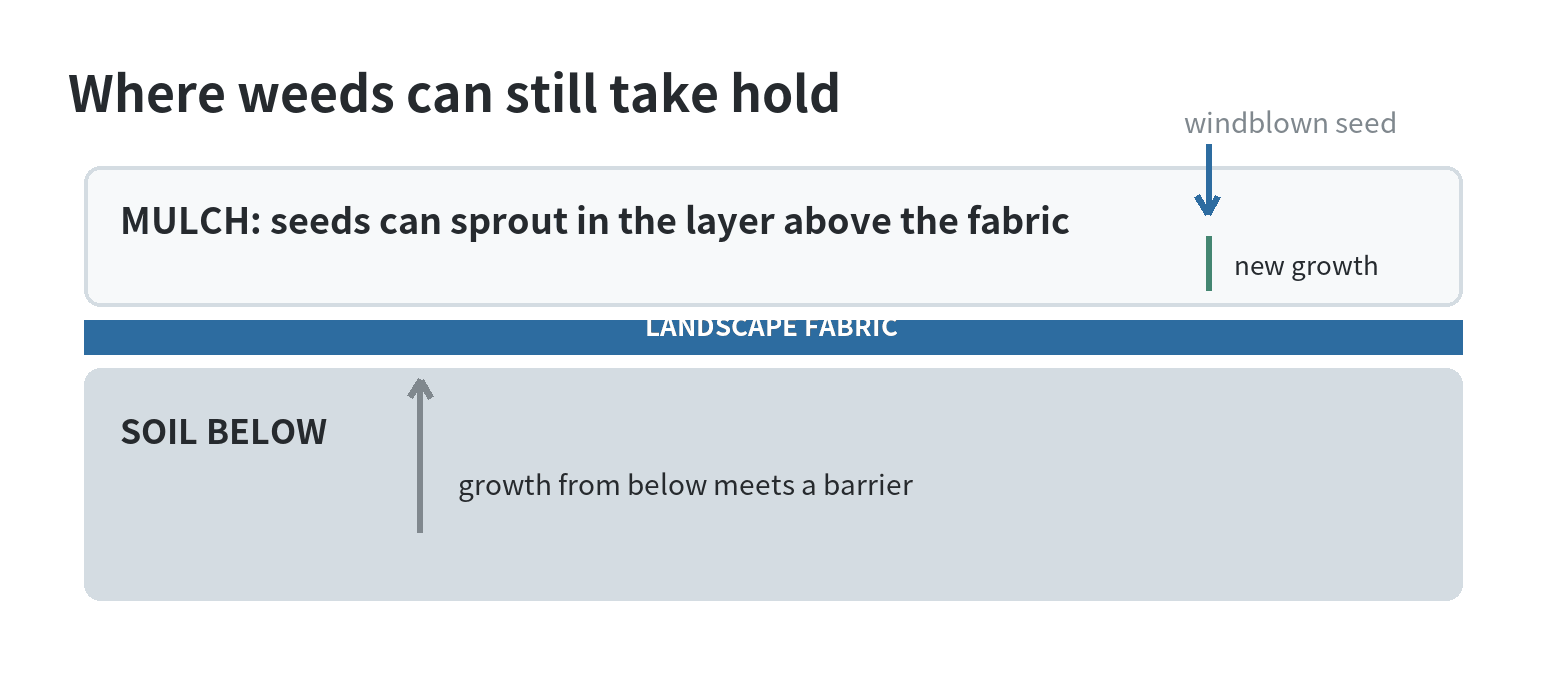
Fabric is not a permanent weed fix. Oregon State University Extension explains that weeds can grow in mulch above the fabric, push through gaps, or grow through the material. Roots can become tangled in it, so later removal can disturb the bed. If you do not want that maintenance tradeoff, use mulch by itself and pull young weeds as they appear; UC IPM recommends removing young weeds before they flower and set seed.
Check the surface when you refresh the path or bed. Look for exposed edges, openings around plants, and weeds rooted in the top layer. Pull young weeds while they are small; UC IPM recommends removing them before they flower and set seed. If you plan to change a planted bed, account for the sheet as a material that may need to be cut away around roots; Oregon State University Extension describes roots becoming enmeshed with landscape fabric.
Install it for the surface you have
- Clear the area. Remove existing weeds and debris before covering soil. Oregon State University Extension notes that rhizomes from some grasses can grow through fabric, so deal with established growth before installation.
- Lay the sheet flat. Follow the product directions for which side faces up and how to secure the edges. Utah State University’s guidance calls for overlapping fabric strips by about 4 inches.
- Make only the openings you need. Cut around plants that are already in place, leaving enough room for the stem. Each opening is also a place where growth can emerge, so avoid unnecessary cuts.
- Cover the fabric. Use the surface material intended for the project, such as gravel on a path or mulch where specified. Organic mulch above fabric can collect seeds and support new growth.
A quick decision before you unroll it
- Gravel path with no planting: Fabric may help separate stone from soil; check that the product is intended for this use.
- Seasonal garden cover: A temporary sheet can be useful when you plan to remove or replace it as the bed changes.
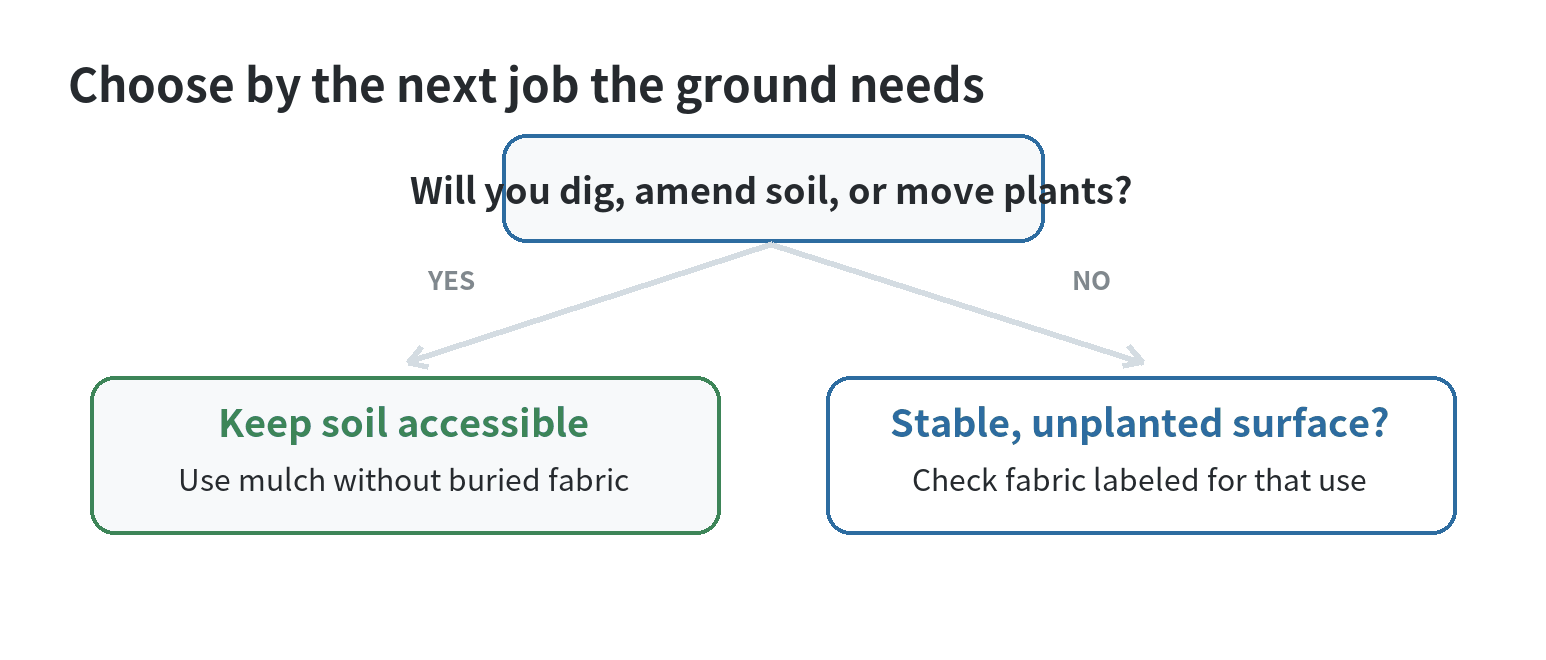
- Permanent shrub or perennial bed: Skip it if you expect to amend soil, spread plants, or divide clumps.
- Mulch-covered bed with recurring weeds: Remember that seeds can sprout in the mulch above the barrier; fabric will not remove that upkeep.
Before opening the roll, picture the next few seasons of work in that spot. If you will need to dig, feed the soil, or move plants, keep the soil accessible. If the surface will remain an unplanted path, choose a product labeled for that construction and plan for occasional weed removal at the edges and in the top layer.
FAQ
How much mulch should go over landscape fabric?
The depth depends on the setting described by the source. Utah State University Extension places fabric beneath 3 to 4 inches of mulch in unplanted walkways, while UC IPM describes a shallow layer of about 1 inch to cover geotextile. Follow the product directions for its stated use.
Should I plant before or after laying landscape fabric?
Either order can work if you keep openings small and close the fabric around the plant. UC IPM describes laying fabric after planting or cutting an X and planting through a sheet already in place.
Should landscape fabric reach all the way to a tree trunk?
Leave the trunk area free of fabric. Utah State University Extension warns that fabric can girdle trees as their trunks expand, and recommends keeping mulch away from the base of woody plants.