
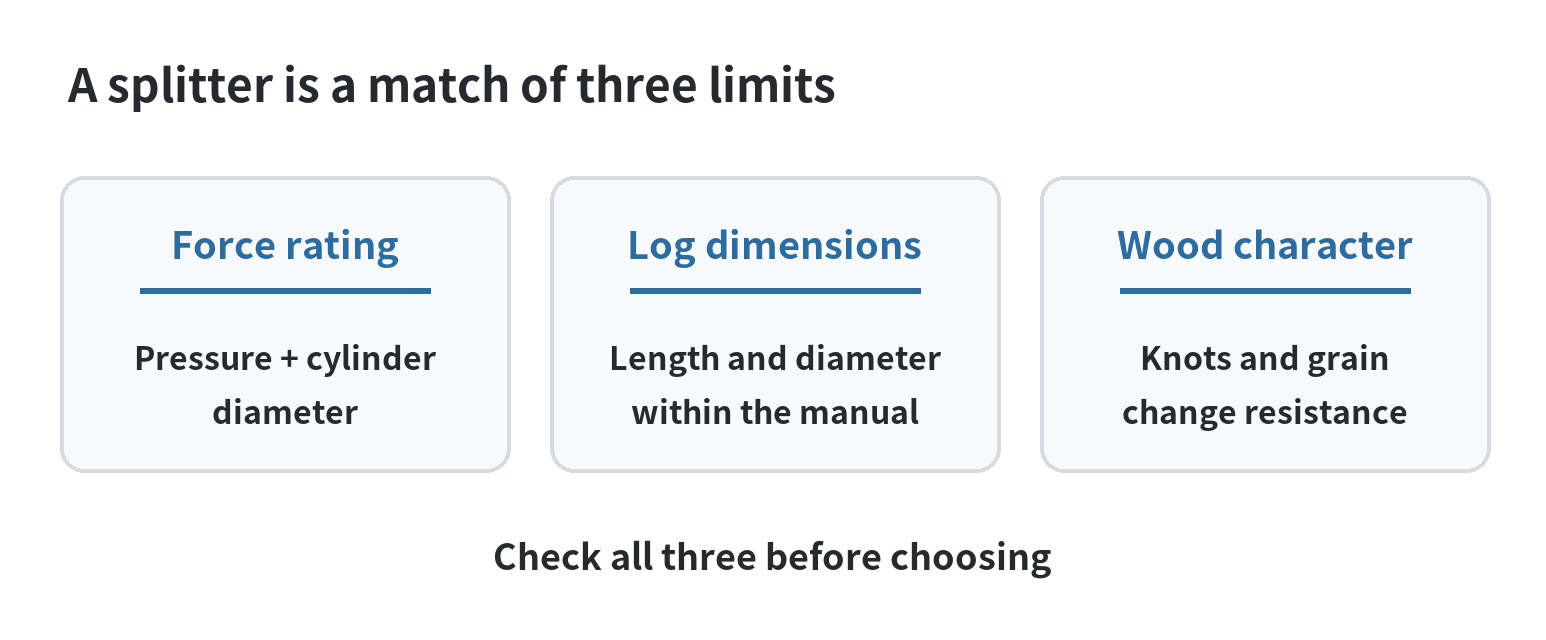
Match a log splitter to its force rating, your rounds, and the work area. A larger tonnage label alone does not guarantee that a machine can split every log in your pile.
Measure several rounds and note their knots and grain before comparing electric and gas models. Then check the exact manual for length, diameter, power, and safety limits.
What the tonnage number tells you
Tonnage describes a splitter’s rated force. Cornell Cooperative Extension explains that hydraulic force depends on cylinder diameter and pump pressure.
The number is useful when comparing force ratings, but it does not give one universal log-size limit. Manufacturers set those limits for each machine.
Wood matters too. Illinois Extension says that some dense species, including black locust and osage orange, are harder to split.
Cornell Cooperative Extension describes straight-grained, knot-free wood as easier to split. Interlocking grain can be difficult.
A round with a large knot may resist differently from a clear round of the same size.
A 5-ton rating describes the force rating, not the length or diameter of the wood that will fit. Read force, maximum length, and maximum diameter together.
Passing one limit does not cancel another.
Measure the rounds before comparing machines
Measure several pieces from your pile, including the thickest and longest rounds. Record length and diameter as separate measurements.
Length runs from one cut end to the other. Diameter is the width across a cut face.
If cutting logs is part of your preparation, see our chainsaw guide for choosing a cutting setup.
Also mark pieces that are forked, twisted, or knotted. A neat average can hide the few rounds that will determine whether a splitter is a good match.
Compare those measurements with the machine’s maximum log length and diameter. Southland’s electric splitter specifications list a 20.5-inch maximum length.
Length limits vary by model and do not follow from tonnage alone, so check the selected machine’s manual.
If your rounds exceed either stated limit, plan to cut them down before splitting or find a model whose published limits cover them.
Do not force an oversized round into the work area.
Nor should a higher force rating be treated as permission to ignore length or diameter restrictions. Keep each dimension within the machine’s instructions.
The electric and gas splitter manuals reviewed both tell users to prepare square ends. A slanted cut can let a round shift as the ram moves.
Place the round as the manual directs, and do not stack logs or load more than it permits. Good preparation starts with pieces the machine is designed to hold.
For a pile from different trees, keep the measurements grouped by stack or known species. That way, a few difficult rounds do not disappear inside one average.
If you do not know the species, mark it as unknown instead of guessing. Length, diameter, visible knots, and grain still give you useful details to compare with a manual.
Look at the cut faces and sides of unusual rounds before loading. A fork, large knot, or twisted grain is a reason to check the machine’s instructions again.
Gas or electric depends on the work area
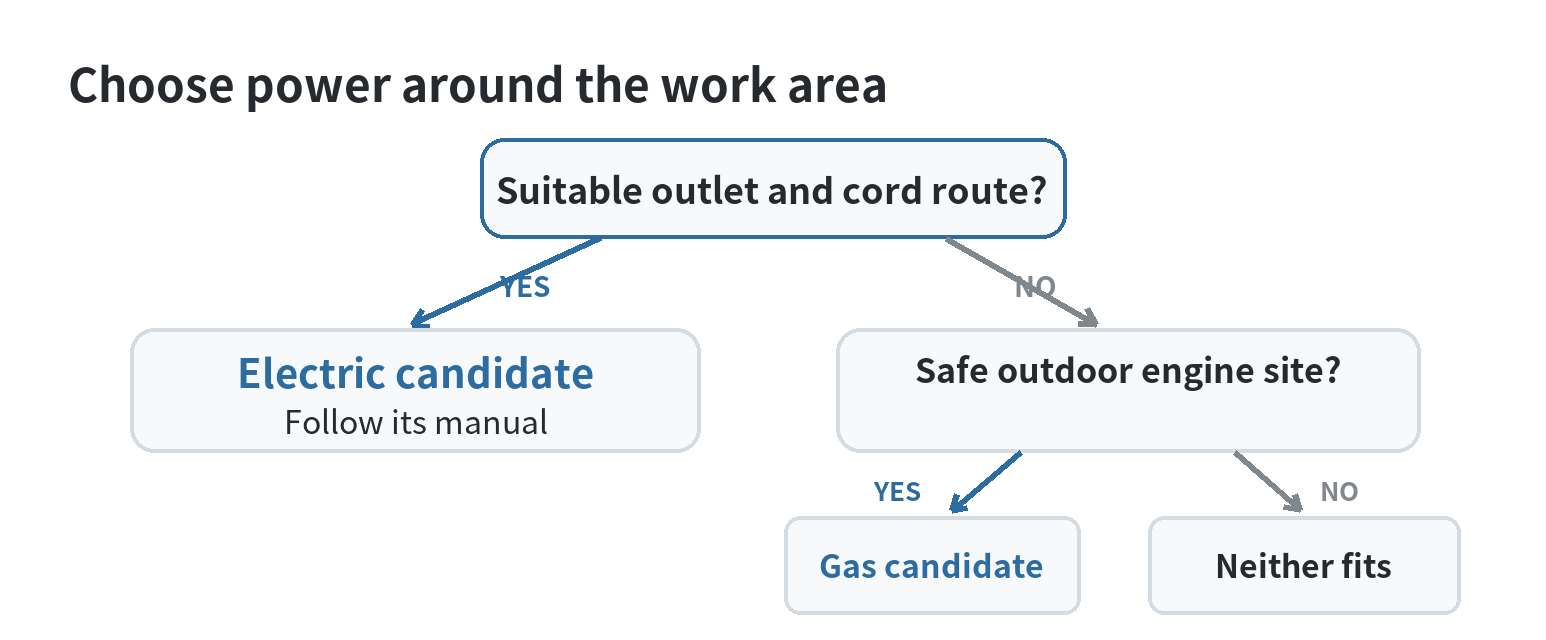
A corded electric splitter needs a suitable outlet and a cord route allowed by its manual. Check the machine’s voltage, amperage, grounding, and extension-cord instructions.
Dirty Hand Tools’ electric splitter manual specifies a 120-volt, 15-amp motor and gives extension-cord guidance. Those details cannot be assumed for another model.
Before settling on electric, trace the cord route from outlet to work area. Make sure it does not cross a path where people or split wood will move.
A gas splitter avoids dependence on an electrical cord. Its engine brings fuel, oil, hot surfaces, and exhaust into the job.
FIRMAN’s gas splitter manual says to operate that unit outdoors, away from occupied spaces.
The same manual prohibits using it inside a home, garage, shed, or other partly enclosed area because engine exhaust contains carbon monoxide.
Champion’s gas splitter manual also directs users to operate outdoors.
If your only usable work area is indoors or partly enclosed, a gas model is not a fit. Follow the exact model’s outdoor location and clearance instructions.
Think about where the rounds are stacked as well. Moving heavy wood to reach an outlet adds handling, while a gas unit still needs a safe outdoor site and space around it.
Compare the route from the pile to the splitter, the surface where it will stand, and where split pieces will go.
After splitting, keep the stack plan in mind too; our firewood rack instructions cover a simple place to store the finished pieces.
A flat, stable surface and a clear operator area are part of the setup.
Use this quick match for your pile
- Write down the real dimensions. Measure the longest and widest rounds you expect to split, not just the neatest pieces.
- Mark difficult wood. Flag knots, forks, and twisted grain. Illinois Extension and Cornell Cooperative Extension explain that species and grain patterns affect splitting difficulty.
- Filter by the manual’s limits. Check rated force, maximum length, and maximum diameter. Remove any machine that misses one of those limits.
- Check the site. For electric, verify outlet and cord requirements. For gas, confirm that you can use it outdoors as its manual requires.
- Compare the work rhythm. Look for stated cycle time and operating instructions, if provided. Force describes splitting power, not how quickly a machine returns for the next round.
Suppose your pile includes 18-inch rounds, and several are wide and knotty. An electric model with a 20.5-inch length limit passes the length check only.
You would still need to compare diameter capacity and read the manual’s instructions for suitable logs.
The length number alone does not show whether knotty pieces are a good match.
If you prepare wood in more than one batch, check whether later rounds differ in size or species.
A machine that suits the first stack may not suit a batch with thicker, more twisted pieces.
Keep the measurements with your notes while comparing models. That makes it easier to spot the exact limit that rules out a unit without relying on a broad label.
Cycle time is a separate specification when the maker provides it. Dirty Hand Tools’ 5-ton electric splitter manual lists 25 seconds for a down-and-back cycle.
That timing belongs to that model. Compare cycle time separately from force, and do not use a faster cycle to excuse a mismatch in force or log dimensions.
Read the manual before the first round
Safety instructions differ by model. Dirty Hand Tools’ electric manual requires level ground and dry conditions, and it tells users to keep hands away from the ram and wedge.
FIRMAN’s gas manual adds engine-specific instructions for outdoor use and fueling.
Read the exact machine’s manual for its start, stop, loading, and maintenance steps.
Keep hands away from the wedge, ram, and partly split wood. The electric manual says to hold logs at the sides when loading, not between the log and wedge.
Stop the machine before clearing a jam or making an adjustment, and follow the manual’s procedure.
If a round will not split, do not increase hydraulic pressure or improvise an attachment.
Use only adjustments and accessories that the manufacturer authorizes. The manual is where you confirm the machine’s limits and the safe way to operate it.
FAQ
Should a log splitter cut across the wood grain?
No. The electric and gas splitter manuals direct users to split along the grain, not across it.
Can a helper hold a log while I operate the splitter controls?
Do not let a helper position a log while someone else works the controls. The reviewed manuals require the loading area to be clear before the ram moves.
What should I do if a log gets stuck on the wedge?
Keep your hands clear and use the stuck-log procedure in that machine’s manual. Do not pry the log loose while the ram or wedge is moving.