For gifts for coworkers, base your limit on money left after bills, savings, and planned expenses, not on a guessed office standard.
List the occasions you expect, divide the total across the months before they arrive, and decide separately about group collections.
You can be thoughtful without treating every invitation as an obligation.
Start with the amount your budget can spare
Open recent account and card statements.
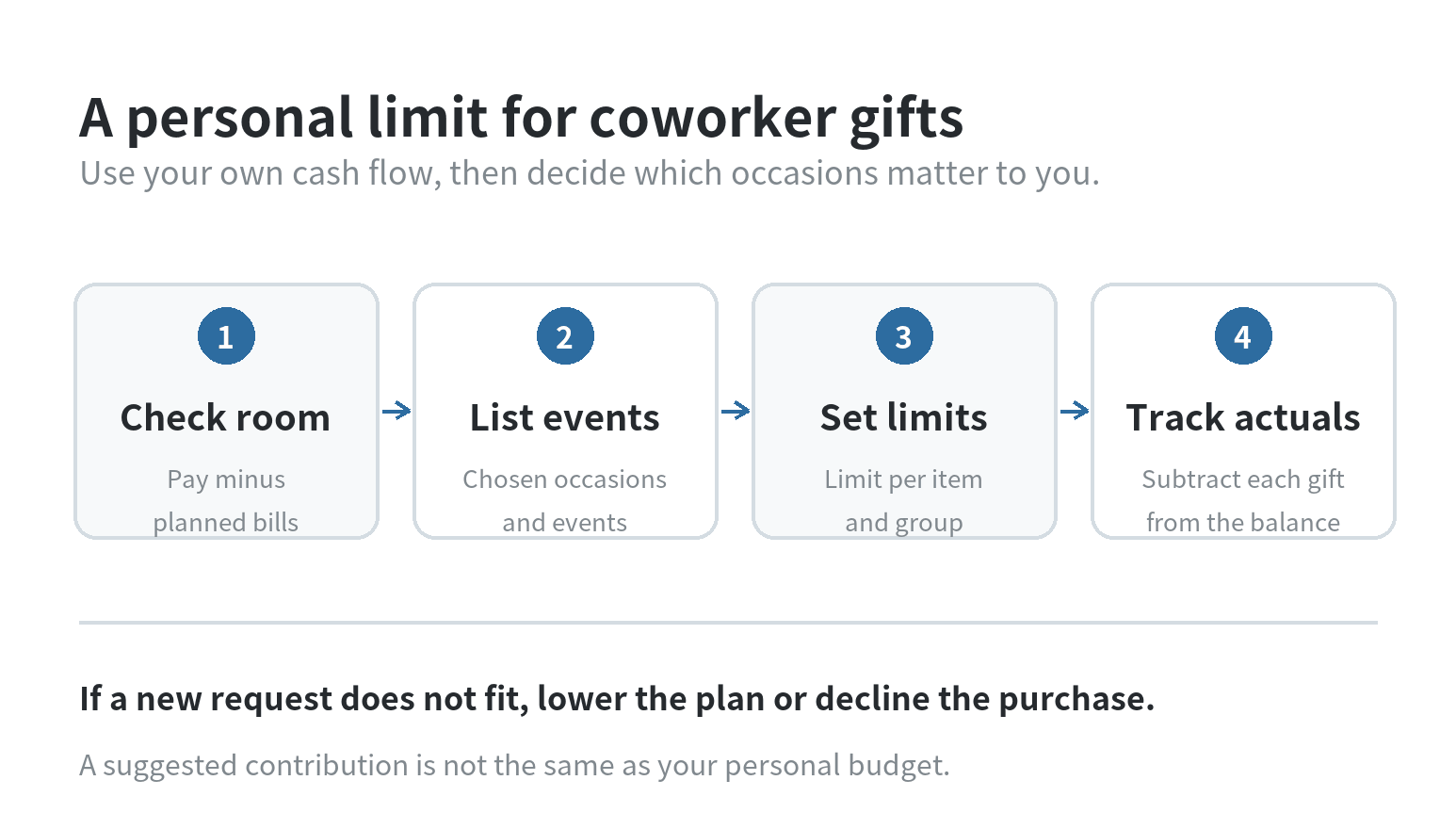
Write down take-home income and expenses that already have a job: housing, food, transportation, debt payments, savings, and other plans.
CFPB spending guidance says to review several months of records. It names gifts as a less frequent expense (checked September 30, 2026).
Include those costs before comparing the budget with take-home pay. That gives you a personal ceiling instead of a number borrowed from coworkers.
For a worked example, imagine that your monthly plan leaves $45 for office giving after other priorities. That $45 is a ceiling for the month, not a target you have to use.
If an unexpected bill arrives, set the gift line lower or skip a purchase. Do not make up the difference with a balance you cannot comfortably repay.
Keep the gift amount distinct from the rest of your social budget. Put team lunches, a farewell card, or an office event in separate lines if you also pay for them.
Otherwise, shared activities can consume the same dollars that appear available for gifts.
Build a list around the occasions you expect
Make a calendar for the next twelve months.
Add only events you know about or choose to plan for: a team exchange, a manager’s departure, a colleague’s milestone, or a shared thank-you.
The CFPB’s holiday spending guidance suggests making a list of the gifts you need and crossing them off as you go (checked September 30, 2026).
Do not assume every coworker expects an individual present.
Check what the event actually is: a voluntary group collection, an exchange with a stated cap, or a personal occasion where a note may fit better.
If the organizer has set a contribution amount, decide whether it fits your limit. A suggested amount is information, not a command.
Here is an illustrative list, not a typical price guide:
| Planned occasion | Your example limit | What counts toward it |
|---|---|---|
| Team gift exchange | $20 | Gift and any required wrapping |
| Two personal thank-you gifts | $15 each | Gift, card, and tax if applicable |
| One group collection | $10 | Your chosen contribution |
| Planned total | $60 | Revisit if an event changes |
Use your own event count and limits. Include the full amount that leaves your account, not just the shelf price: wrapping, a card, shipping, or sales tax can change the total.
If the list comes to more than you can spare, lower a limit, choose a no-cost gesture, or remove an occasion you do not want to fund.
Set both a per-event limit and a total office-gift limit for the year. The first guards one purchase.
The second keeps several small requests from outgrowing the amount you planned.
For recurring collections, keep two decisions visible: whether you want to participate and how much you will contribute if you do.
If a team request has no deadline or suggested amount, ask the organizer what the collection covers and when it closes.
That tells you whether it belongs in this month’s plan or a later one.
A calendar of planned celebrations can help you avoid counting a group collection and a personal gift as one expense.
Convert the yearly list into a monthly set-aside
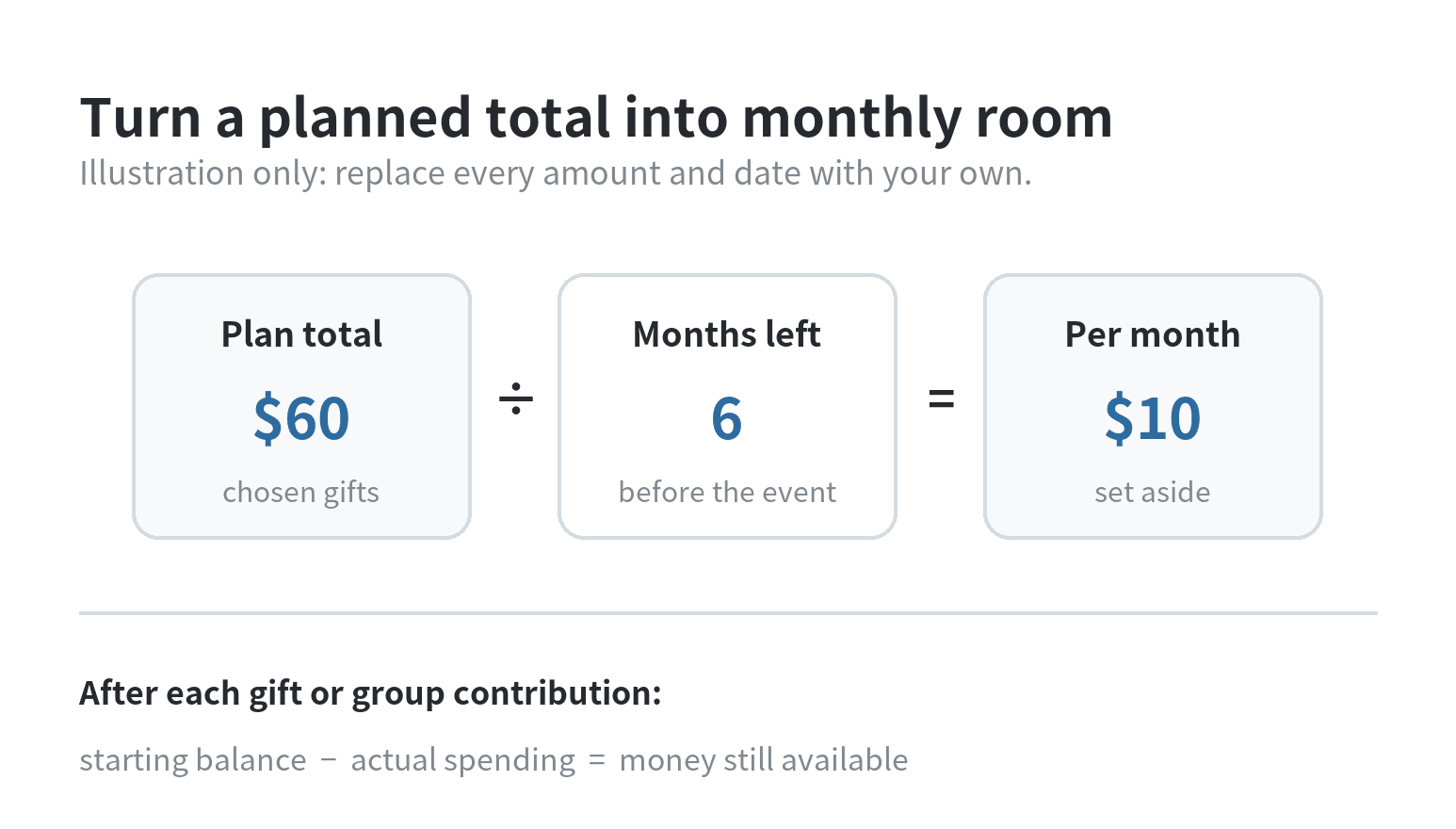
Add the amounts you have chosen, then divide by the months before you need the money. If your example calendar totals $60 and you have six months, the set-aside is $10 per month.
If the event is sooner, calculate what remains after money already saved. If that amount does not fit, adjust the gift plan rather than forcing the monthly budget.
You can also save by payday. If your example has $60 to cover and twelve paydays before the event, setting aside $5 from each payday reaches the same total.
Count the paydays you actually have before the date rather than assuming every calendar month lines up with your deposit schedule.
The CFPB’s financial-planning worksheet uses a three-month average for expenses to build a monthly picture (checked September 30, 2026).
Its spending assessment also names gifts among expenses that can be easy to miss (checked September 30, 2026).
Use that history to spot past spending, then add upcoming occasions that have not happened yet. The past is a starting point, not a promise to repeat the same spending.
Keep this fund where you track other planned expenses: a budget category, a note beside your checking balance, or a separate savings bucket.
MyMoney.gov’s Spend guidance recommends tracking spending and setting a planned maximum (checked September 30, 2026).
Record each actual purchase or contribution against your limit so you know what remains.
If separate accounts make your finances harder to manage, do not open one just for office gifts.
A simple running total works: starting amount, minus each gift or contribution, equals what is left.
If you prefer a spreadsheet, use one row per occasion and columns for planned amount, actual amount, and remaining balance.
Keep group collections and personal gifts separate
A group collection combines contributions toward one shared present or card.
Write your contribution into the group line as soon as you decide.
After you hand over a group contribution, record it as your expense. Do not record the full shared gift again in your own budget.
If you already planned an individual gift for that person, choose whether the group contribution replaces it or whether both fit. Do not count the same dollars in two categories.
For a contribution above your limit, keep your answer brief. You might say, “I’m keeping my office-gift budget to $X, so I’ll contribute that amount.”
Or say, “I can’t join this collection, but I’m happy to sign the card.”
You do not need to explain your household finances.
If you would rather not give a reason, say, “I’m sitting this one out—thank you for including me.”
If the team is planning a recurring exchange, ask the organizer to share the format and any spending cap before you opt in.
An agreed cap gives participants a shared price ceiling. If there is no cap, suggest one or set a private limit for yourself; do not assume everyone has the same budget.
When a new occasion appears
Pause before adding a new occasion to the plan. Check the remaining balance and the date of the next planned expense.
If there is room, assign a limit and record it. If there is not, choose a lower-cost gesture, a contribution within your limit, or no purchase.
A handwritten note, sharing a useful work resource, or offering a sincere thank-you can mark the occasion without creating an expense.
At month-end, compare planned and actual amounts. The CFPB’s spending tracker sorts expenses by category and totals them (checked September 30, 2026).
Its spending assessment advises comparing your budget with account records (checked September 30, 2026).
If you spent less, leave the balance for a future event or return it to its original purpose.
If you spent more, identify which occasion changed the plan and reduce a future limit before the next event arrives.
For help choosing a simple tracking format, see our budget tracker setup guide.
If you prefer app-based categories, our budgeting app overview discusses ways to organize a spending plan.
FAQ
How do I budget for a coworker gift when I started the job midyear?
Start with occasions still ahead, not events that already passed. List each one and set an amount that fits your current budget.
Divide the remaining total across the pay periods or months before those dates.
Should I give my manager a different gift from the rest of the team?
You do not need to add a separate gift by default. Check your workplace’s event plan and your own comfort level.
A signed card or joining a group collection may be enough for you.
What if a coworker collection has no stated amount?
Choose a contribution that fits your limit, or ask the organizer whether there is a suggested range.
You can also decline while still signing a card or sharing a kind message.
How should I handle a gift exchange with a spending cap?
Treat the cap as the exchange’s maximum, then set your own limit at or below it. Include wrapping or delivery if those costs apply.
Skip the exchange if the amount does not fit.
Last updated: September 2026
Last updated: 2026-09