Start a pest-control budget with a written scope, not a national average. Identify the pest and compare quotes for the same work.
Then spread a planned bill across the months before it is due. Keep a one-time visit separate from a recurring service plan.
EPA recommends getting several estimates and weighing competence as well as cost (EPA, checked September 30, 2026).
Minnesota Extension recommends written estimates and comparing services and rates (Extension, checked September 30, 2026).
UC IPM says to request the total cost of the proposed plan (UC IPM, checked September 30, 2026). None gives a nationwide household price range.
Use quotes for your address and pest problem instead of treating an online average as your likely bill.
Make a pest-control line that fits your budget
Start with take-home pay and required bills. Add a “pest control and prevention” line to your household budget.
Keep it separate from groceries, cleaning supplies, and repairs. Then you can see whether a quote is one-time or recurring.
Before calling, write down what you observed: where it appeared, what it looked like, and when you noticed it.
Note any access points or damp areas. Share the same summary with each company so they assess the same problem.
Identify the pest before choosing treatment. EPA puts monitoring and identification ahead of prevention and control (EPA’s IPM principles, checked September 30, 2026).
One sighting does not always mean treatment is needed. EPA favors less risky approaches before broad pesticide use (EPA, checked September 30, 2026).
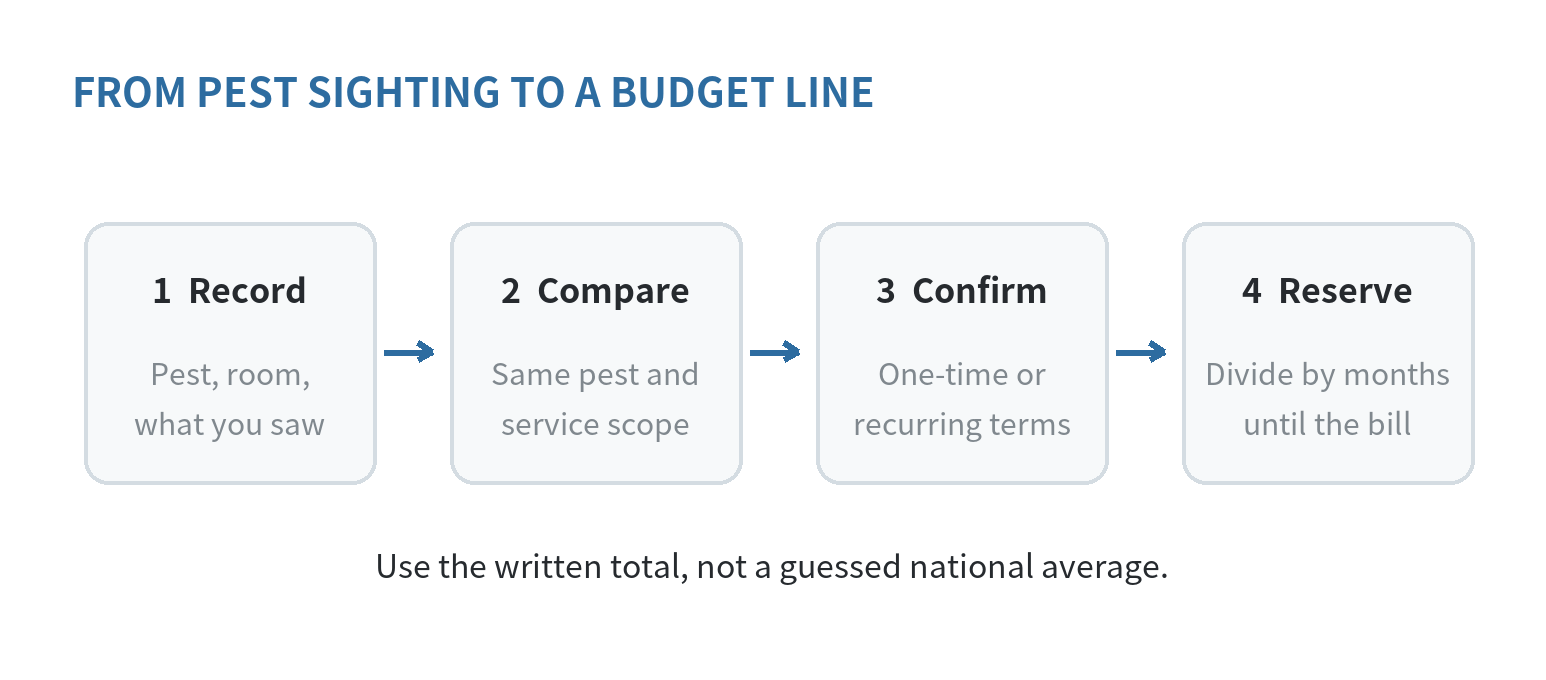
If cash is tight, write down what you can pay now without missing a bill. Also decide what you could set aside from later paychecks.
Use the first amount to discuss an initial payment. Use the second to judge an installment schedule or future renewal against other bills.
Ask for quotes you can compare
Ask each company to assess the same pest and affected areas. Request the estimate in writing.
List the inspection fee, treatment steps, number of visits, follow-up conditions, and recurring charges separately.
Minnesota Extension recommends comparing written estimates; EPA says cost should not be the only factor (Extension; EPA, checked September 30, 2026).
Ask whether an inspection fee is credited toward later service. Write any credit conditions beside the quote.
Do not subtract a possible credit until the estimate says when it applies. Recheck it if the scope changes.
Ask whether another inspection or return visit has its own charge. Record what would trigger that charge.
A low total may cover fewer visits or exclude sealing, cleanup, monitoring, or a return visit. A higher quote may include items you do not need.
Ask what each line covers and what triggers another charge. Ask whether you can decline optional work without changing the core service.
| Quote item | What to write down | Budget question |
|---|---|---|
| Inspection | Included or separate fee; credited toward service? | What is due before work begins? |
| Treatment | Pest, rooms or exterior areas, method, visits | Is this one total or a per-visit amount? |
| Follow-up | Return visit terms and any added charge | What event starts another bill? |
| Ongoing plan | Service interval, cancellation terms, renewal price | What repeats, and when can the price change? |
| Preparation | Tasks you must do and any supplies you provide | Does the plan require extra household spending? |
Ask to see the applicator’s credentials. Check them with your state pesticide agency; EPA points to state agriculture departments (EPA, checked September 30, 2026).
Minnesota Extension recommends checking that the license classification matches the pest problem (Extension, checked September 30, 2026).
States, territories, and tribes may change certification categories. Use your state agency’s search or contact page (EPA standards, checked September 30, 2026).
Turn the written total into a monthly reserve
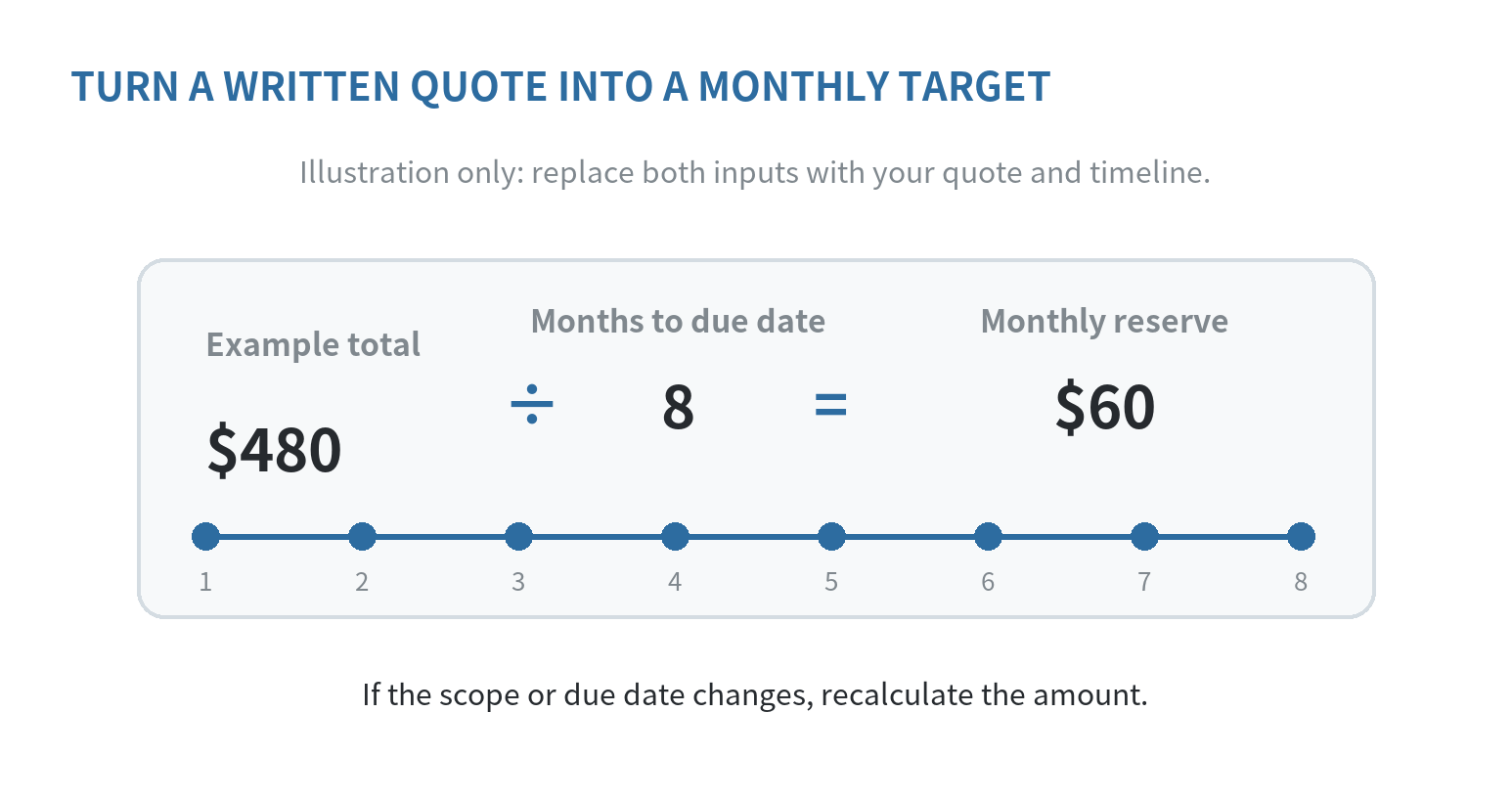
For work you plan to schedule later, divide the written total by the months before payment. A made-up $480 total due in eight months works out to $60 per month.
Those amounts are arithmetic placeholders, not a pest-control price estimate. Subtract any savings you already have before dividing the balance.
Tie planned transfers to deposits that arrive before the bill is due. Write the transfer dates next to the quote.
In the example, two deposits a month would mean setting aside $30 from each. The monthly reserve remains $60.
If a third paycheck lands before the due date, decide whether any of it goes to this bill or another planned expense.
When pay varies, count deposits expected before the due date. Divide the remaining quote amount across those deposits.
For an ongoing contract, convert every charge to the same period before deciding whether it fits. If a plan bills quarterly or annually, record the full payment date.
Reserve a portion each month. UC IPM recommends listing inspection and treatment frequency in the written estimate (UC IPM, checked September 30, 2026).
When a new quote changes the total, replace the old estimate in your budget. Do not keep reserving toward an outdated amount.
Record whether the change came from a different scope, extra visits, or a renewal price. Compare like items during your next review.
Put prevention items in the pest-control line only when they are part of the pest plan, such as a door sweep or storage container. Keep building repairs under home maintenance.
This shows whether money went to professional service, a preventive change, or a repair without blending different costs.
Our monthly budget walkthrough shows a phone-based way to track irregular bills.
A separate emergency savings guide can help keep surprises apart from a planned service reserve.
Use the service plan as a decision, not an automatic bill
Ask whether the recommendation is one-time, monitoring, or a repeating plan.
UC IPM says service can be one-time or recurring, depending on the contract. Ask for total cost (UC IPM, checked September 30, 2026).
EPA says contracts can include inspections. It cautions against routine applications if nonchemical methods have failed (EPA, checked September 30, 2026).
UC IPM advises asking for monitoring, trapping, or baiting as alternatives to routine spray service (UC IPM hiring guidance, checked September 30, 2026).
UC IPM says not to hire contractors for calendar-based pesticide treatments without pest evidence (monitoring guidance, checked September 30, 2026).
For each recommended visit, ask what evidence the company will record and how it will decide whether another visit is needed.
EPA’s IPM framework uses monitoring and identification to guide control decisions.
Ask the company to explain its inspection notes in ordinary language (EPA, checked September 30, 2026).
Before signing, compare the full contract, not only the first payment. Check the total, renewal date, cancellation terms, follow-up, and what happens if the problem changes.
EPA warns against pressure to sign immediately. Check guarantee coverage and inspection charges (EPA, checked September 30, 2026).
When the estimate does not fit this month
Ask for an itemized scope and whether the company can price a narrower service without omitting necessary work. Ask which action is time-sensitive and what can wait.
Ask what preparation is included. EPA says consumers can take time to review estimates when the problem can wait (EPA, checked September 30, 2026).
Avoid a rushed decision based on an unsolicited warning or immediate-discount pitch.
If the full amount does not fit, ask for the written estimate and payment schedule before agreeing to work.
Compare that schedule with rent, utilities, food, debt minimums, and other due dates.
For planned service, use the monthly-reserve calculation. Adjust the timeline or scope before accepting a plan with a total you cannot explain.
For renters, share the written estimate with the property manager before authorizing work that affects the building. Keep copies of messages and the quote.
This keeps the service decision and household budget tied to the same written description.
FAQ
How much should I set aside for pest control each month?
Use the written quote and due date to calculate the amount. Divide what you still need by the months available.
Do not use a generic national average as your personal budget.
Should I budget for a monthly pest-control visit?
Only if a written plan calls for it and fits your situation. EPA advises against routine applications unless pests persist and nonchemical methods have failed (EPA).
UC IPM says treatments should follow pest evidence, not the calendar (UC IPM, both checked September 30, 2026).
What should I do if two pest-control quotes cover different work?
Ask both companies to price the same pest, areas, visits, follow-up, and contract period. Compare the revised written scopes and total charges before choosing a budget line.
Last updated: 2026-09