A well pump choice starts with the water level while the pump is running, not the total depth printed on a well record. A shallow-well jet pump sits above ground and pulls water; a submersible pump sits in the well and pushes water upward. Before comparing horsepower, collect the well’s pumping level, desired flow, pressure, voltage, and existing pump information.
Start with the water level, not the drilled depth
A well may extend far below the water surface. The pump works against the level water falls to during pumping, plus the height and resistance between the well and the water outlets. Ask for the well log and the installer’s pump record. Look for static water level, pumping water level, pump setting depth, casing diameter, and the well’s tested yield.
Static level is the water level when the pump is off. Pumping level is measured while water is being drawn. They can differ because the water level drops as the well supplies water. The distinction matters: sizing from total drilled depth can misstate the lift the pump must handle, while sizing from static level alone can miss drawdown.
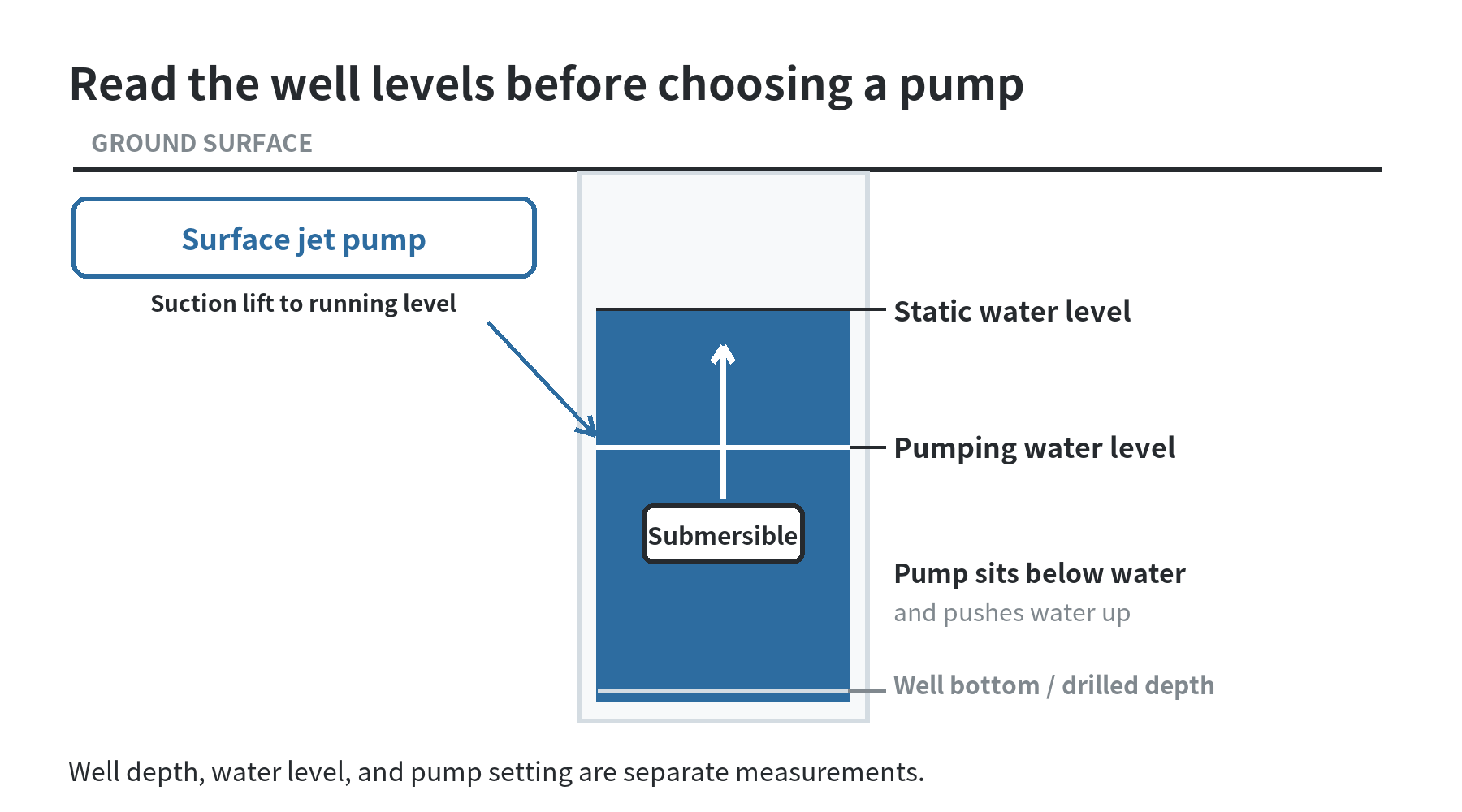
The EPA’s private-well overview describes jet pumps as above-ground equipment commonly used for shallow wells and submersible pumps as units placed inside the casing for deeper private wells (checked October 9, 2026). A Pentair shallow-well jet manual gives a maximum lift of 25 feet for that pump family. Treat that as a product limit, not a universal cutoff for every jet pump.
Choose the pump arrangement around the pumping level
| Setup | Where it sits | What to check | Trade-off to plan for |
|---|---|---|---|
| Shallow-well jet | Above ground | Maximum suction lift in the specific manual; pumping water level; pipe friction | Accessible for service, but suction limits apply |
| Convertible or deep-well jet | Motor above ground; ejector assembly in the well | Rated well-water depth, ejector arrangement, and both pipe connections | More well piping and fittings than a shallow setup |
| Submersible well pump | Inside the well casing | Flow at required total head, casing fit, setting depth, wiring, and control box | Service requires pulling the pump and drop pipe |
The buying guide’s general ranges place shallow jet pumps at water depths up to 25 feet, deep-well jet pumps in an intermediate range, and submersible models for deeper settings. Product manuals narrow those broad categories: one convertible jet manual calls for a deep-well setup when the water level is more than 25 feet below the pump, while a different model can have a different rated limit. Use the exact model’s manual and pumping level rather than treating a category label as a guarantee.
A convertible deep-well jet system also has an ejector assembly and drive and suction plumbing in the well. Pentair’s manual diagrams show how those lines connect. Check the pump’s required arrangement against the well casing and existing wellhead before comparing a convertible model with a submersible that uses a different setup.
A well pump delivers groundwater from a well into a home’s water system; a sump pump removes collected water from a basement or crawlspace basin. They solve different water-moving jobs.
Match flow and pressure before horsepower
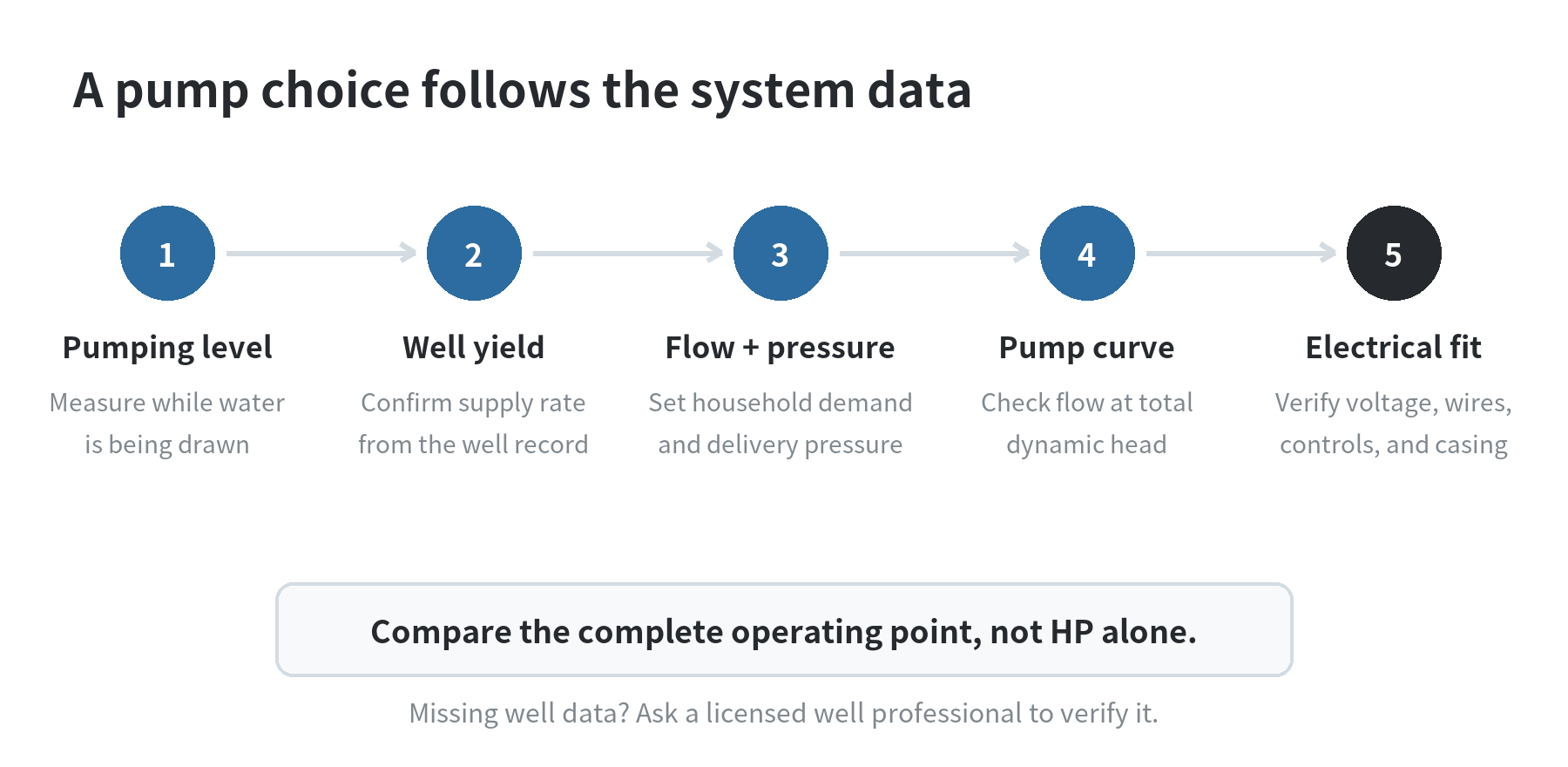
Horsepower is only one line on a pump specification. First write down the flow the household needs, the pressure required at the pressure tank or fixtures, and the total head the pump must overcome. Total dynamic head combines vertical lift, pressure demand, and losses from pipe length, diameter, fittings, and valves. The pump curve shows what flow a particular model can deliver at a particular head.
Penn State Extension defines well yield as the highest pumping rate that does not lower the water below the pump intake. That is different from the pump’s rated capacity. If the pump can draw faster than the well replenishes, the water level can fall during use. Get the well’s test yield and pumping level together; a pump professional can compare them with the home’s peak demand and pressure tank setup.
That is why a higher horsepower number alone does not prove a pump fits. In Pentair’s published shallow-jet performance table, the listed flow changes as suction lift and discharge pressure change. Franklin Water’s selection material likewise identifies flow and total dynamic head as core selection inputs. Compare the pump curve at your actual operating point, not just the maximum GPM or maximum lift shown separately on a package.
For a replacement, record the old pump’s horsepower, voltage, wire configuration, control box, pressure-switch setting, and any tank information from labels or service records. A guide may suggest keeping the same horsepower for a like-for-like replacement, but that is a starting check. A new appliance, changed plumbing, a lower pumping level, or a different pressure requirement can change the operating point. Confirm the full system selection against the pump curve and the well’s measured yield.
A model’s maximum lift and maximum flow are separate limits; a pump does not deliver its maximum flow at every head. A performance chart or pump curve maps the combinations. If the package gives only a headline GPM and horsepower, find the manual or ask for the curve before comparing it with your well data.
Use the well record to narrow the options
- Find the running water level. Use the well log or ask the well professional who measured it. Do not substitute total drilled depth.
- Check the well’s yield. The pump should not be selected to demand more water than the well can supply. Ask for the pump test or measured recovery information.
- Set the household flow and pressure. List simultaneous uses that matter, such as a shower and irrigation zone, then share that demand with the pump professional.
- Read the pump curve. Find the flow available at the calculated total head and pressure; do not compare horsepower in isolation.
- Confirm fit and power. Check casing diameter, discharge connection, voltage, wire count, control box match, and the manufacturer’s installation limits.
For example, a record might show a 180-foot drilled well but a pumping water level of 62 feet. Those figures are not interchangeable. Use the measured pumping level in the system calculation, then account for the home’s pressure, vertical rise, and pipe losses. Treat the example as a way to read the record; plug in the measurements for your own well before comparing pump curves.
Check details that can make a listed pump incompatible
Voltage and wiring are easy to overlook because they may sit beside the horsepower rating in a listing. Match the pump’s voltage and wire arrangement to the documented system, then confirm the control box, breaker, and cable against the manufacturer’s wiring diagram. A manual can specify more than one voltage setting for a motor; use the setting and supply voltage stated for that exact installation.
Check the casing’s inside diameter and pump body dimensions before choosing a submersible unit. Also compare the discharge size, maximum rated head, water temperature range, and any requirement for a control box. If the pump will supply irrigation, livestock, or a second building as well as household taps, include those uses in the flow estimate.
Service access differs too. An above-ground jet pump can be reached at the pump location, while the well-pump guide notes that a submersible unit must be pulled from the casing for repair. Include the drop pipe, wire, and lifting method in a replacement discussion; those parts affect the work even though they do not change the pump’s horsepower label.
Ask the well contractor to confirm the pumping level, test yield, pump setting, total head calculation, and pump curve point in writing. If the well record is missing or the water level is unknown, resolve that measurement before choosing by horsepower. A licensed well professional can verify system-specific electrical and installation details.
FAQ
Can I use the full drilled depth to choose a pump?
No. Use the pumping water level and pump setting with the system’s required flow and pressure. Total well depth describes the hole, not the complete lift the pump must handle.
Does a deeper well always need a higher-horsepower pump?
No single horsepower rule covers every well. The required flow, total head, pump curve, and well yield determine which model can serve the system; compare those values in the manufacturer’s sizing material.
What should I bring when asking about a replacement pump?
Bring the well log, old pump label or manual, measured pumping level, test-yield information, voltage and wire details, and pressure-tank or switch information. Those records let a professional check compatibility and performance together.
Last updated: 2026-10