
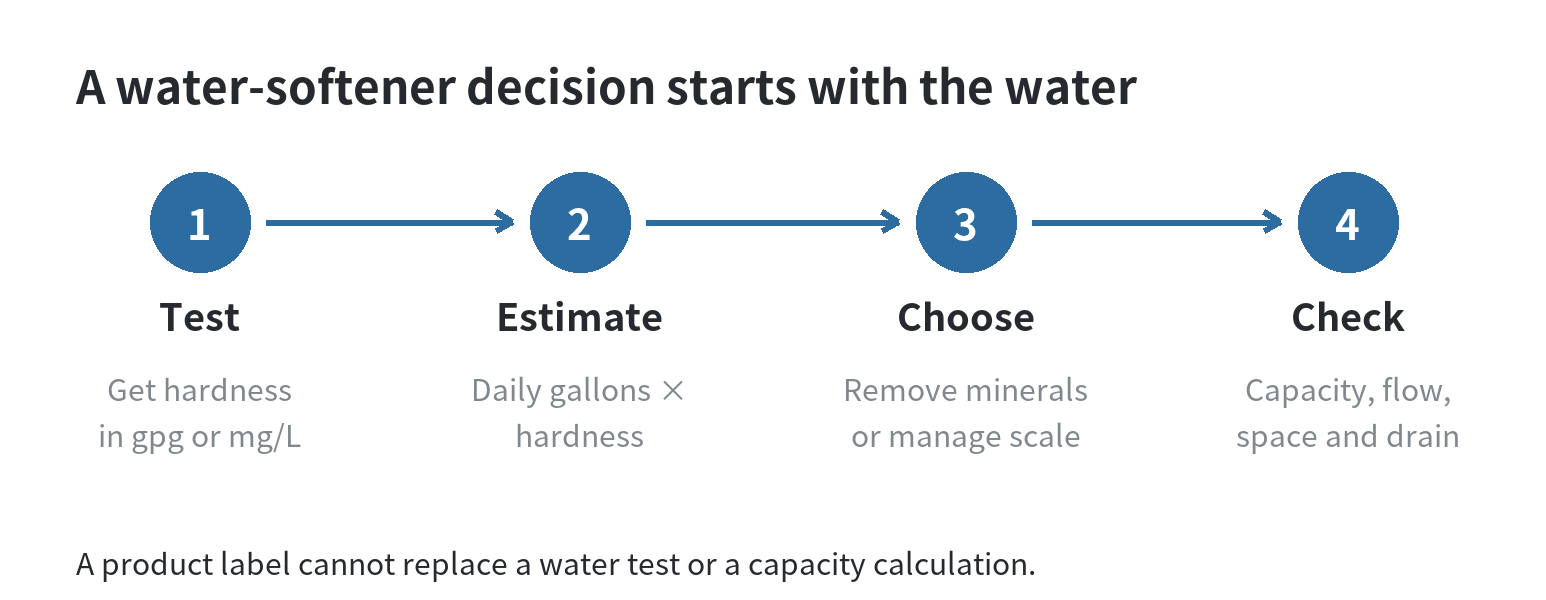
Choose a whole-house water softener from a water test and a capacity calculation, not from household size alone. First confirm that hardness is the problem you want to address; then compare the system’s usable grain capacity, regeneration controls, flow rate and installation needs. A salt-free conditioner follows a different goal: scale management without removing calcium and magnesium.
Start with the hardness number
Hard water contains dissolved calcium and magnesium. A test report may express hardness as grains per gallon (gpg) or milligrams per liter (mg/L). Penn State Extension defines one gpg as about 17 mg/L and classifies water above 7 gpg as hard; Virginia Tech describes water above about 7 to 8 gpg as a level that may interfere with soaps and leave mineral deposits. These are useful reference points, not a substitute for your own test.
Use a test kit or a laboratory result for the water entering the home. If you use a private well, a hardness number alone does not check for other water-quality concerns. Virginia Tech recommends having a sample analyzed by a certified lab before purchasing water-treatment equipment. For municipal water, the utility’s water-quality report may offer context, but a home-level test can be more relevant when plumbing or a private service line affects what reaches your fixtures.
Write down both the result and its unit. Do not compare a figure in mg/L directly with a product setting in gpg. If the report gives mg/L, divide by about 17 for a rough gpg conversion; confirm the conversion and the tester’s instructions before setting a control valve.
Turn the test into a capacity estimate
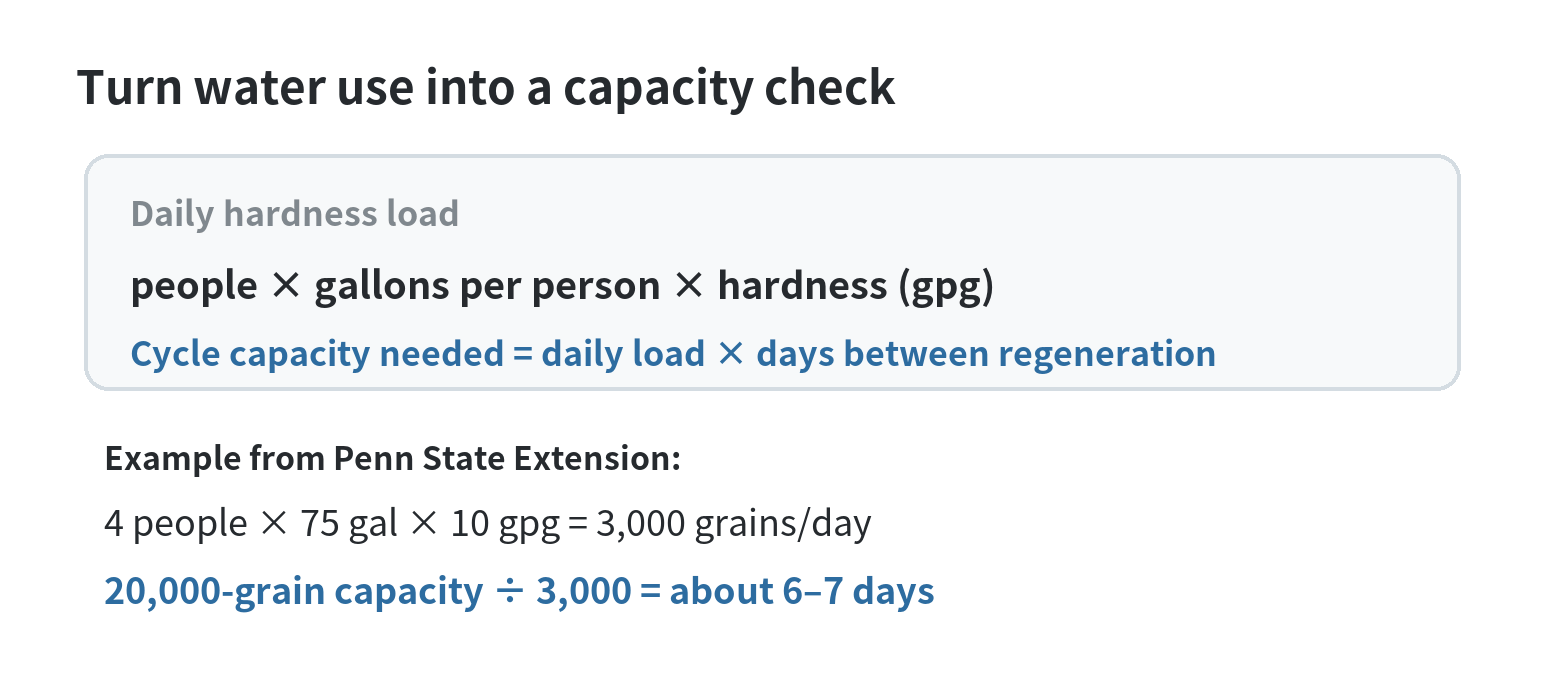
Grain capacity describes how much hardness a system’s resin can exchange before it needs regeneration. Penn State Extension gives this planning method: estimate gallons used per person each day, multiply by household size and measured hardness, then compare daily load with the system’s rated grains per regeneration. Its worked example uses four people, 75 gallons per person per day, 10 gpg hardness and a 20,000-grain capacity. That works out to 3,000 grains of daily load and roughly six to seven days between regeneration cycles.
Treat the example as a calculation pattern, not a household average. Replace its people, water-use and hardness inputs with your own information. Read the system’s spec sheet for the actual capacity at each salt setting: a higher advertised maximum can depend on using more salt per regeneration.
| Label or setting | What to check | Why it matters |
|---|---|---|
| Grain capacity | Rated grains at the salt setting you would use | Capacity determines how much hardness the resin can exchange before regeneration. |
| Control type | Metered/demand-initiated or timed regeneration | Metered controls respond to water use; timed controls follow a set schedule. |
| Flow rate | Service flow at the pressure drop listed in the spec sheet | Compare it with simultaneous household water use, not just tank size. |
| Installation | Drain, power, plumbing access, floor space and local rules | These determine where a whole-house system can be installed and maintained. |
A larger grain number is not automatically a better fit. A system that regenerates too often uses its salt and drain cycle more frequently; an oversized unit may have higher upfront and space requirements. Ask for the rated usable capacity at the programmed salt dose, the expected regeneration settings for your test result and the service-flow figure. Those details make model labels easier to compare.
Keep five entries on one comparison note: your hardness result and unit, estimated gallons used per day, usable grain capacity at the intended salt setting, service flow at its listed pressure drop, and the regeneration control type. If a product page shows only a maximum capacity, check the model manual for capacity at other salt settings. A single capacity headline cannot tell you the expected interval between cycles without your water use and hardness.
Decide whether you need softened water or scale management
A conventional salt-based ion-exchange softener passes water through resin that exchanges sodium ions for calcium and magnesium. The resin eventually fills with hardness minerals, so the unit regenerates with brine and sends the removed minerals to a drain. Check whether your household is comfortable with salt refills, a brine tank and regeneration discharge.
“Salt-free” systems may refer to conditioners rather than true softeners. Nebraska Extension describes these no-salt devices as descalant devices rather than hardness-removing equipment, since they do not remove hardness from the water, though they are intended to manage mineral buildup. If your goal is to lower the measured calcium and magnesium level, compare ion-exchange capacity. If your goal is scale management without exchanging those minerals, read the conditioner’s treatment method and independent performance documentation carefully.
Salt-based systems add sodium to softened water, as the exchange replaces hardness minerals with sodium. Virginia Tech advises people on restricted-sodium diets to consult a physician before consuming softened water. Ask whether a system can leave a drinking-water tap or outdoor line untreated if that matters in your home.
Check the space and the plumbing before comparing models
A whole-house unit needs a connection to the incoming supply, access for maintenance and a route for regeneration discharge. Confirm the available footprint, drain location, electrical needs, bypass valve access and the manufacturer’s required clearances. If the drain or plumbing layout is uncertain, get an installer to review the site before choosing a tank size. The site’s water-heater installation notes offer a related checklist for planning questions with an installer.
Check peak flow as well as capacity. A softener can have ample grain capacity and still be a poor match if its service-flow rating does not suit the home’s simultaneous demand. Use the manufacturer’s flow data and include the pressure drop stated beside it. For homes with several showers or appliances likely to run together, have the installer compare the expected peak demand with the unit’s rated service flow.
Control features change how the unit regenerates. Penn State Extension describes timer controls that recharge at a programmed time and demand-initiated controls that detect when resin needs recharging. Ask how the control uses your hardness setting and water-use data, what happens after a power interruption, and whether you can see a regeneration history or alert. Confirm these details in the exact model’s manual instead of inferring them from a generic product description.
Compare ongoing work, not just the tank label
Before narrowing the choices, put the maintenance items side by side: salt type and refill access, brine-tank cleaning instructions, regeneration-water use, resin warranty, control-valve warranty and the cost of any required pre-treatment. Regeneration water use depends on the system, so check the model documentation rather than applying one generic gallons-per-cycle figure.
Check that your water report and the product spec sheet use compatible hardness units, that the grain rating reflects the setting you would actually use, and that the flow rating fits your plumbing. A water filtration system addresses different contaminants and is not a substitute for hardness treatment; see the site’s water-filtration guide if you are comparing treatment goals.
Last updated: 2026-10. Recheck local rules and the selected model’s manual before installation.
FAQ
Can a water softener also remove iron from well water?
Some ion-exchange units can handle limited iron, but the amount depends on water chemistry and the model. Virginia Tech says performance is designed around specific water conditions and recommends certified-lab analysis before purchasing treatment equipment. Use an iron result and the manufacturer’s stated limit to determine whether a separate treatment stage is needed.
Should outdoor faucets go through a water softener?
They do not have to. Penn State Extension notes that outdoor spigots can be bypassed, which avoids using softened water for outdoor tasks. Ask the plumber to map which branches would remain untreated before installation.
Will water still flow while a single-tank softener regenerates?
On most single-tank systems, the tank cannot soften water while it is regenerating, so the house is typically without softened water during that cycle; a dual-tank design keeps one resin tank in service while the other regenerates. Confirm this in the selected model’s manual and decide whether any interruption fits your household’s schedule.
Does a water softener make unsafe water safe to drink?
No. A softener treats hardness minerals; it does not necessarily remove more serious drinking-water contaminants. Penn State Extension notes that a softener will not necessarily remove more serious drinking-water contaminants.