
Choose a ducted range hood when your kitchen can carry a properly sized duct to an exterior wall or roof. Choose a recirculating hood when an outside route is not available and you can keep up with its filters. Then size the fan around the cooking surface and the duct path; the highest CFM on a product page is not automatically the right fit.
HVI’s kitchen ventilation guidance (checked October 7, 2026) ties airflow to the range’s location and width. Its table gives a useful starting point, while the hood’s installation manual sets the duct size, mounting clearance, and permitted installation method for that model.
Decide where the air can go
A ducted hood pulls cooking air through a metal duct and discharges it outdoors. A recirculating hood draws air through filters and returns it to the kitchen. The Home Ventilating Institute says a nonducted recirculating hood does not provide actual ventilation. Broan-NuTone explains that moisture, smoke, and heat from cooking are recirculated back into the home by nonducted filters.
The retailer’s range hood buying guide describes the same practical split: ducted units need an exterior opening, while ductless units filter and recirculate air. Its guide also notes that a convertible hood can support either mode, but the required parts and filter setup depend on the specific model. Check that the configuration is included or listed in the installation instructions.
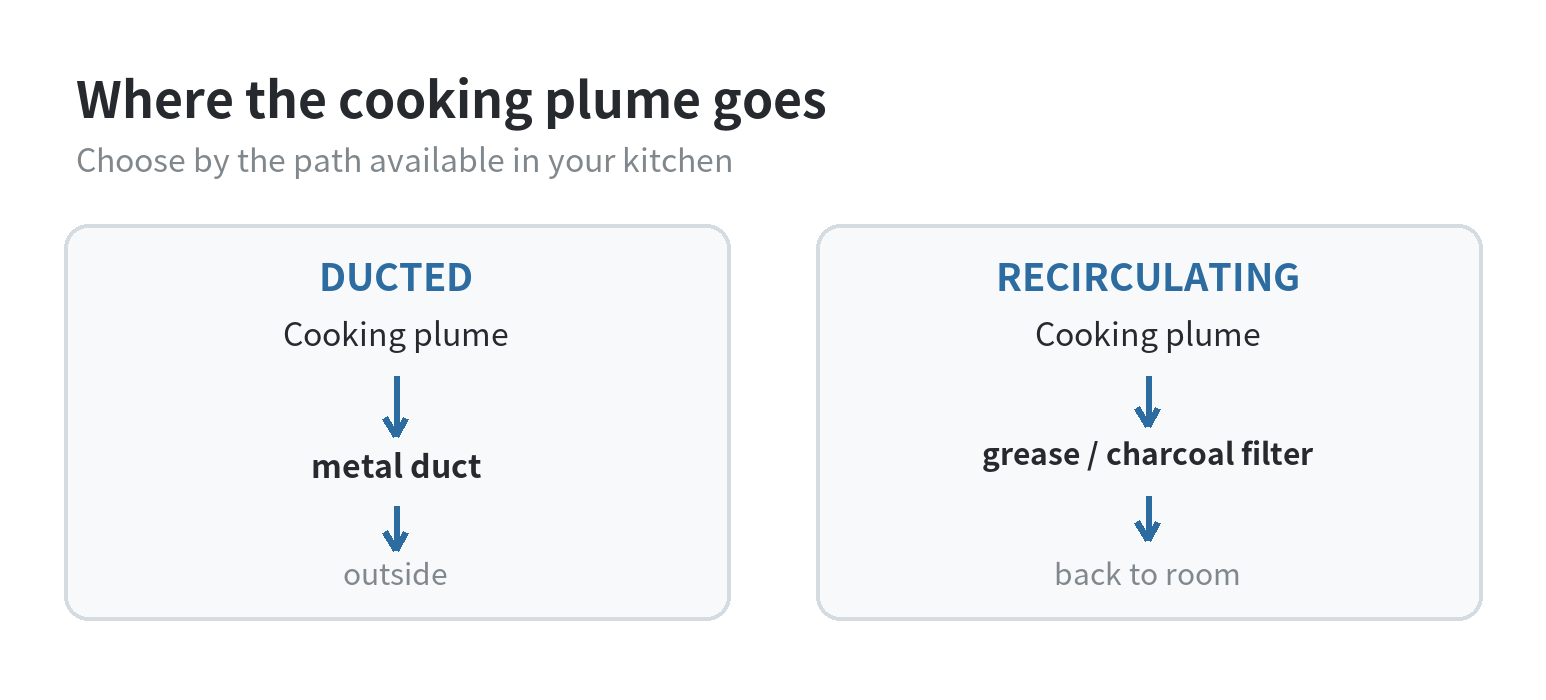
If there is no route through a wall or roof, recirculation may be the workable option. If a duct route exists, confirm where it terminates and whether the new hood’s outlet matches it. Exhaust should discharge outdoors, not into an attic, crawl space, garage, or wall cavity; the manufacturer’s installation instructions specify the permitted route and duct material.
Use CFM as a starting point, not a score
The retailer’s buying guide uses CFM, or cubic feet per minute, to describe how much air a fan moves. HVI’s guide recommends about 100 CFM per linear foot of a wall-mounted range and 150 CFM per linear foot for an island range. For a 30-inch wall hood, its table lists 250 CFM as a recommended rate and 100 CFM as a minimum. HVI says to multiply the rate by 1.5 for a hood over an island.
The retailer’s buying guide adds that gas ranges usually call for a higher CFM rating than electric cooktops, but it does not give one number for every gas range. Use the appliance maker’s guidance for a professional-style or high-output cooktop rather than treating a broad rule of thumb as a model-specific calculation.
HVI assigns different rates to wall and island locations, so location changes the airflow starting point even when the cooking surface has the same width. For a 30-inch island cooking surface, applying HVI’s island rate of 150 CFM per linear foot gives a starting figure of 375 CFM. Treat it as a planning reference, then check the cooktop maker’s guidance and the hood’s installed airflow data.
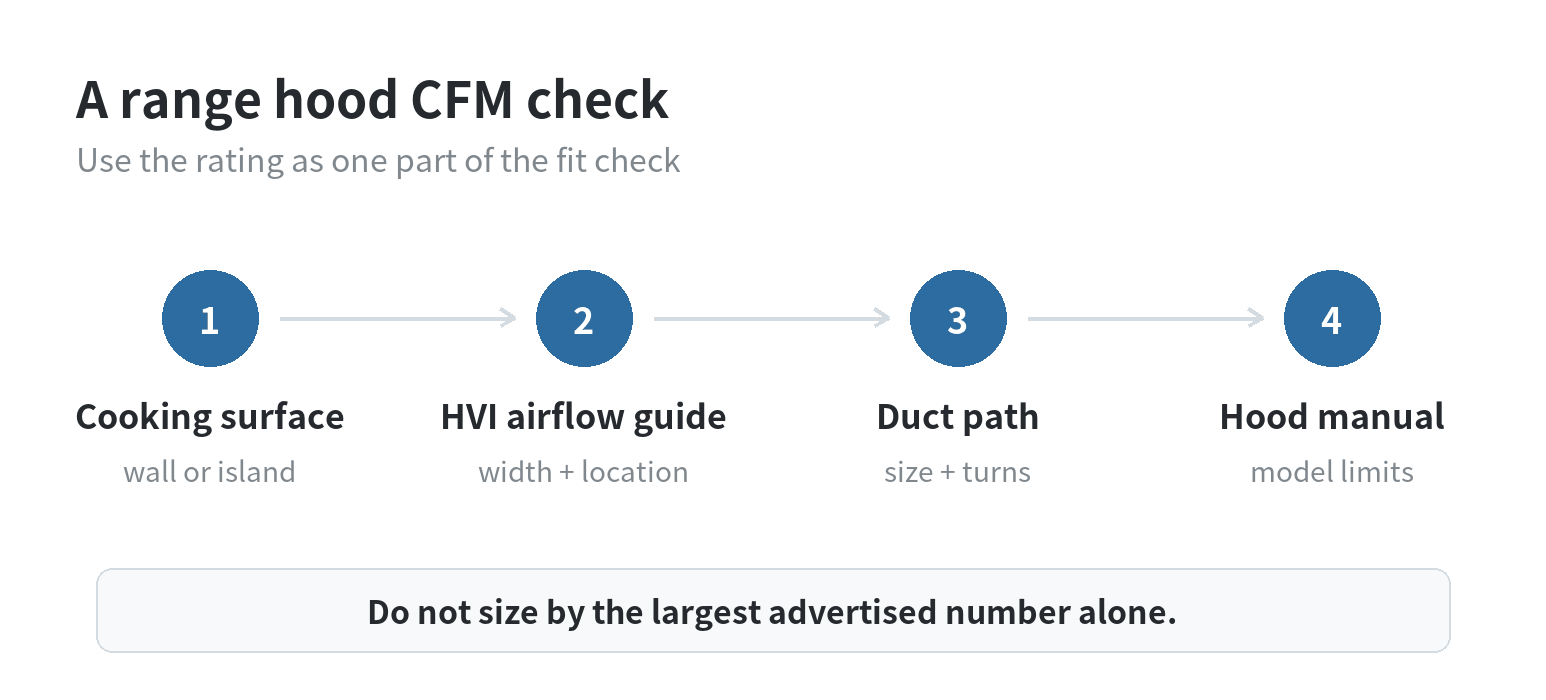
Those figures help narrow a search; they do not replace the cooking appliance and hood manuals. HVI directs owners of professional-style cooktops to the cooktop manufacturer for ventilation requirements. A long duct, a narrow duct, or several bends can restrict delivered airflow, so an advertised maximum may not match the installed result. HVI’s certified ratings offer a standardized basis for comparing rated airflow.
Check the space before choosing a hood shape
Measure the cooktop width, the cabinet or wall space above it, and the available ceiling height. The retailer’s guide says the hood should be at least as wide as the cooking surface. A wider capture area may suit the layout, but the cabinet edges, nearby walls, and clearance rules can limit what fits.
Mounting height is model-specific. The retailer’s guide describes about 30 inches from the cooking surface to the hood’s lower edge, while Broan-NuTone’s installation FAQ gives a 24-to-30-inch range and tells owners to check the instructions for their unit. Treat those figures as source-specific guidance, not a universal clearance: the range manual and hood manual both matter, and either may set a different minimum or maximum.
For an under-cabinet hood, inspect the cabinet bottom and the path through the cabinet or wall. For a wall hood, check whether the duct can go straight up or out through the wall. An island hood needs a route through the ceiling. If cabinets are part of a renovation, settle the duct path before finalizing the overhead layout; our kitchen remodel plan covers how appliance placement fits into that sequence.
Replacing an existing hood? Photograph the duct opening and measure the cabinet space before removing anything. A replacement that vents upward may not fit a rear-facing outlet without a different configuration. If no duct is visible, do not assume the current hood vents outdoors; check the installation paperwork or look for the exterior wall or roof cap before choosing a replacement mode.
Match the duct and filter details
Write down the existing duct shape, diameter, direction, and approximate route before comparing models. Broan-NuTone’s range hood FAQ says to use metal duct and avoid reducing the duct below the size specified for the hood. It also explains that bends and longer routes add airflow resistance. The selected hood’s manual takes precedence for its duct dimensions and allowable turns.
For recirculation, check which grease and charcoal filters the unit takes, whether a conversion kit is needed, and how the maker says to clean or replace each part. Grease filters and charcoal filters do not necessarily have the same care instructions. Broan-NuTone says its nonducted charcoal filter replacement interval depends on cooking frequency and type, so use the instructions for the exact filter rather than applying one calendar schedule to every kitchen.
Surface care is a separate task from filter care. Follow the hood maker’s cleaning directions for the finish and filter material. For nearby counters and cabinets, see our kitchen cleaning overview.
A short comparison worksheet
| What to check | Ducted | Recirculating |
|---|---|---|
| Air path | Metal duct to outdoors | Filter, then back into the room |
| Before choosing | Route, duct size, outlet direction | Convertible setting, filter type, replacement parts |
| What it moves out | Exhaust air discharges outside | Air is filtered and returned; moisture and heat remain indoors |
| Best next check | Compare the current duct with the hood manual | Confirm filter availability and care instructions |
Before settling on a model, keep four notes together: cooking surface location and width, the HVI airflow starting point, the duct route and dimensions, and the manufacturer’s installation clearances. That list makes it easier to compare compatible hoods without treating a fan number as the whole decision.
Last updated: 2026-10.
FAQ
What does a range hood sone rating tell me?
A sone rating describes perceived sound level, so compare it at the fan speed or airflow setting you expect to use. The retailer’s guide and Broan-NuTone’s FAQ both explain sones as a sound rating; listed values can differ by speed.
Can a convertible range hood work without a duct?
Yes, if the model is designed for recirculation and has the required conversion parts and filters. The retailer’s guide and Broan-NuTone’s FAQ describe convertible hoods as supporting ducted and nonducted setups, with configuration details varying by model.
Does a range hood replace the kitchen’s other ventilation?
No single hood selection should be treated as a whole-home ventilation plan. HVI discusses range hoods separately from continuous whole-house ventilation, and local building requirements can differ. Ask the local building department or a qualified ventilation professional about requirements for a specific remodel.
What should I bring when comparing hood listings?
Bring the cooktop width and location, current duct measurements and direction, ceiling height, and the model instructions for any hood under consideration. Those details let you check fit and installation requirements before comparing fan ratings.