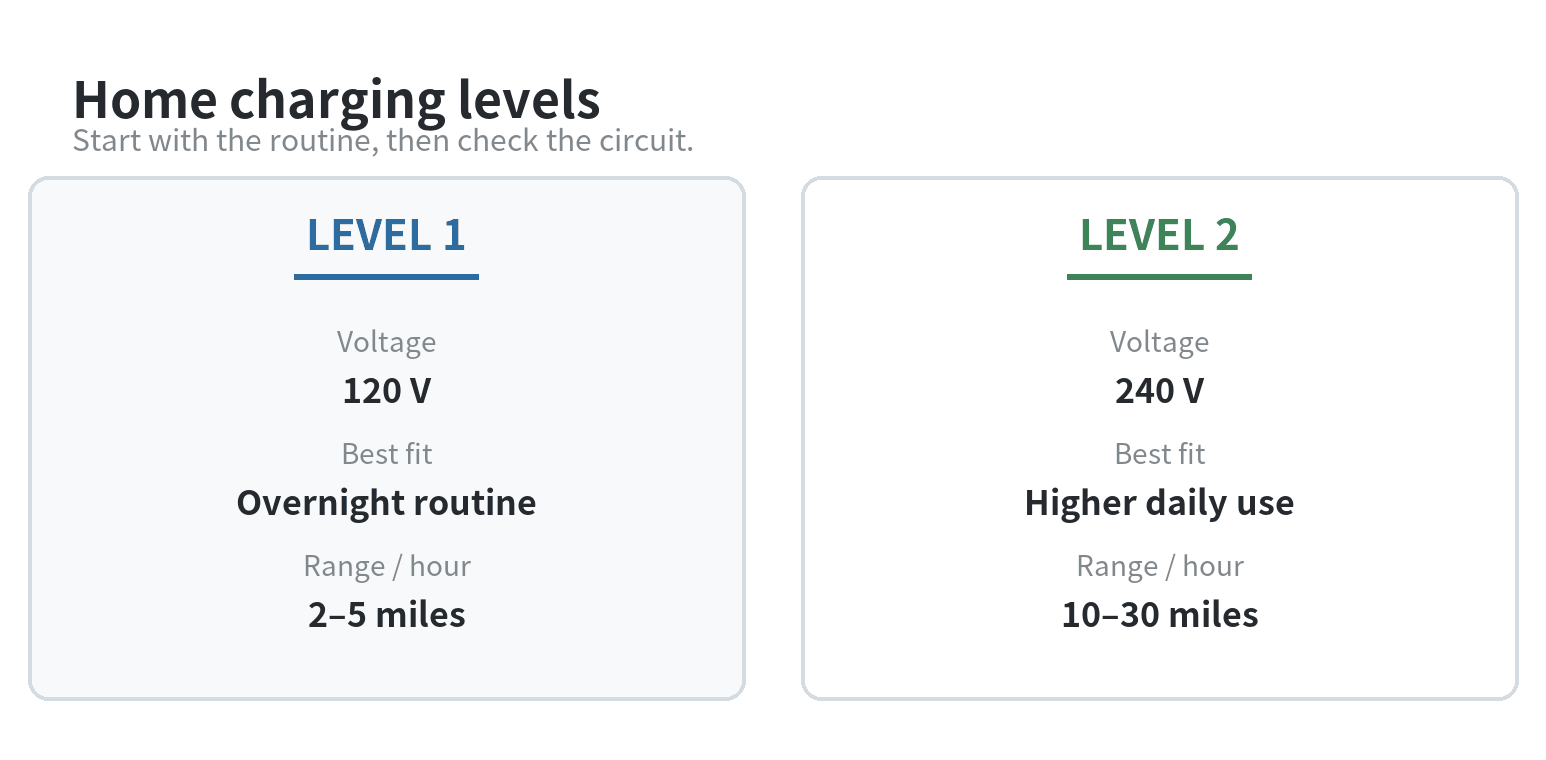
The right home EV charger is decided by three things: the distance you drive between plug-ins, whether your panel can support a dedicated circuit, and whether the charger matches your vehicle’s connector. Level 1 uses a standard 120-volt outlet and can suit an overnight routine. Level 2 uses 240 volts and is the practical home choice when you need more charging capacity between trips. The U.S. Department of Energy’s home-charging guide confirms that both AC levels are used for residential charging.
Start with your daily driving pattern
Write down the distance you drive before the vehicle sits at home again. If the car is parked overnight and your daily use is modest, a Level 1 cordset may fit without a new charging installation, provided a suitable dedicated branch-circuit outlet is available near the parking space. The DOE says Level 1 can meet daily needs when the car has that overnight parking window. See the DOE consumer charging overview for the basic Level 1 and Level 2 comparison.
Level 2 makes more sense when the car returns with a larger energy gap, when two EVs share one parking area, or when you want a repeatable charging window between errands. DOE lists Level 1 at about 2–5 miles of range per charging hour and Level 2 at about 10–30 miles per hour; the result depends on the vehicle, charger setting, and electrical service. Treat those figures as planning ranges, not a promise for a particular car.
Level 1, Level 2, and DC fast charging
Level 1 is the simplest residential path: a 120-volt cordset connects to a household outlet. It avoids the added wiring work of a 240-volt circuit, but its lower charging rate makes it less flexible for high daily mileage.
Level 2 is a 240-volt AC system. It may use a plug-in connection to a properly installed outlet or a hardwired connection to a dedicated circuit. The official installation guide describes both approaches and notes that residential jobs commonly involve Level 2 equipment.
DC fast charging is a different category. It is designed mainly for public or commercial locations and needs service that a typical home installation does not provide. For a home buying decision, compare Level 1 and Level 2 rather than treating a DC fast charger as the next size up.
Match the charger to the vehicle
Check the vehicle manual before comparing charger features. Confirm the charging connector, the vehicle’s supported AC charging rate, and whether an adapter is required. A charger can advertise a higher output than the car can accept, but that does not make the car charge at the advertised maximum.
Also check the cable length against the actual parking position. The installation guide lists common charger cords in the 18–25 foot range. Measure from the proposed wall location to the vehicle’s charge port with the car parked in its usual position. Leave a safe route for the cable so it does not cross a walking path or become pinched by a door.
Plug-in or hardwired installation?
A plug-in Level 2 unit can be convenient if the home already has a correctly rated 240-volt outlet in the right location. The outlet, circuit, breaker, and charger must be compatible as a set; a dryer outlet or another existing receptacle is not automatically suitable for EV charging.
Hardwiring connects the charger directly to the branch circuit. It can create a cleaner installation and may be the better fit for an outdoor location or a setup that will stay in place. The decision also affects permitting, disconnecting, and future service work. Use the charger’s installation instructions and local electrical requirements rather than choosing by plug shape alone.
Check the panel before choosing output
EV charging adds a sustained electrical load, so the panel and service need a load calculation before a Level 2 circuit is specified. The installation guidance recommends checking existing usage and planning a panel upgrade if the available capacity cannot support the new load. An open breaker slot alone does not prove that the service has enough capacity.
Give the electrician the charger specifications, the proposed mounting location, and a list of large loads such as an electric range, heat pump, water heater, or another EV charger. Ask which work requires a permit and inspection in your jurisdiction. If the charger will be outside, select equipment rated for outdoor use; DOE says outdoor residential charging can be safe when the equipment is outdoor-rated.
Features worth comparing
- Adjustable amperage: useful when the home’s available capacity or the vehicle’s onboard charger limits the setting.
- Weather rating: required for an exposed installation, even when the vehicle parks under a partial roof.
- Wi-Fi or app control: helpful for status checks and scheduling, but only if the mounting point has a reliable home-network signal.
- Connector and adapter support: verify the vehicle connection before relying on an adapter.
- Cable management: a wall hook or integrated holder can keep the cable off the floor and away from the vehicle’s tires.
Current official listings show the residential category as a mix of portable Level 2 units, wall-mounted units, plug-in units, hardwired units, and cable-management accessories. Compare the installation method and electrical rating first; smart features come after those constraints.
A practical selection order
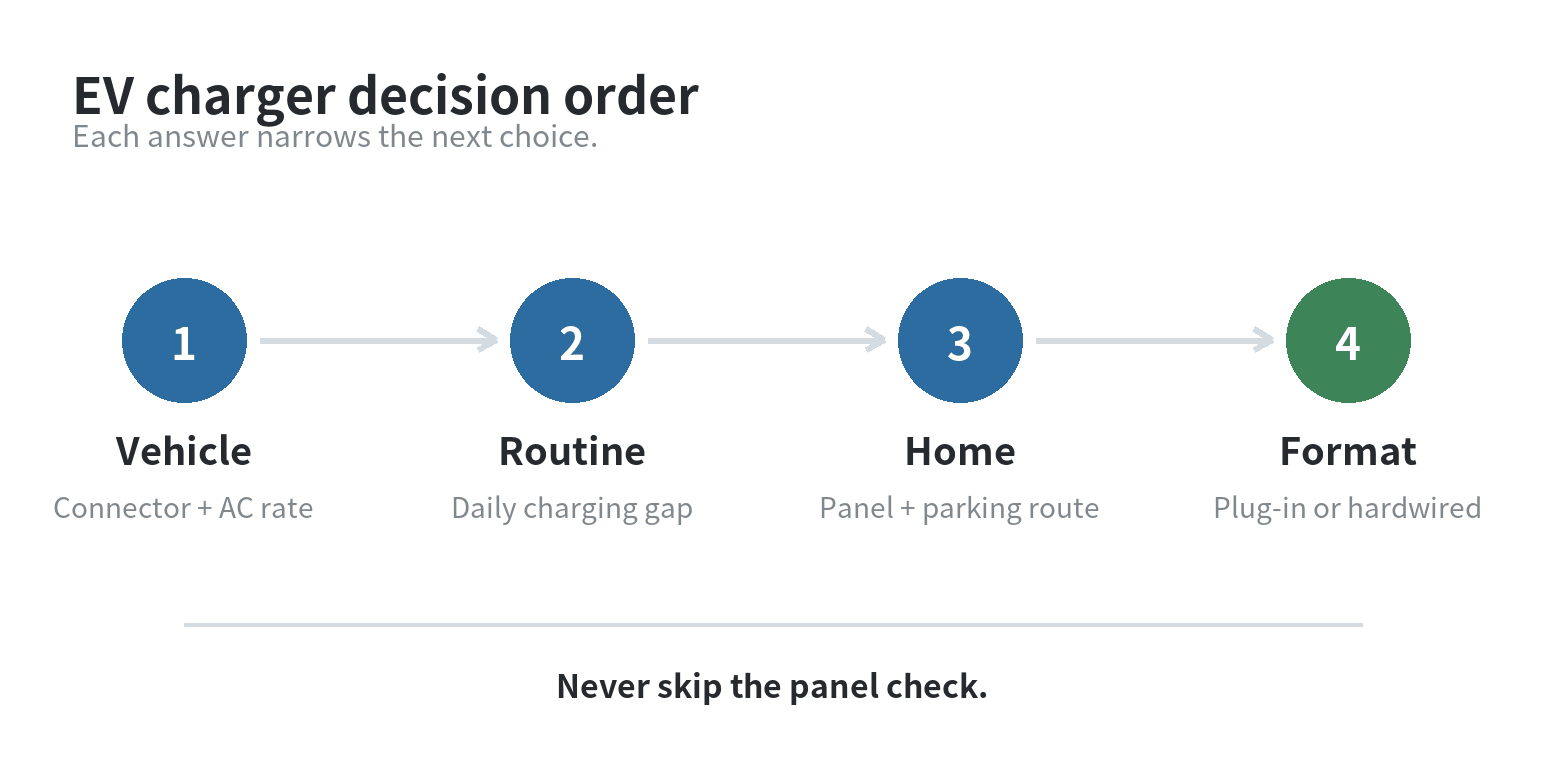
- Record the vehicle connector and its supported AC charging rate.
- Estimate the charging gap after a normal day, not an unusual road trip.
- Measure the parking space, cable route, and distance to the panel.
- Have a qualified electrician evaluate service capacity and local permit needs.
- Compare Level 1, plug-in Level 2, and hardwired Level 2 options that fit those facts.
This order keeps the charger choice tied to the home and vehicle you actually have. The best listing is the one whose electrical requirements, cable reach, weather rating, and connector all fit the installation plan.
FAQ
Can I use a Level 1 EV charger in a garage with a normal outlet?
Yes, if the outlet is suitable and on a dedicated branch circuit near the parking space. DOE describes Level 1 as a standard 120-volt option, but an electrician should assess an outlet that is shared, damaged, warm, or connected through an extension cord.
Does every Level 2 charger need a new electrical panel?
No. A load calculation determines whether the existing service can support the added circuit. If capacity is insufficient, the electrician may propose a service or panel change before installation.
Is a plug-in charger easier to move than a hardwired charger?
A plug-in format makes the charger itself easier to disconnect, but the 240-volt outlet and circuit still need to be correctly installed. Moving the setup to another wall can require new wiring or a new permit.
Can a home EV charger be installed outdoors?
Yes, when the equipment is rated for outdoor use and the installation follows local electrical requirements. DOE specifically notes that outdoor charging is possible, including in rain, when outdoor-rated equipment is used.
Last updated: 2026-09