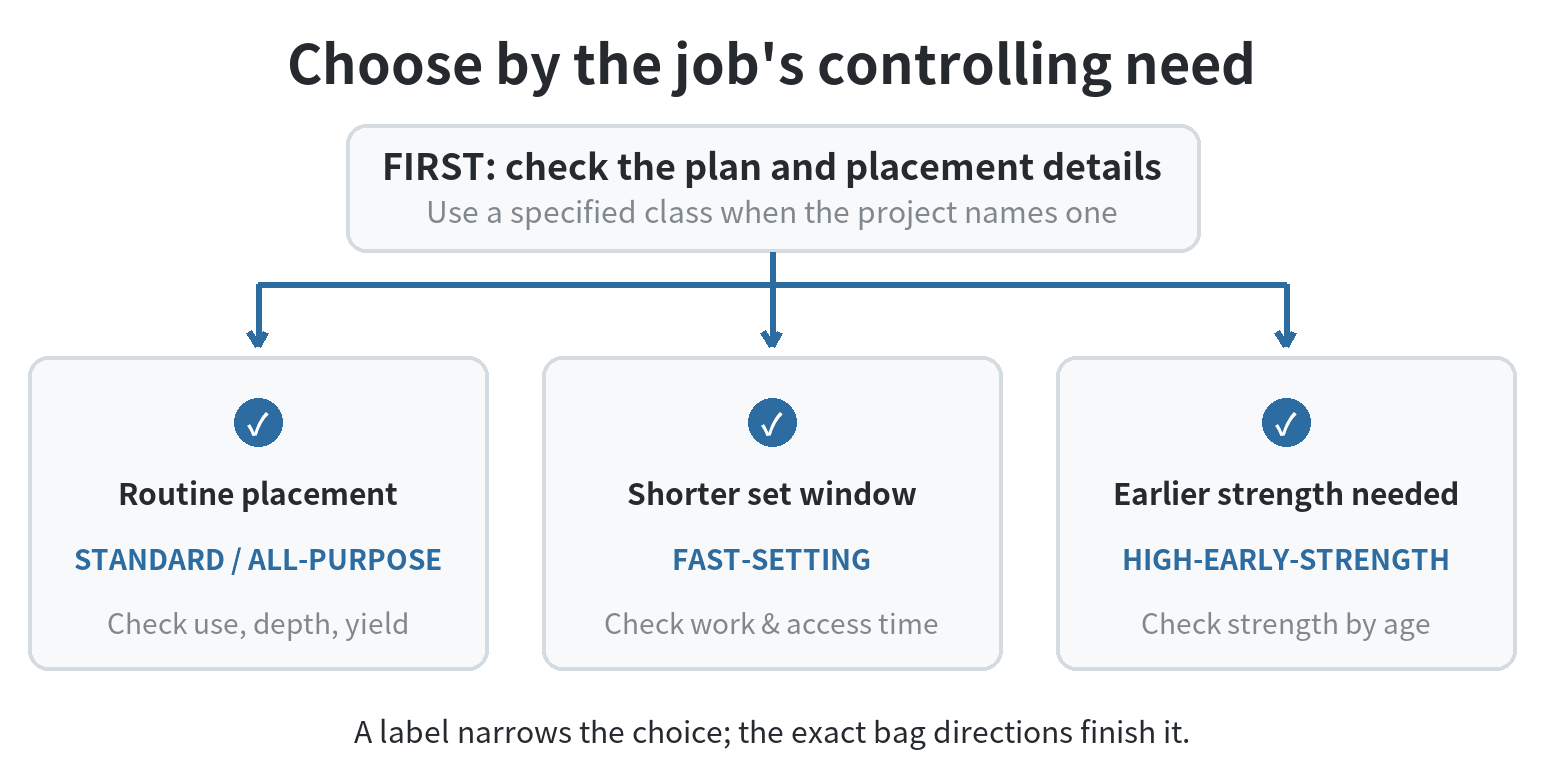
Choose a bag by the job’s controlling need: a general-purpose mix for ordinary slabs and posts, a fast-setting mix when the placement itself must set quickly, or a high-early-strength mix when the specification calls for strength sooner. The label “high strength” does not automatically mean “fast setting,” so check the bag’s use, thickness, yield, and timing details before you plan the pour.
Start with the constraint the job cannot tolerate
Write down the project’s non-negotiable requirement before comparing bags. Is the pour a routine slab, step, or footing? Is a post being set and bracing time limited? Does a plan or engineer specify a strength class, minimum thickness, or time before the area can reopen? Those answers narrow the shelf more reliably than a color or the largest number printed on a bag.
For an ordinary small placement, begin with a standard or all-purpose concrete mix. For post setting or a short turnaround, check a fast-setting label and the instructions for that exact use. For a load-bearing or otherwise specified project, use the mix class named by the plan and confirm the required strength and placement details with the responsible designer. A bag’s headline strength does not replace project specifications.
This distinction matters when browsing the e-commerce platform’s listings: one fast-setting listing displays both a strength rating and a rapid-set category, but those labels answer different questions. The manufacturer’s technical sheet says how the material is intended to be used; the e-commerce platform listing helps identify the product and package currently shown. Compare like with like, and use the current bag instructions for the final decision.
What the three mix labels tell you
Standard or general-purpose mix is the baseline category for common concrete work. One current 80-pound general-purpose listing describes a 4,000-psi mix for sidewalks, steps, slabs, and posts, with a stated yield of 0.60 cubic feet. A separate manufacturer product page describes its 4,000-psi concrete mix for slabs, footings, walkways, and post setting. These examples show how one label can cover several ordinary placements; they do not make every bag interchangeable.
Fast-setting mix focuses on setting time and work sequence. One manufacturer sheet describes post setting and slabs, and gives a final-set window of 20–40 minutes. Another product page states a 30-minute set time. Those are product-specific figures, not a promise that the concrete can carry foot or vehicle traffic at that time. Follow the separate re-entry timing on the exact product sheet.
High-early-strength mix is formulated to gain strength earlier than a conventional mix. A technical sheet for an 80-pound product lists typical strength of 1,500 psi at one day and 5,000 psi at 28 days; its stated walk-on time is 10–12 hours. Another manufacturer page describes a high-early-strength mix for heavy-duty work and lists separate foot- and vehicle-traffic times. The project’s spec and the product sheet should control; do not assume “high strength” means the same early-age performance across products.
| Label family | Question it helps answer | What to verify |
|---|---|---|
| Standard / all-purpose | Is this ordinary placement work? | Permitted uses, thickness, strength, yield |
| Fast-setting | Does the set time fit the placement sequence? | Working time, set time, traffic opening time |
| High-early-strength | Does the specification require earlier strength gain? | Strength by age, application depth, access timing |
A retaining wall is a structure, not a fourth concrete-mix family: the retaining-wall block category is separate from bagged mix listings, and the American Concrete Institute’s guidance treats wall design as a structural topic. The International Code Council’s discussion addresses retaining-wall provisions and soil pressure. Treat a wall plan as its own project question; do not select a bag merely because a listing or article mentions “retaining wall.”
Read the bag as a set of separate answers
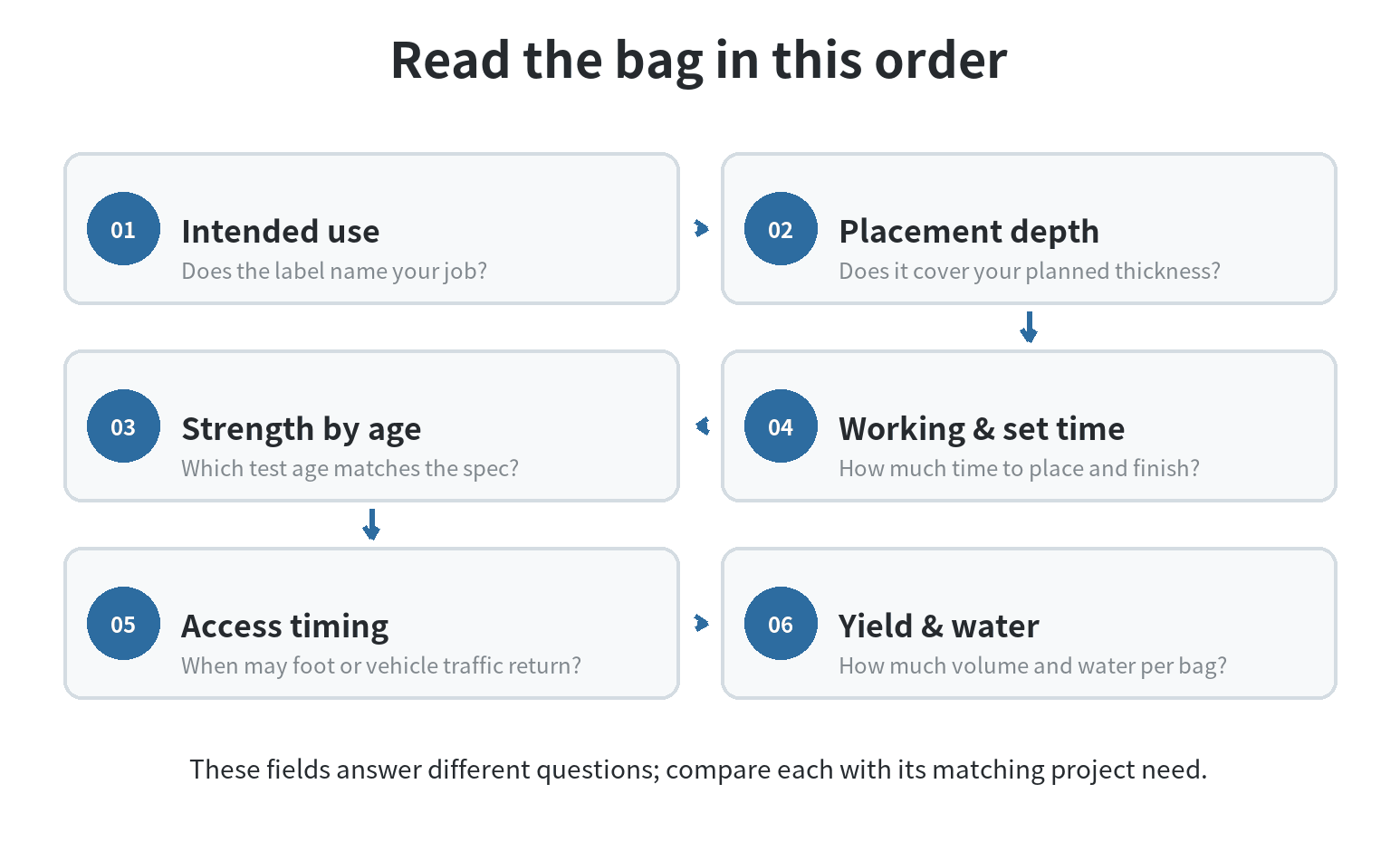
Check the front and technical sheet for intended use, minimum placement thickness, compressive strength, working time, set time, traffic timing, yield, and water instructions. Keep those fields separate. A 30-minute set-time listing and a 5,000-psi-at-28-days data-sheet result describe different milestones. The strength figure is not a countdown to when the surface may be used.
Set time and access time are separate entries. One fast-setting product sheet lists a 20–40 minute final set but separately says to wait 4 hours before placing strain on a post and at least 4 hours before walking on a slab. Those times apply to that product and those uses; they do not replace instructions on another bag.
Also check the placement depth. A concrete mix data sheet specifies slabs at least 2 inches thick, while a manufacturer repair product is listed for applications from 1/4 inch to 2 inches. If the bag’s minimum thickness exceeds your planned depth, look for a product explicitly rated for that depth or ask the project designer.
For post setting, read whether the manufacturer permits dry placement or requires pre-mixing, and whether the post needs temporary support; fast-setting product directions can specify a no-mix method for that use. For a slab, check preparation, mixing, finishing, and curing instructions. Fast-setting material gives you less time to place and shape it, so prepare the form, tools, water, and access route before opening the bag. Follow the product’s water range and mixing directions; the instructions warn against leaving standing water in the mix.
Estimate volume before counting bags
Measure the form’s inside length and width, then multiply by the planned thickness expressed in feet. That gives cubic feet of concrete before any allowance for an uneven base, spillage, or a changed form. Divide the result by the yield printed for the selected bag and round the bag count up. The bag yield is product-specific, so do not use the same yield for every weight or mix family.
For a swap-in example, a 4-by-4-foot pad that is 4 inches deep has a volume of about 5.33 cubic feet. If the selected 80-pound bag lists a yield of 0.60 cubic feet, the arithmetic is 5.33 divided by 0.60, or about 8.9 bags; that is 9 bags before any extra allowance. Check the manufacturer sheet for the exact product you plan to use.
Use a calculator only after confirming the measurements and unit conversions. For inches to feet, divide the thickness by 12. For an irregular shape, split it into simple rectangles or ask the supplier or project designer to help calculate the volume. A calculation estimates material volume; it does not confirm that the mix is structurally suitable.
When the job needs a specification, pause at the label
Steps, slabs, posts, and footings can look like familiar do-it-yourself projects, but a bag label does not replace the project’s design requirements. The International Code Council’s discussion of retaining-wall provisions treats wall design separately from material selection, and the American Concrete Institute’s guidance points to structural design requirements for reinforced concrete walls. Follow engineered plans or permit documents when they name a concrete class, strength, air entrainment, or placement detail. If no plan exists and the work supports a building, retaining wall, vehicle area, or other significant load, ask a qualified local professional what the design requires before choosing bagged material.
For a small yard project, connect the mix decision to the rest of the work. If a post anchors a short fence, the concrete type is only one part of setting the post; see our small fence planning article for the surrounding layout. For a molded garden path, our stepping-stone project notes cover the form-and-placement context. Check the concrete manufacturer’s directions for whichever mix you use.
FAQ
Does a higher psi number mean the bag sets faster?
No. Psi describes compressive strength at a stated age, while set time describes how the fresh mix changes after water is added. Read both fields separately on the product’s technical sheet.
Can I use fast-setting mix for a slab?
Some fast-setting concrete mixes list slab use, but the product’s depth, working time, and traffic instructions still apply. Check the specific sheet before planning the pour.
How many bags do I need for a small pad?
Calculate the pad volume in cubic feet, then divide by the yield shown for the exact bag size. Round up and account for the form and base measurements before finalizing the estimate.
Is a retaining-wall mix another name for high-strength concrete?
No. A retaining wall is a structure; “high strength” describes a concrete mix performance label. Use the wall design to determine its material requirements.
Last updated: October 2026.
Last updated: 2026-10