For an above-ground pool, start with a filter-pump system listed for your pool type and water capacity, then check that its hoses and replacement cartridge match your pool and pump. A higher flow number on a box is not enough by itself: the plumbing and filter affect the flow the installed system actually delivers.
This guide focuses on the circulation and filtration equipment. A water test kit, skimmer net, and fitted cover may also belong on a pool-maintenance list, but choose those separately for the jobs they perform.
Start with the pool’s water capacity
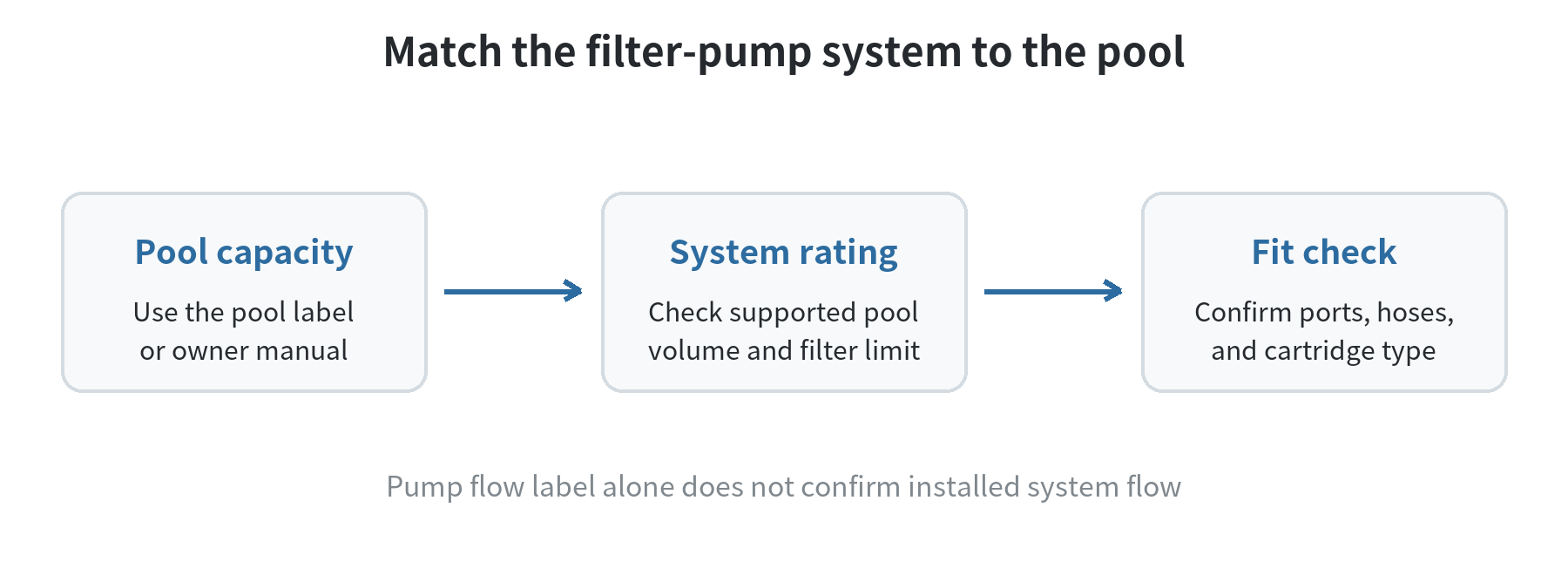
Find the pool’s water capacity on its label, packaging, owner’s manual, or manufacturer’s product page. Bestway’s pool-maintenance guidance uses pool capacity to size a filtration system, and Pentair’s above-ground filter specifications show that the rated turnover capacity depends on the filter model and the selected run time (checked October 2, 2026).
Next, compare that capacity with the filter-pump system’s stated pool range or filtration capacity. Read the pump and filter as one matched system rather than assuming the pump’s gallons-per-hour (GPH) figure tells the whole story. Pentair notes that actual system flow depends on plumbing size and other system components, so a label’s pump flow rate is not necessarily the flow rate at your installed pool.
If a listing gives only a pump flow number and no compatible pool range, look for the full model manual before deciding. The manual should identify the system, the supported filter type, connection sizes, and any flow or capacity limits. If those details are missing, ask the manufacturer to confirm compatibility instead of estimating from horsepower or a larger GPH number.
When replacing equipment, first decide whether the pump, filter housing, or only the cartridge needs replacement. Replacing a cartridge is a different compatibility check from replacing the pump-and-filter assembly: the cartridge must fit the existing housing, while a new assembly must also match the pool ports and hoses. Keep the existing model label until you have confirmed the replacement part number.
Do not compare two flow figures until you know what each one measures. A pump’s listed output, a filter’s maximum rate, and an installed system’s flow are different specifications. Pentair says the installed flow depends on plumbing and other components; Bestway tells pool owners to size its filtration system using pool capacity. If a product page leaves the measurement unclear, ask what system configuration the rating describes (both checked October 2, 2026).
Check the whole connection path
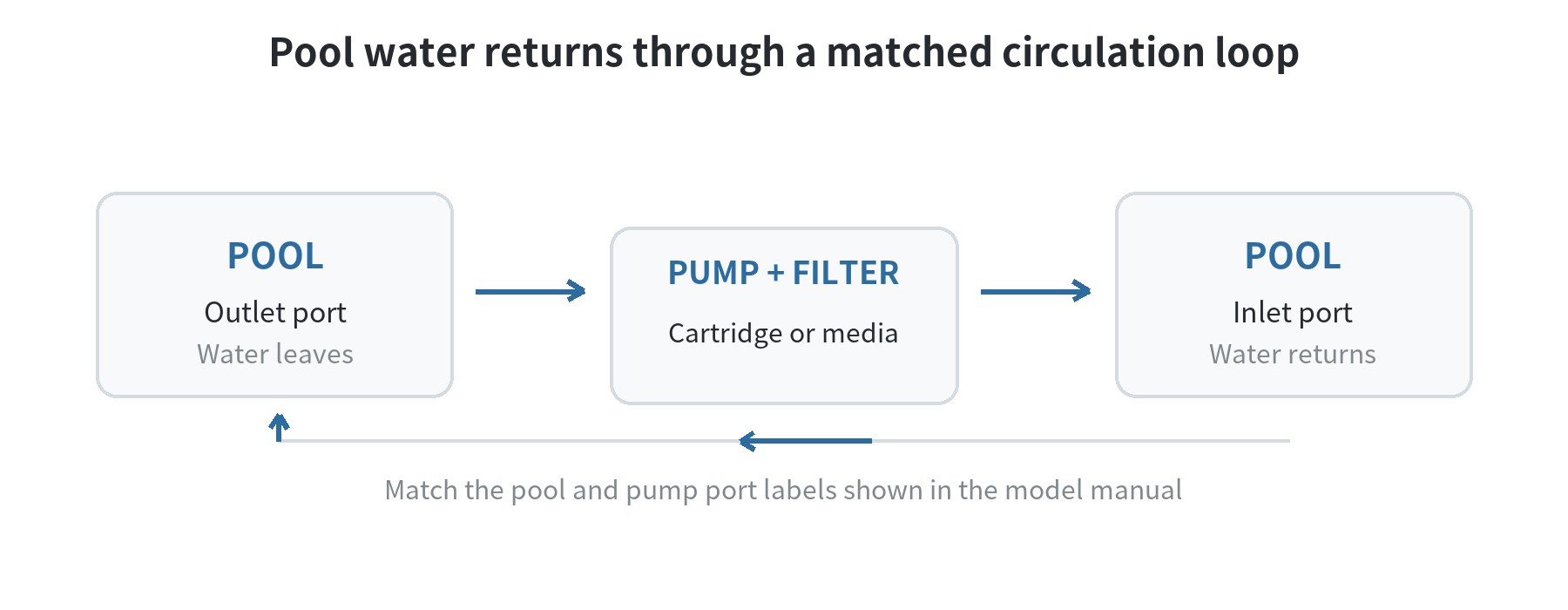
A filter pump has to connect to the pool’s inlet and outlet, not just sit beside it. Before choosing a replacement or a standalone system, compare the pool’s port labels and hose diameter with the pump’s included fittings and manual. A mismatch can leave you looking for adapters or unable to make a secure connection.
Bestway’s cartridge-pump setup instructions say to match the lettered ports on the pump and pool, secure the hoses with clamps, and keep the pool water above the inlet and outlet before running that system. Those are model-specific directions, but they illustrate why connection diagrams and minimum water-level marks belong in your compatibility check (Bestway guidance checked October 2, 2026).
Look at where the pump will stand as well. The pump manufacturer should specify its permitted location and setup surface. Bestway’s guide calls for a flat, stable location next to the pool. Check that the planned position keeps hoses from kinking, avoids a trip path, and leaves room to reach the pump lid and shutoff without pulling on the hoses.
Before the first run, verify the manual’s electrical instructions and use its test procedure for any built-in ground-fault device. Bestway’s cartridge-pump guide says to test its GFCI before use and to do so with dry hands. Keep this check tied to the exact pump model because plug, timer, and control arrangements vary across systems.
Choose the filter style you can maintain
Cartridge systems use a removable element that can be rinsed and reinstalled when the model’s instructions allow it. Sand systems use filter media and a valve with cleaning settings such as backwash and rinse. Bestway’s support instructions describe both maintenance paths and note that its sand-filter backwash and rinse process lowers pool water; read the complete manual before choosing a system type (checked October 2, 2026).
For a cartridge setup, identify the exact replacement element before you need one. Match the pump or filter model number, cartridge type, dimensions, and end-cap shape against the equipment manual or the manufacturer’s replacement-parts list. Bestway’s support guidance warns that a cartridge with the wrong dimensions can prevent the filter cover from closing correctly (checked October 2, 2026). Similar-looking elements are not proof of fit.
For sand systems, check the media type and the cleaning-valve instructions rather than assuming every tank uses the same material or sequence. Backwashing sends water through the filter in the reverse direction to flush collected debris; a rinse setting then returns the valve to the normal filtering path. Bestway’s support page notes that its backwash and rinse process lowers pool water, so its instructions include checking and restoring the pool level afterward (checked October 2, 2026).
Also check what comes in the box. A listing may include the pump and filter, or it may show a replacement cartridge alone. Verify whether hoses, clamps, strainer pieces, fittings, and the first filter element are included. Keep the model number and a photo of the original cartridge label with your pool records; it makes later replacement checks more direct.
Use the gauge and manual to plan cleaning
Filter maintenance is model-specific. If the system has a pressure gauge, record the clean-filter starting pressure after the equipment is set up according to its manual. Pentair’s Clean & Clear above-ground manual says to clean its cartridge when pressure rises 8 to 10 PSI above that clean starting reading. That trigger belongs to those Pentair systems; use another manufacturer’s stated threshold for a different filter.
Some above-ground cartridge pumps use a different routine. Bestway’s support page recommends checking its cartridge weekly and replacing it every two weeks depending on use; it also says to rinse a cartridge and replace it if it remains dirty or discolored. Those intervals apply to the products covered by that guidance, not to every cartridge on the market (checked October 2, 2026).
Before cleaning or opening equipment, follow the manual’s shutoff and pressure-release steps. Pentair warns that trapped air can pressurize a filter and separate its lid; its manual instructs owners to shut the pump off and release pressure before service. If the housing, locking ring, gauge, or pressure-release valve is damaged, stop and contact the equipment maker or a qualified pool professional.
What to compare before choosing a system
| Check | What to match | Where to confirm |
|---|---|---|
| Pool capacity | Pool volume and the system’s stated supported range | Pool label and equipment manual |
| Water flow | Pump and filter limits for the complete installed system | Manufacturer specifications |
| Connections | Pool port labels, hose size, fittings, and clamps | Pool and pump diagrams |
| Replacement element | Model, cartridge type, dimensions, and end-cap shape | Parts list or manual |
| Routine care | Gauge trigger or stated cartridge cleaning method | Owner’s manual |
For other pool supplies, use the job as the filter: surface debris calls for a skimming tool, water monitoring calls for a test kit, and seasonal protection calls for a correctly fitted cover. Keep chemical handling separate from equipment selection; the site’s chemical-disposal guide covers label and local-disposal checks. For broader yard planning, the summer outdoor checklist groups other seasonal tasks.
When you compare listings, put the pool model and capacity beside the filter-pump model, then verify each hose, cartridge, and maintenance requirement in the manuals. If any compatibility detail is unclear, get the manufacturer’s answer before choosing a replacement.
Last updated: 2026-10
FAQ
What should I check if the filter gauge stays high after cleaning?
Check for blocked hoses, partly closed connection valves, and a damaged hose, then compare the reading with the model’s manual. Bestway’s maintenance guidance lists those checks for its sand-filter systems and says the gauge should return to zero when the motor is off (checked October 2, 2026).
Does a filter pump tell me whether the water chemistry is correct?
No. A filter pump has no chemical test reading; use a pool test kit and follow its instructions for the measurements it covers. Bestway’s maintenance guidance separates particle filtration from checking pool chemistry (checked October 2, 2026).
Can I plug a filter pump into an outlet timer?
Check the pump’s electrical instructions first. Bestway says an external timer cannot be used with its filter pump or sand filter pump when the unit has an external GFCI or RCD; follow the instructions for your own model and outlet (checked October 2, 2026).
What records make replacement parts easier to identify next season?
Keep the pool and pump model numbers, cartridge identifier, hose size, and a copy of the manuals together. Those details let you check compatibility without relying on a visual guess.