A thermal expansion tank is needed when a storage water heater is part of a closed plumbing system and local code requires a way to control the pressure created as water heats. A check valve, pressure-reducing valve, or backflow preventer can close the system. To size a tank, use the heater’s capacity, measured cold-water pressure, temperature range, and the exact manufacturer’s chart or calculator; heater gallons alone are not enough.
What the small tank does
Water takes up more space as it warms. In a plumbing system that can send the extra volume back toward the supply, that expansion has somewhere to go. A one-way valve can block that path. The added volume then raises pressure inside the closed section of pipe.
A thermal expansion tank provides a compressible air cushion separated from the water by a diaphragm or bladder. As heated water expands, some enters the tank and compresses the air. The Watts Series PLT specification describes this use in potable hot-water systems. The tank works alongside the water heater’s temperature-and-pressure relief valve; it does not replace or permit removal of that safety valve.
Check whether the plumbing is closed
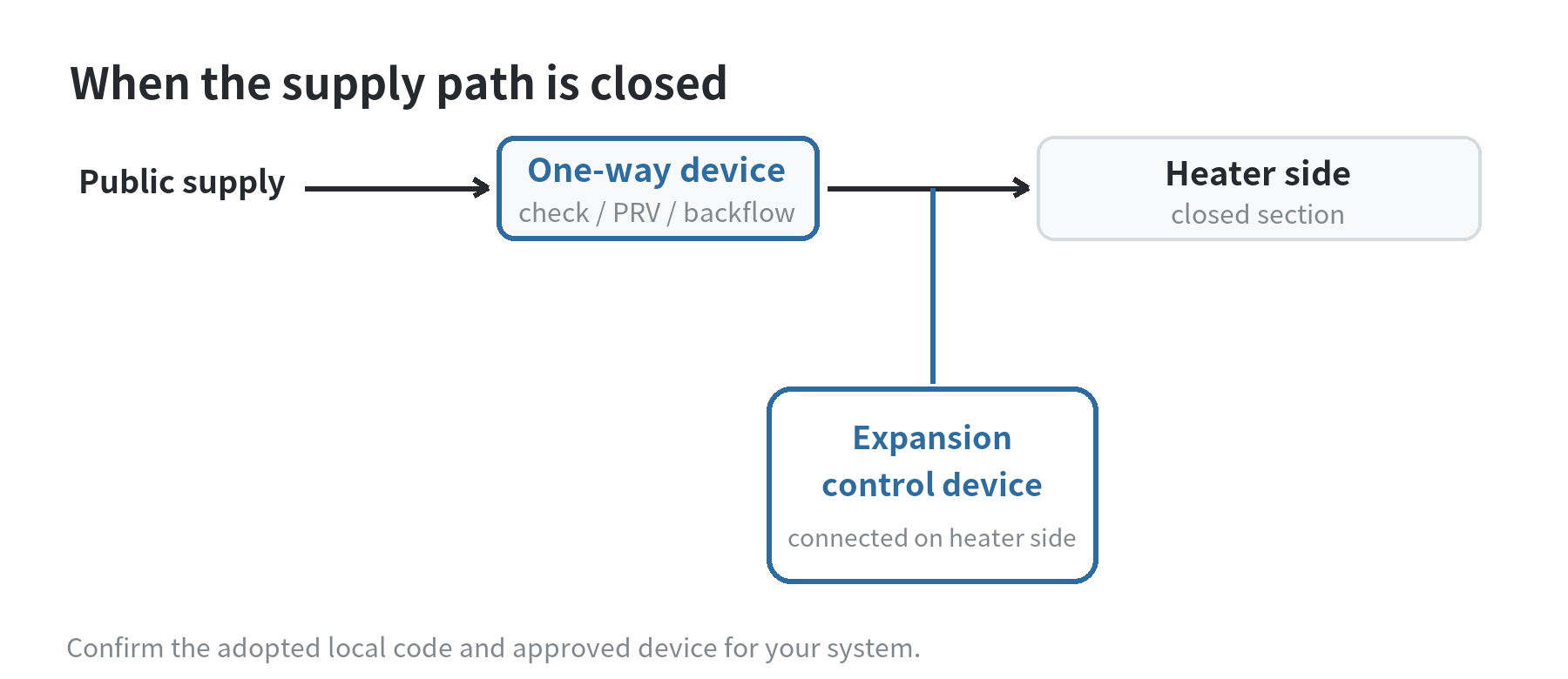
Look at the cold-water line serving the storage heater and identify any check valve, pressure-reducing valve, or backflow preventer between the heater and the incoming supply. Those devices can prevent water from moving backward. A pressure-reducing valve can also create the relevant closed section.
Clark County, Nevada’s Building and Fire Prevention field guideline says valves that do not let pressure bypass—such as check valves and pressure-reducing valves—create a closed loop. For that system, the guideline calls for a listed expansion tank on the building side of the one-way device and says to size it by the manufacturer’s instructions. Arapahoe County’s clarification quotes its adopted residential code: when a check valve, backflow preventer, or similar device on a storage-heater supply causes thermal expansion pressure, a pressure-control device is required.
Those local code examples do not settle every home’s requirement. States and local jurisdictions adopt and amend different plumbing codes, and an approved control device may not have to be a tank in every system. Ask the local plumbing or building department which code applies to your address and whether the existing setup already includes an approved control device.
Gather the inputs before choosing a size
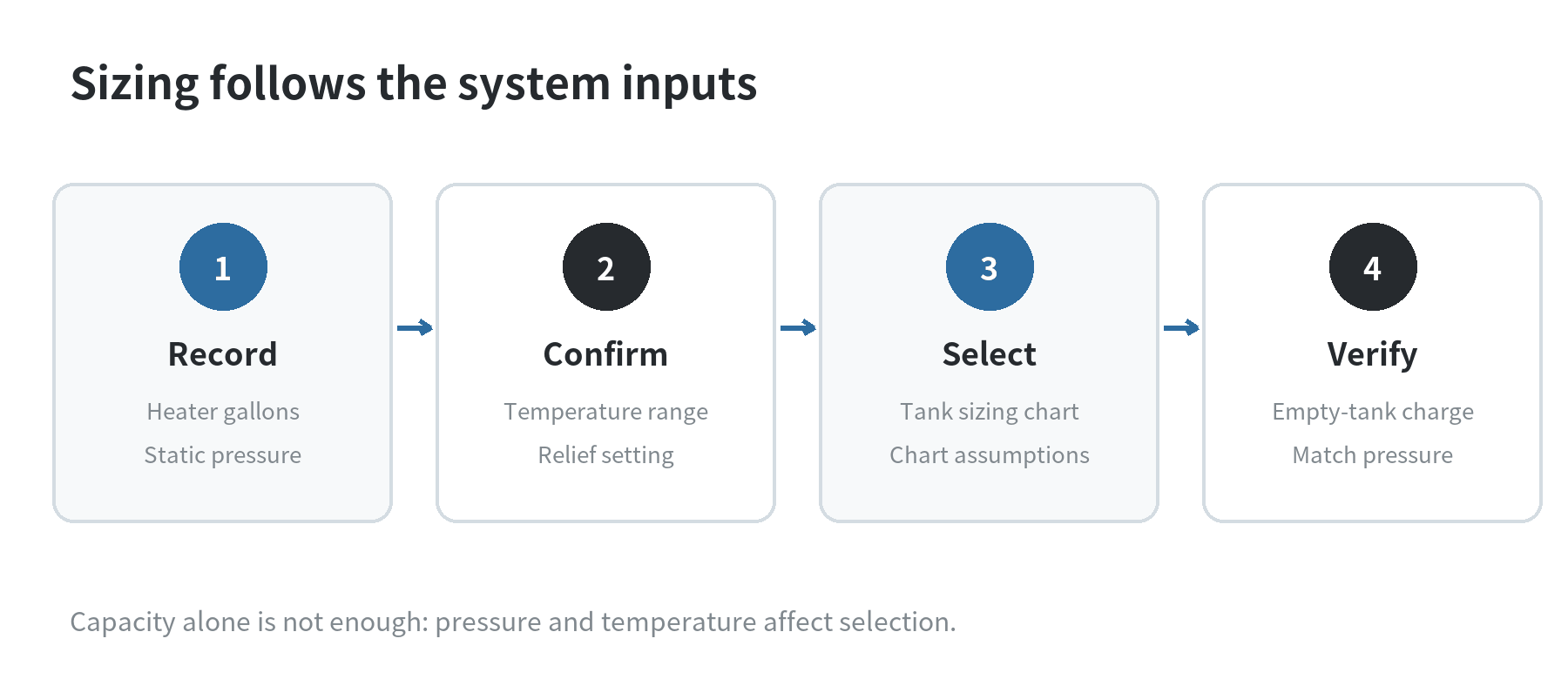
Start with four details: the water heater’s storage capacity, static cold-water pressure, incoming-water temperature, and the temperature the heater will raise water to. Also check the maximum pressure allowed by the relief valve and the tank manufacturer’s sizing instructions. Those inputs affect how much water expands and how much volume the tank must accept.
Use a pressure gauge to measure static pressure at a suitable hose connection, with water not flowing. If the home has a pressure-reducing valve, the pressure after that valve is relevant to the tank location. Do not substitute a city’s advertised pressure or a guess for a measurement. If you cannot identify a safe measuring point or interpret the result, have a plumber take the reading.
Manufacturer sizing tools are tied to their own inputs. Amtrol’s calculator asks for domestic hot-water volume, heater temperature, relief pressure, and supply pressure. Watts’ Series PLT quick guide is based on a 150-psi relief-valve setting and a maximum 50°F temperature rise. Use the chart or calculator for the tank being considered, and contact its manufacturer or a licensed plumber if your conditions fall outside the chart.
Why heater gallons do not determine the answer
Two homes with the same storage heater can need different tank capacities if their supply pressures or temperature ranges differ. Conversely, a larger heater does not by itself tell you which tank to select. The charts convert a set of system conditions into a required acceptance volume, then match that requirement to a tank model.
Use the selection rule printed with the chart. Watts’ Series PLT guide says to use the next higher listed supply pressure and heater capacity when a measured value falls between entries; it also warns that higher temperature or pressure conditions may need multiple tanks and directs users to the manufacturer for sizing. That is a Watts chart rule, not a shortcut to apply to every product.
Do not choose by a package label such as “fits most homes.” Compare the chart’s assumed relief setting and temperature rise with the actual heater and system. If a table lists total tank volume and acceptance volume separately, use the field the manufacturer calls for in its sizing method; the two figures are not interchangeable.
If a tank is already installed, copy its model and pressure information from the label before replacing or adjusting it. Record the heater’s gallon capacity and temperature setting, the pressure reading at the tank location, and whether the cold line has a pressure-reducing valve, check valve, or backflow preventer. Amtrol’s selection tool asks for water volume, temperature, relief pressure, and supply pressure; Watts’ chart also ties the selection to system conditions. These notes let a plumber or manufacturer support representative check the right chart instead of estimating from the tank’s appearance. Before work is scheduled, ask the local department whether a permit or inspection applies and whether another approved device already provides the required control.
Set precharge to the measured pressure
Precharge is the air pressure inside an empty expansion tank before it is connected. Amtrol says to adjust it to match the home’s incoming water pressure. Watts likewise instructs installers to measure system pressure and set the tank precharge to that reading before installation. A factory precharge printed on the label is not automatically the right setting for every house.
Pressure adjustment must follow the specific tank instructions. The Watts PLT manual says to adjust precharge at zero system pressure before installation. Its manual also sets product-specific pressure limits, so do not apply those limits or steps to another tank without checking that tank’s documentation.
Confirm placement and installation details
For a closed system covered by the local rule, the expansion-control device connects to the cold-water supply downstream of the check valve, pressure-reducing valve, and backflow preventer—that is, on the water-heater side. Manufacturer diagrams show the tank connected at the cold-water line serving the heater. Keep the connection between the one-way device and heater clear of shutoff valves that could isolate the tank from the heater.
Mounting, support, orientation, clearances, and drainage details vary by tank and installation. A water-filled tank is heavier than an empty one, so its connection needs suitable support when the instructions call for it. The Watts PLT manual permits vertical or supported horizontal mounting; Amtrol’s support page says the standard orientation is vertical with the connection down; consult the supplied manual for other orientations. Follow the exact manual and local rules rather than transferring one model’s installation detail to another.
Use a licensed plumbing professional where local rules require one, a permit or inspection applies, or work involves draining, isolating, or reconnecting the water heater. A relief-valve concern can involve safety risks; have a qualified plumber assess it and the pressure-control setup. If the relief valve discharges repeatedly, have a qualified plumber check the pressure-control setup and the valve.
FAQ
Can an expansion tank be added to a tankless water heater?
A tankless heater has no storage tank to size from, so do not apply a storage-heater chart automatically. If a storage tank is added downstream or the system has another closed hot-water section, ask the local plumbing authority or a licensed plumber which expansion-control rule applies.
Can the water heater’s relief valve replace an expansion tank?
No. The relief valve is a safety device, not a routine expansion-control method. Keep it installed and unobstructed, and have a plumber investigate repeated discharge rather than capping or disabling it.
What if the chart does not include my pressure or heater size?
Do not extrapolate beyond the chart. Use the manufacturer’s sizing calculator or contact its technical support with the measured pressure, heater capacity, temperature range, and relief-valve setting; a plumber can confirm those inputs and local requirements.