What If the Only Thing Between You and the Life You Deserve Is a Hidden Wealth Code Waiting to Be Activated
>>> Open the Door <<<

Fix Phone Clock Not Syncing With Network Time (Android & iOS Steps)
That constantly wrong clock flashing on your screen is incredibly annoying, isn’t it? You rely on your phone for accurate scheduling, yet it seems perpetually stuck in the wrong minute or forgotten an hour due to daylight saving time. The truth is, most modern automotive devices get their precise time from network servers, similar to how they update software. When that automatic time function malfunctions, you get discrepancies.
Failure to sync with the network time often stems from basic connectivity issues or a small software hiccup on your smartphone. It isn’t usually a sign of a major hardware failure inside your device. This guide cuts through the confusion and gets straight to actionable steps you can take. We’ll fix this for both Android and iOS users quickly.
We’ll walk you through simple toggles, network resets, and configuration checks tailored for your specific smartphone. By addressing common culprits like poor internet connections or incorrect time zone settings, you’ll restore accurate network synchronization. Get ready to see the correct time populate your screen again.
The Quick Fixes: Checking Basic Settings First
When your phone clock is acting rebellious, don’t immediately assume you need a factory reset or a complicated software overhaul. More times than not, the issue hides right in plain sight within your settings menu. These initial checks involve verifying that your smartphone is actually allowed to talk to the network for time updates. If the automatic features are toggled off, your device is forced to rely on its internal, often inaccurate, clock. We start here because these fixes take seconds and solve the problem a surprising majority of the time. Let’s make sure those fundamental switches are flipped to the “on” position before proceeding with anything more involved.
There Is a Frequency That the Wealthiest Families Have Used for Generations and Most People Will Never Know It Exists
>>> Open the Door <<<

Confirming Automatic Time Settings Are Enabled
The primary method your phone uses to stay current is by syncing with the time signaled by your cellular provider or Wi-Fi network. This process relies on protocols like NTP (Network Time Protocol) to obtain highly accurate time data, often accurate to milliseconds. If this setting is disabled, your device cannot perform these essential background checks, causing the time drift you are seeing on your Android or iOS device. You must verify this setting on both platforms.
For Android users, you typically locate this setting by navigating through:
- Settings
- System (or General Management on some devices)
- Date & time
Here, you are looking for a toggle labeled Use network-provided time or Automatic date and time. When this is active, your smartphone pulls the current time zone and time directly from the cell tower or carrier data. For more information on how Android handles these settings, you can review the official instructions for setting time and time zone. Set time, date and time zone – Android Help
On an iPhone or iPad, the path is slightly different but serves the same purpose:
- Settings
- General
- Date & Time
On Apple devices, the corresponding option is Set Automatically. Ensure this switch is green, indicating it is active. This setting allows your device to automatically adjust for time zone changes and Daylight Saving Time, keeping your clock precise. If you can’t change the time or time zone on your Apple device – Apple Support Confirming this simple toggle is your fastest path back to synchronized time.
Restarting Your Smartphone to Clear Glitches
Sometimes the time sync mechanism simply gets stuck. Software, even on the most advanced mobile hardware, can encounter minor temporary bugs or memory corruption that prevents proper communication with network services. When this happens, the setting might be correct, but the software process responsible for verifying the time isn’t executing correctly. This is where a simple power cycle, or restart, becomes your best friend.
A full restart acts like hitting the reset button on your smartphone‘s operating system. It forces all in-memory processes to close down and then reload cleanly from scratch. This clears out those transient software glitches which may be blocking the phone from reaching out to the network time servers. Think of it as clearing the cache for the system clock function.
To perform this quick fix:
- Press and hold your phone’s power button until the on-screen options appear.
- Select the Power off or Restart option. If you select power off, wait about 30 seconds after the screen goes black before powering it back on.
- Once the phone boots up completely, check if the clock has snapped to the correct network time.
This approach resolves countless minor software misbehaviors without requiring you to adjust any deeper settings or configurations.
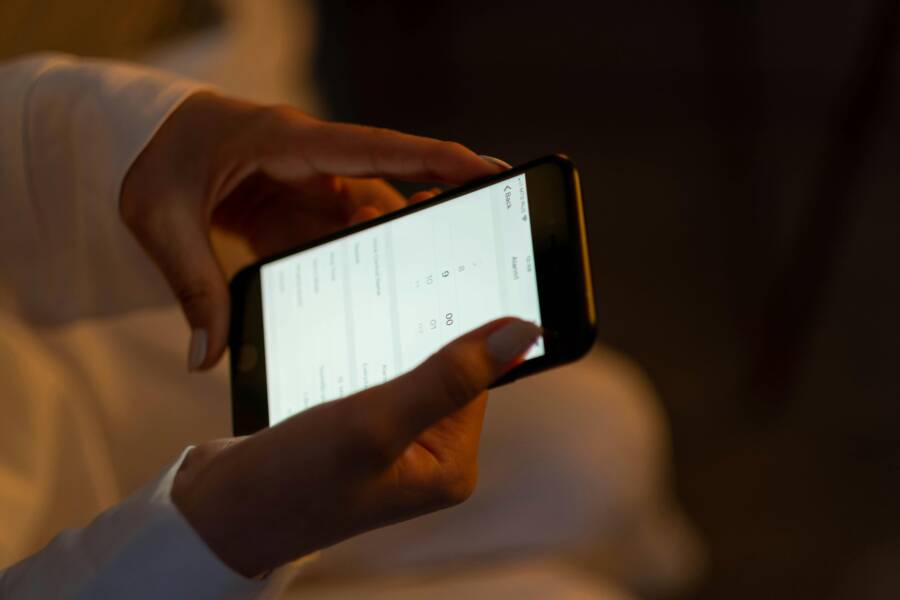
 Photo by cottonbro studio on Pexels
Checking for Poor Cell Signal or Wi-Fi Connection
Your phone cannot receive the accurate time signal if it can’t connect reliably to the communication network. Whether you are relying on cellular data or a Wi-Fi network, a weak or intermittent connection will stop the time synchronization process dead in its tracks. Even if the “Automatic Date & Time” setting is enabled, the data packet from the time server might never arrive or might arrive corrupted due to signal instability.
The time information transmitted over the cellular network (sometimes using protocols like NITZ) or obtained via the internet requires a stable handshake. If your signal bars are low, or if your Wi-Fi connection is dropping frequently, the system defaults to keeping whatever time it last knew, resulting in an incorrect display. You might notice your phone searching for service or showing very few signal bars.
Before moving on to more tedious settings adjustments, take a moment to verify connection strength:
- Cellular Signal: Look at the signal indicator at the top of your screen. If you see only one or two bars, or if it shows “No Service,” you need better reception.
- Wi-Fi Connection: If you are relying on Wi-Fi for time updates (which often happens indoors), check that your Wi-Fi icon shows a strong connection, not one that is constantly buffering or showing an exclamation mark.
If your signal is poor, relocate your device. Step outside, move away from thick concrete walls, or walk closer to your Wi-Fi router. Once you have a strong, recognized network connection, your phone will usually attempt to sync again automatically, often fixing the clock discrepancy immediately.
Solving Time Zone Confusion on Your Device
Even with your basic network time settings confirmed, the clock on your smartphone might still be wrong. This usually points directly at the time zone setting being incorrectly identified or applied. If your phone mistakenly believes you are traveling internationally, showing you London time when you are firmly rooted in New York, you need to manually intervene. The automatic time detection relies heavily on GPS data or cell tower location, which isn’t perfect, especially indoors or when using Wi-Fi far from your actual location. Fixing this means overriding the automatic assumption and telling your device exactly where it is located on the map.
Forcing the Correct Time Zone Setting
When your device’s automatic time zone selection fails, it leaves you stuck in the wrong hour. This happens when the hardware signal for your location is ambiguous or your carrier information is momentarily misread. You need to take manual control of this setting to correct the discrepancy immediately. This process ensures your smartphone adheres to the standard time observed in your geography, regardless of what the network briefly suggested.
To manually set your time zone, follow these general steps, which look slightly different based on your operating system:
- Access your main Settings menu on your device.
- Look for the System settings on Android or the General settings on iOS.
- Locate the Date & time screen. This is where all time-related adjustments reside.
On an Android device, after navigating to Date & time, you must first turn off the “Use network-provided time” setting. Once automatic time is disabled, a new option, Select time zone, becomes available for modification. Tap this option and scroll through the comprehensive list of global time zones. Select the one that accurately reflects your current location; for instance, you would choose EST or EDT for New York City. You can review the list of time zones recognized by major operating systems to ensure you select the correct identifier. Once the zone is selected, remember to turn on Automatic date and time again if desired, though keeping it manually set might be necessary temporarily.
For those using an iPhone, the process involves a similar override. Navigate to Settings > General > Date & Time. If “Set Automatically” is on, turn it off. When you turn it off, you gain immediate access to manually selecting the correct time zone from a displayed list. Pick the specific city or region that corresponds to your actual physical location. After selecting the correct time zone, you can usually re-enable Set Automatically. If the phone syncs correctly after this manual input, the problem was likely a location reading error.
Managing Daylight Saving Time (DST) Adjustments
Daylight Saving Time shifts can be a frequent source of time errors. Even when your phone is set to automatically acquire time from the network, sometimes the carrier signal responsible for announcing the DST change is delayed, intermittent, or simply missed by your phone’s internal processor. When this occurs, your device holds onto the previous setting, resulting in an hour discrepancy as the rest of the world springs forward or falls back.
While the system is designed to handle these biannual shifts automatically, a gentle reboot of that feature can force a re-check. If you suspect DST caused the issue, try toggling the automatic setting off and then back on after a short wait.
She Pressed Play on a Strange Audio Track and Within Days Her Financial Reality Started Shifting in Ways She Could Not Explain
>>> See How It Works <<<

Here is the suggested procedure to prompt a DST check:
- Go back to the Date & time section in your Settings.
- If Automatic date and time (Android) or Set Automatically (iOS) is on, turn it off.
- Wait three to five minutes. This pause gives the system time to clear the previous sync marker.
- Toggle the Automatic date and time setting back to on.
This action forces the smartphone to immediately query the network again, looking specifically for the updated DST status alongside the current time stamp. This technique often successfully corrects the clock without needing a full device restart or manual time entry. If you recently traveled across a boundary where DST rules differ, this refresh is particularly effective for getting your smartphone back in line with local standards.
Disabling Location Services Temporarily
Location services play a significant role in determining your correct time zone because they provide the GPS coordinates the operating system uses to look up local time rules. If your location services are experiencing glitches, perhaps struggling to lock onto a stable signal, the time zone determination process can halt or fail entirely. This failure often leaves your phone running on the last known, possibly incorrect, time zone. Isolating this variable can sometimes resolve the sync problem.
You can test if location uncertainty is the root cause by temporarily disabling it and then reapplying the automatic time setting. This forces the device to rely solely on network time signals, which might be clearer than conflicting location data.
Perform these steps to check location impact:
- Disable Location Services or GPS on your smartphone. On Android, this is usually found in the Quick Settings panel or under Settings > Location. For iOS users, it’s in Settings > Privacy & Security > Location Services.
- Once location is off, return to the Date & time settings.
- Toggle Automatic date and time off, wait one minute, and then toggle it back on. Observe if the time and time zone adjust correctly based on the cellular tower signal alone.
- If the time snaps to the correct setting, the issue appears tied to GPS precision or a location service bug.
- Re-enable Location Services. Allowing your smartphone to use GPS again should now work correctly alongside the now-verified accurate time zone setting.
If the time stays correct after re-enabling location services, you’ve successfully identified and bypassed a temporary location data conflict that was interfering with accurate time synchronization.
Deep Dive Troubleshooting: Network and Software Checks
When the simple toggle flips don’t solve your time synchronization problem, it’s time to look a bit deeper into how your smartphone is physically connecting to the world and how its software is managing that connection. We are moving past basic settings verification and into refreshing the underlying communication pathways and checking the operating system’s integrity. Sometimes the issue isn’t that the setting is wrong, but that the path used to enforce the setting is blocked or outdated. We need to clear out old connection data and make certain the operating system itself is running the most recent, stable code designed to handle time protocols accurately. These advanced checks often reveal configuration errors that user-facing menus don’t easily expose.
Resetting Network Settings to Refresh Carrier Links
Resetting network settings is a powerful step when time synchronization repeatedly fails. This action doesn’t wipe your personal data like photos or installed apps. Instead, it targets only the settings related to connectivity. Specifically, a network settings reset clears all saved Wi-Fi passwords, your preferred cellular settings, and any stored Bluetooth pairings. Think of it as cleaning out the phone’s memory of every network it has ever successfully connected to, forcing a total relearn.
Why does this help the clock? Because time synchronization relies heavily on a clean, verified connection to your cellular carrier or Wi-Fi access point, which then connects to the authoritative time server. If old, corrupt, or conflicting carrier profiles are buried in the settings, they can prevent the phone from establishing a fresh, clean connection necessary for the time request to complete successfully. For users running newer software, updates from 2024 and 2025 sometimes introduce minor inconsistencies in how saved network preferences talk to the updated system clock functions, making this reset a highly recommended troubleshooting step. You can find general guidance on performing this action for different devices here.
Caution: Before proceeding, you must remember all your Wi-Fi network passwords. Once the reset completes, you will need to re-select and re-enter the password for every saved Wi-Fi connection your device used previously. This process effectively forces your smartphone to re-authenticate with every single wireless network it knows.
The Impact of VPNs on Time Synchronization
If you use a Virtual Private Network (VPN) to secure your internet traffic or spoof your location, this application could be the direct culprit behind inaccurate network time. A VPN routes all your phone’s internet requests, including the request for time data, through a remote server located somewhere else in the world. The problem arises when the phone relies on network-provided time; if the VPN redirects the time request, the smartphone might receive the time stamp associated with the VPN server’s location, not your actual geographical location.
This discrepancy causes two main issues:
- Incorrect Time Zone: If the VPN server is in another time zone, your phone will incorrectly adopt that time zone’s value, overriding your manually set zone or the automatic detection based on cell towers.
- Protocol Interruption: Some VPN protocols might interfere with the specialized, lightweight protocols phones use, like NTP, to pull precise time data from carriers.
To test this theory, the solution is direct and temporary. You need to eliminate the VPN as a variable. Simply disable your VPN application completely or turn off the VPN connection through the system settings if integrated deeply. Once disconnected, let your smartphone sit for a few minutes while connected to a stable Wi-Fi or cellular network. If the clock immediately snaps to the correct time, you know the VPN redirection was indeed scrambling the time source. Remember to reconnect your VPN afterward, but if the clock remains accurate, you’ll need to adjust your VPN’s settings to allow time queries to pass through unfiltered or use a VPN server located closer to your actual location.
Checking for Necessary Operating System Updates
Software bugs frequently impact network functions, and time synchronization is no exception. Operating systems, whether they are Android or iOS, are complex systems where tiny errors in code can cause larger synchronization failures. As one recent report indicated following system updates in 2025, changes in how the system handles time protocols can sometimes lead to errors like sudden time jumps or incorrect application of Daylight Saving Time rules. Keeping your smartphone updated ensures you have the latest patches correcting these known, subtle issues.
When your phone clock isn’t syncing, always check if a software update is waiting in the queue. The phone’s ability to correctly communicate with Network Time Protocol (NTP) servers relies on stable, verified code paths. An older build might contain a bug where the phone fails to properly interpret the time packet received from the carrier, causing it to stick to an outdated reading.
To verify the status of your operating system, check the primary System Settings page:
- Navigate to the Settings application.
- For Android users, typically look under System or About Phone, then find System Update.
- For iOS users, check under General, followed by Software Update.
If an update is pending, download and install it immediately. This often includes critical stability fixes related to network communication stacks. Running the most current version of your OS is the single best preventative measure against software-related time drift; it’s key to maintaining accurate timing on your device.
When All Else Fails: Seeking Carrier or Manufacturer Help
We’ve tried restarting, toggling settings, refreshing network connections, and even checking our location settings. If your phone clock remains stubbornly inaccurate, it suggests the problem might exist upstream from your device. Sometimes, the issue isn’t a bug on your smartphone but rather a failing or misconfigured component within the massive infrastructure that provides your time data. When you’ve exhausted every user-accessible fix, it’s time to call in external experts; this usually means reaching out to your mobile carrier or, in rare cases, the device manufacturer. Don’t feel defeated; even complex networks experience occasional hiccups.
What If the Only Thing Between You and the Life You Deserve Is a Hidden Wealth Code Waiting to Be Activated
>>> Open the Door <<<
Contacting Your Mobile Carrier About Time Server Issues
Your mobile carrier is the most direct source of the network time your phone seeks. Remember, your device is pulling that time synchronization from a specific server maintained by your carrier for its network sector. If that server experiences an outage, a configuration error, or has simply been bypassed during maintenance, your phone receives faulty or no time data. It’s essential to communicate this technical possibility clearly when you speak with support staff.
When you contact carrier support, avoid vague statements like “My clock is wrong.” You need to use precise language that directs them toward the network layer of the problem. Here are the key points to relay:
- State the Problem Clearly: Begin by stating that after performing all local troubleshooting (checking automatic date/time settings, restarting the smartphone), the clock remains inaccurate.
- Identify the Scope: Specify if the time is consistently wrong by an exact amount (e.g., plus one hour, or ten minutes slow). This helps them locate potential time zone server offsets.
- Mention the Source: Inform them you suspect an issue with the time broadcasting equipment or the Network Time Protocol (NTP) server handling the time announcements for your cell tower sector. Mentioning protocols shows you’ve done your homework.
- Request Verification: Politely ask the technician to check the status and configuration of the local time server responsible for providing time information to your device’s area. They can check internal dashboards for known outages or configuration drift, like issues related to Daylight Saving Time transitions that sometimes persist server-side.
If the carrier technician insists the network is perfect, yet your device still refuses to sync, this points toward a more persistent system bug or a problem located deep within how your phone interprets the signal. In that less common scenario, shifting focus toward the device manufacturer becomes the next logical step.
Considering a Full Factory Reset (Last Resort)
When every preceding step, including external communication with your carrier, has failed to correct the time synchronization problem, a factory data reset represents the absolute final measure you can take directly on your smartphone. This process wipes the device clean, returning all software settings, including deep system configurations and cached network data, to the exact state they were in when you first powered on the phone out of the box. It is a drastic measure because it erases everything that isn’t specifically backed up.
This must be treated as the final option. Before initiating a factory reset, you absolutely must perform a full backup of all your critical data. This includes photos, contacts, text messages, application data, and any locally saved files. Failing to back up data before this step means the permanent loss of irreplaceable files. Once everything of value is safely stored in the cloud or on an external drive, you can proceed to reset the device.
If the clock issue persists even after a full factory reset and initial setup, the problem is almost certainly related to the SIM card, the specific cellular account provisioning, or, very rarely, a subtle hardware fault affecting the communication chip.
Conclusion
You’ve covered the major reasons your clock loses sync, moving from simple settings checks to deeper network investigation. Remember, nine times out of ten, the issue isn’t a hardware failure but a temporary glitch caused by poor connectivity, an overlooked setting, or a signal handover between your carrier’s towers. The most effective immediate actions remain confirming that “Automatic date and time” is active and giving your smartphone a quick restart. If that fails, resetting network settings clears out old connection conflicts, often resolving lingering issues related to aggressive power saving features or VPN interference. After following these detailed troubleshooting steps, you have the knowledge to properly diagnose and correct any time discrepancy affecting your device. Restoring accurate network time ensures your schedule stays on track, thanks to precise control over your smartphone’s timing functions.
Thousands of People Were Struggling With Money Until They Discovered This One Ancient Secret Hidden in Sound
>>> Unlock It Now <<<
