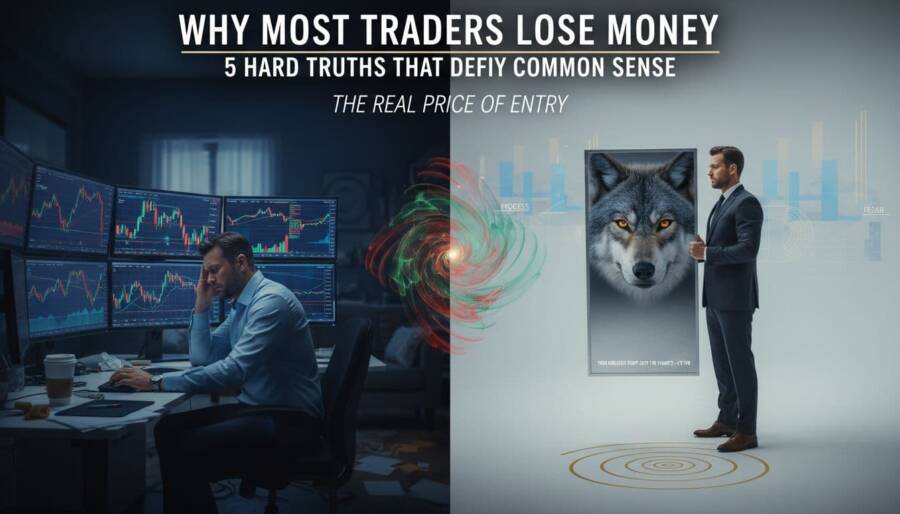
Why Most Traders Lose Money: 5 Hard Truths That Defy Common Sense
Introduction: The Real Price of Entry
The allure of trading is undeniable. It promises a world of financial freedom, intellectual challenge, and profits made with a few clicks of a mouse. Most aspiring traders walk through the door believing the biggest challenge is learning to read charts or predict market movements. They spend years chasing the perfect indicator or the secret strategy, assuming that knowledge is the key to unlocking the vault.
The surprising reality is that the market is rarely the cause of a trader’s failure. The greatest risk isn’t a volatile price chart; it’s the volatile psychology of the person reading it. The biggest obstacle isn’t a lack of information, but a surplus of self-sabotaging instincts and flawed beliefs. Many aren’t trading at all—they are simply gambling under the guise of speculation.
The path to consistent profitability is a journey inward. It requires embracing a set of principles that often feel completely backward to our ingrained human nature. In this article, we’ll break down five hard-won lessons that separate the small minority of successful traders from the struggling masses. These aren’t technical tricks; they are the foundational truths you must master to win the only battle that truly matters.
1. Your Greatest Enemy Isn’t the Market—It’s You
Before you analyze a single chart, you must analyze yourself. The single greatest risk in trading is not the market; it is the trader. Success requires mastering two distinct, critical views: the ability to see the market clearly and the ability to see yourself clearly. For most, the second part is where the real work lies.
A professional approach begins with a candid self-assessment, grounding your trading ambitions in reality. This requires brutal honesty about three key areas:
- Your Financial Reality: Your trading capital should be proportional to your financial life. A practical rule is to never invest more in a single year than 20% of your annual income. This ensures you can trade without the desperation and fear that comes from risking money you can’t afford to lose.
- Your Personality: Trading styles are not one-size-fits-all. Are you naturally patient or impatient? A patient person may be better suited for long-term trend following, while an impatient person might find more success in short-term strategies. Forcing a trading style that conflicts with your innate personality is a recipe for frustration and failure.
- Your Psychological Limits: You must know your breaking points. What level of loss keeps you up at night? At what point does an open profit make you too anxious to think clearly? By understanding your personal tolerance for profit and loss, you can build rules that protect you from your own emotional reactions.
This introspective work isn’t optional; it’s the true foundation of a trading career. Without it, you are simply an amateur, reacting emotionally to the market’s whims and destined to become another casualty.
2. To Make More Money, Stop Watching Your Money
One of the most profound paradoxes in trading is this: to make more money, you must stop focusing on the money. Instead, your entire focus should be on the flawless execution of your trading process. Obsessing over the fluctuating numbers in your account is the fastest way to derail a sound strategy.
Think of it like learning to swim. If you fixate on the fear of drowning, you’ll panic and sink. To stay afloat and move forward, you must concentrate on your breathing, your form, and the rhythm of your strokes. The result—swimming—happens naturally when the process is correct. Trading is the same. Focus on executing your plan with discipline, and the profits will eventually take care of themselves.
There is a scientific reason this is so critical. Research by psychologists like Daniel Kahneman has shown that humans are wired with “loss aversion”—the pain from a financial loss is psychologically 2 to 2.5 times more powerful than the pleasure from an equivalent gain. When you constantly watch your account balance, you are subjecting yourself to this amplified emotional pain with every normal market dip. This leads to fear-based decisions: cutting winning trades short and hesitating to take valid signals. As the legendary trader Jesse Livermore noted:
Profit can take care of itself, but losses never stop on their own.
By shifting your focus from the outcome (money) to the process (execution), you build the emotional detachment and discipline required for long-term survival and success.
3. The Less You Look, The Better You’ll Do
For many traders, constantly watching the screen feels like diligence. It feels like being in control. In reality, it is a poisonous addiction that actively destroys performance. The more you watch, the more you expose your decision-making to the random noise of the market, and the more likely you are to deviate from your plan.
The data backs this up. One study found that investors who check their accounts daily suffer a loss rate approaching 50%. In contrast, those who check their accounts only once a year see that loss rate fall to between 15% and 20%.
The psychology is straightforward. Frequent screen-watching magnifies emotional reactions to normal market fluctuations. It creates a constant state of anxiety and temptation, leading directly to the most common trading sins: over-trading, closing positions prematurely, and chasing price movements that aren’t part of your strategy. This isn’t just financially costly; it leads to severe mental exhaustion.
Professional trading is not about constant engagement; it’s about planned engagement. A professional has a system with predefined entry, exit, and risk management rules. They don’t need to react to every price tick. They only need to monitor the market to see if the specific conditions outlined in their plan have been met. The rest is just noise.
4. You Can Be Wrong 70% of the Time and Still Get Rich
Beginners are obsessed with being right. They search for a Holy Grail strategy that wins on almost every trade because they believe a high win rate is the key to profitability. This is a fundamental, and costly, misunderstanding of trading mathematics.
The secret to long-term profitability isn’t winning often; it’s ensuring your wins are significantly larger than your losses. This is the principle of “win big, lose small.” The destructive power of large losses cannot be overstated. A 50% loss in your trading capital requires a 100% gain just to get back to your starting point. This simple math shows that avoiding catastrophic losses is far more important than achieving frequent small wins.
Consider a trading system with what seems like a terrible win rate—just 30%. If that system maintains a reward-to-risk ratio of 3:1 (meaning the average winning trade is three times larger than the average losing trade), it is highly profitable over time. Out of 10 trades, you might lose on seven, but the profit from the three winners will more than cover those losses and leave you with a net gain.
Understanding this concept is liberating. It frees you from the emotional burden of needing to be right. The goal is not to predict the market flawlessly. The goal is to be disciplined, manage risk impeccably, and let your statistical edge play out over the long run.
5. Trading Isn’t a Skill; It’s a Battle Against Your Own Brain
Ultimately, trading is not a battle against the market. It is a process of transcending oneself. The greatest obstacles to your success are not external; they are the deeply ingrained aspects of human nature that are disastrous in a world of probability and uncertainty.
Most trading failures can be traced back to a handful of psychological flaws:
- Stubbornness: The refusal to admit a mistake and take a small, manageable loss is the single greatest impediment to a trader’s success. It turns a minor error into a catastrophic one.
- Perfectionism: The desire to catch every single market move or create a flawless trading record leads to over-trading, frustration, and an inability to stick to a proven system.
- Impatience: A good trading system identifies high-probability setups. The inability to sit patiently and wait for those specific conditions to appear causes traders to take low-quality trades out of boredom or anxiety.
- Greed & Fear: These are the twin pillars of poor decision-making, driving traders to take on excessive risk when winning and to panic when facing normal market volatility.
A consistently profitable trader is not necessarily smarter or a better analyst than everyone else. They are someone who has cultivated a set of “anti-human” qualities: the patience to wait, the discipline to execute without hesitation, the humility to accept a loss, and the ability to operate objectively in an environment of constant uncertainty.
Conclusion: Are You Ready to Trade Against Yourself?
The common thread connecting these lessons is a single, powerful truth: successful trading is an internal game, not an external one. It has far less to do with predicting the future and everything to do with managing yourself in the present. The path to consistent returns is paved with discipline, rigorous self-awareness, and an unwavering focus on process.
The market offers endless opportunities for profit and loss, and it will be here tomorrow, next week, and next year. The real challenge is not in conquering the market, but in conquering the counterproductive instincts that reside within you. Now that you know the real opponent is in the mirror, what is the first change you will make to your approach?